

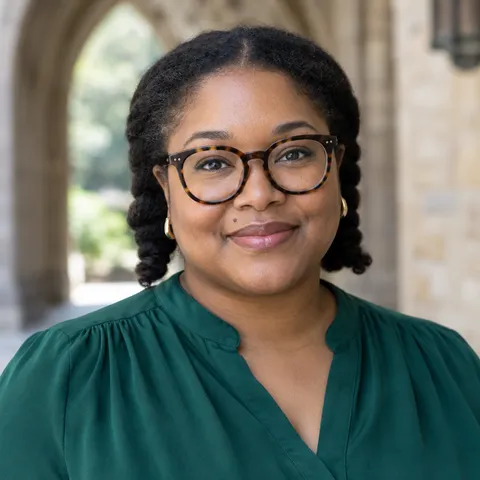
Dr. Simone Ferris
Assistant Professor of Management
Instructor for MGT 410, Fall 2026
- Office
- Tidewell Hall 324
- sferris
@university.alkimi.ai
MGT 410 · Business Administration
Process design, capacity planning, forecasting, inventory management, quality management and Six Sigma, lean operations, and supply chain coordination, using quantitative decision models.
Fall 2026 · At a glance
400-level courses: advanced capstone, senior research, and specialized seminars. Counts toward the 36 upper-division credits every bachelor's degree requires (Undergraduate Catalog §2.3). Details: Undergraduate Catalog §9.12.
Assistant Professor of Management
Instructor for MGT 410, Fall 2026
Questions about a major or your plan: Academic Advising Center, Lovell Hall 101, (555) 555-0158.
Class meetings
Tue & Thu, 1:00–2:15 p.m.
Tidewell Hall 210
Final exam
Monday, December 14, 2026
1:00–3:00 p.m., Tidewell Hall 210
Office hours
Tue & Wed, 9:30–11:00 a.m.
Tidewell Hall 324
Fri, 2:00–3:00 p.m.
Virtual (Zoom link in Canvas)
You may use generative AI tools to review quantitative operations formulas, troubleshoot Excel spreadsheet optimization models, and explore theoretical explanations of lean concepts. You may not use AI tools during examinations, nor may you submit AI-generated numerical calculations, simulation outputs, or supply chain strategy memos as your original work.
From the syllabus
Grading
Letter grades follow the university scale (Student Handbook §4.1).
Key dates
First day of classes Past
Midterm Examination 1 Past
Midterm Examination 2 Next
Operations & Supply Chain Optimization Project
Required materials
Lee J. Krajewski, Manoj K. Malhotra, and Larry P. Ritzman. Operations Management: Processes and Supply Chains. 13th ed., Pearson, 2022.
Approx. $65 digital rental, $140 print purchase.
Operations Case Studies and Excel Decision Templates (Canvas OER).
Free digital access provided via Canvas.
Degree planning
What to take first, what this course opens up, and the requirements it can satisfy, from the Undergraduate Catalog.
No other catalog course lists MGT 410 as a prerequisite.
Every course also counts toward the 120 credits needed for a bachelor's degree. Confirm your plan with your advisor or the Academic Advising Center.
No AP exam awards credit for MGT 410 (Undergraduate Catalog §3.11).
Registration
MGT 410 is offered in the fall semester. Register through AlkimiHub self-service registration, which opens by credit standing. Until the add deadline, you don't need instructor permission as long as seats remain and you've met the prerequisites. Details: Student Handbook §3.3.
When a seat opens, AlkimiHub offers it to the first student on the waitlist and emails you. You have 24 hours to claim it before it goes to the next student. Details: Student Handbook §3.10.
Fall 2026 withdrawal deadline
Last day to withdraw with a W or elect Pass/No Pass.
Fall 2027 registration opens
By credit standing, in AlkimiHub.
The Fall 2026 add deadline passed on Sep 2, 2026.
All dates: academic calendar. Registration help: Office of the Registrar.
Official course syllabus
The syllabus as filed with the department and posted in Canvas for Fall 2026.
Term: Fall 2026
Credits: 3.0
Seminar Times & Location: Tuesday & Thursday 1:00–2:15 p.m., Tidewell Hall 210
Modality: In-Person Seminar
sferris@university.alkimi.ai
Process design, capacity planning, forecasting, inventory management, quality management and Six Sigma, lean operations, and supply chain coordination, using quantitative decision models. MGT 410 examines the strategic design, planning, and control of operating systems that convert inputs into value-added goods and services. Combining qualitative management strategy with quantitative optimization models, students analyze process design, capacity constraints, demand forecasting, inventory theory, Statistical Process Control (SPC), and lean production philosophies. The course emphasizes end-to-end supply chain integration, examining logistics network configuration, risk pooling, coordination across multi-echelon systems, and modern digital supply chain technologies.
MGT 301 and STAT 205.
Upon successful completion of MGT 410, students will be able to:
In accordance with Alkimi University Academic Policies (Student Handbook §5.8), MGT 410 operates under AI Level 2.
| Week | Dates | Topics & Readings | Assignments & Deadlines |
|---|---|---|---|
| Week 1 | Aug 27 | Using Operations to Create Value and Process Strategy: Operations management as a competitive weapon, order winners and qualifiers, process structure, and manufacturing vs. service operations. Reading: Krajewski et al., Ch. 1–2 | First day of classes: Wed Aug 26. |
| Week 2 | Sep 1, 3 | Process Analysis and Flowcharting: Process analysis, flowcharts, service blueprints, process metrics, cycle time, work measurement, and process reengineering. Reading: Krajewski et al., Ch. 3 | Wed Sep 2: Add/section change deadline. |
| Week 3 | Sep 8, 10 | Capacity Planning, Bottlenecks, and Theory of Constraints: Capacity planning, capacity cushions, bottlenecks, Theory of Constraints (TOC), drum-buffer-rope, and Little's Law applications. Reading: Krajewski et al., Ch. 4–5 | Mon Sep 7: Labor Day (no classes). Wed Sep 9: Census date (last day to drop without a W). |
| Week 4 | Sep 15, 17 | Demand Forecasting and Error Metrics: Time-series forecasting, moving averages, exponential smoothing, trend and seasonal adjustments, and tracking signals. Reading: Krajewski et al., Ch. 8 | — |
| Week 5 | Sep 22, 24 | Waiting Line Models and Midterm Exam 1: Waiting line fundamentals, single-server and multi-server queuing models, and cost tradeoffs; Midterm Examination 1 in class. Reading: Krajewski et al., Ch. 5 (Supplement) and Review | Midterm Examination 1 (in class). |
| Week 6 | Sep 29, Oct 1 | Managing Quality and Statistical Process Control: Total Quality Management (TQM), cost of quality, statistical process control (SPC), variable control charts (X-bar and R charts). Reading: Krajewski et al., Ch. 6 | — |
| Week 7 | Oct 6, 8 | Process Capability and Six Sigma DMAIC: Attribute control charts (p and c charts), process capability indices (Cp and Cpk), Six Sigma DMAIC methodology, and ISO certification. Reading: Krajewski et al., Ch. 6 (cont.) | — |
| Week 8 | Oct 15 | Lean Systems and Kanban Production (Fall Break Week): Lean philosophy, eliminating waste (muda), 5S, visual management, value stream mapping, and Kanban pull systems (Fall Break week). Reading: Krajewski et al., Ch. 7 | Oct 12–Oct 13: Fall break (no classes). |
| Week 9 | Oct 20, 22 | Managing Inventory: Deterministic EOQ Models: Inventory pressures, inventory holding and setup costs, basic Economic Order Quantity (EOQ), and quantity discount models. Reading: Krajewski et al., Ch. 9 (pp. 340–370) | — |
| Week 10 | Oct 27, 29 | Inventory Control under Uncertainty and Midterm Exam 2: Continuous review (Q) systems, safety stock determination, service levels, and lead-time variability; Midterm Examination 2 in class. Reading: Krajewski et al., Ch. 9 (pp. 371–405) | Midterm Examination 2 (in class). |
| Week 11 | Nov 3, 5 | Periodic Review and Single-Period Inventory Models: Periodic review (P) systems, comparing continuous vs. periodic review, and single-period inventory models (the Newsvendor problem). Reading: Krajewski et al., Ch. 9 (pp. 406–430) | Fri Nov 6: Last day to withdraw (W) or elect Pass/No Pass. |
| Week 12 | Nov 10, 12 | Resource Planning and Material Requirements Planning (MRP): Master production scheduling (MPS), bills of materials (BOM), Material Requirements Planning (MRP) logic, lot sizing, and ERP integration. Reading: Krajewski et al., Ch. 11 | — |
| Week 13 | Nov 17, 19 | Supply Chain Design and the Bullwhip Effect: Supply chain design, efficient vs. responsive supply chains, bullwhip effect causes and cures, and risk pooling; Project due Friday. Reading: Krajewski et al., Ch. 12 | Operations & Supply Chain Optimization Project due Fri Nov 20 at 11:59 p.m. |
| Week 14 | Nov 24 | Logistics and Facility Location Decisions (Thanksgiving Week): Logistics network configuration, center of gravity method, transportation modes, and warehouse management (Thanksgiving week). Reading: Krajewski et al., Ch. 13 | Nov 25–Nov 27: Thanksgiving break (no classes). |
| Week 15 | Dec 1, 3 | Sourcing, Supplier Management, and Sustainability: Supplier relationship management, total cost of ownership, sourcing strategies, supply chain contracts, and environmental sustainability. Reading: Krajewski et al., Ch. 14 | — |
| Week 16 | Dec 8 | Supply Chain Resilience and Course Synthesis: Digital operations, Industry 4.0, supply chain resilience, operational ethics, and comprehensive review for final examination. Reading: Krajewski et al., Review | Wed Dec 9: Last day of classes. Thu Dec 10: Reading Day. |
| Finals | Dec 14 | Comprehensive Final Examination: Monday, December 14, 2026, 1:00–3:00 p.m., Tidewell Hall 210. | Scheduled during the university final examination period in Tidewell Hall 210. |
Classroom engagement in Tidewell Hall 210 is essential for understanding quantitative modeling methodologies, software demonstrations, and group case discussions. In the event of illness or university-approved absences, notify Dr. Ferris beforehand and arrange to review notes with a fellow student. Students who miss the first two class meetings without notifying the instructor may be dropped. Students may miss class for religious observance without penalty if they notify the instructor in writing within the first two weeks of the semester (by Wednesday, September 9, 2026). Absences for university-sponsored activities (athletics, performances, conferences) are excused with a letter from the sponsoring office at least one week in advance.
Quantitative problem sets and the Operations & Supply Chain Optimization Project are penalized 10% per calendar day late and will not be accepted after three days past the deadline. Simulation quizzes close strictly at their posted deadlines.
The final examination (Monday, December 14, 2026, 1:00–3:00 p.m.) is scheduled by the University Registrar and can't be moved without the Dean's written approval (Faculty Handbook §5.5). A student with three or more final exams on the same calendar day may reschedule one of them. Requests go to the instructor of the middle exam by the last day of classes. For this term, send the request by Wednesday, December 9, 2026 (Student Handbook §6.4).
Alkimi University is an academic community devoted to rigorous scholarship, open intellectual inquiry, and uncompromising ethical conduct. All students are subject to the regulations of the Alkimi University Academic Integrity Policy. Academic dishonesty—including plagiarism, cheating on examinations, unauthorized collaboration, fabrication of empirical data, and unauthorized submission of academic work generated by artificial intelligence—undermines the integrity of the university and carries severe disciplinary sanctions. Sanctions range from a failing grade on an assignment or exam to an administrative course failure recorded as an 'XF' on the official transcript, academic suspension, or expulsion. Suspected violations are formally investigated and resolved through the Office of Academic Integrity in accordance with Faculty Handbook §6. For detailed information, consult the Office of Academic Integrity, Lovell Hall 315, (555) 555-0163, integrity@university.alkimi.ai.
Alkimi University is committed to providing equitable educational access and reasonable accommodations for all students with documented disabilities, including physical, sensory, psychological, learning, and chronic health conditions. Students requesting academic accommodations must formally register with the Office of Accessibility Services, Harlan Hall 204, (555) 555-0155, access@university.alkimi.ai. Once approved, students will receive an official Faculty Accommodation Letter detailing approved accommodations. Students should present this letter to the instructor as early in the semester as possible, and at least one week prior to any exam or assignment requiring accommodation. Accommodations cannot be applied retroactively.
Your physical health, psychological well-being, and mental health are essential to your academic success. If you experience heightened stress, anxiety, depressive symptoms, personal trauma, or academic burnout, free, confidential counseling and medical care are available through the Hollis Health & Counseling Center, located in the Hollis Center. Routine appointments are available Monday–Friday 8:00 a.m.–6:00 p.m. and Saturday 10:00 a.m.–2:00 p.m. during the semester by calling (555) 555-0190 or emailing health@university.alkimi.ai. Urgent, 24/7 crisis psychological counseling is accessible immediately at (555) 555-0199.
advising@university.alkimi.ai
askalibrarian@university.alkimi.ai
health@university.alkimi.ai
BUS, ACCT, COMM, FIN, MGT, MKT courses