
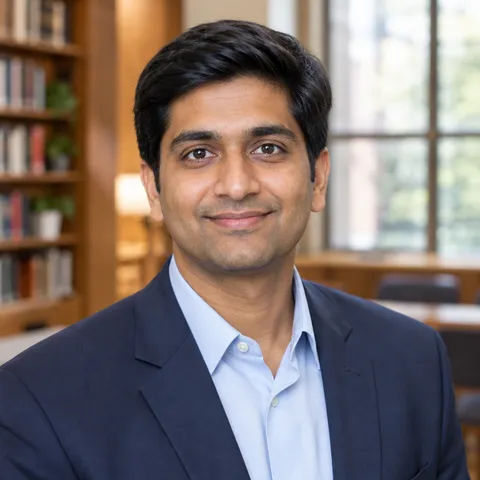
Dr. Nikhil Rao
Assistant Professor of Finance
Instructor for FIN 320, Fall 2026 and Spring 2027
- Office
- Tidewell Hall 314
- nrao
@university.alkimi.ai
FIN 320 · Business Administration
Security markets and trading, risk and return, portfolio theory, the capital asset pricing and factor models, market efficiency, bond valuation and duration, and equity analysis.
Fall 2026 · At a glance
300-level courses: advanced, upper-division courses requiring prior foundational preparation. Counts toward the 36 upper-division credits every bachelor's degree requires (Undergraduate Catalog §2.3). Details: Undergraduate Catalog §9.12.
Assistant Professor of Finance
Instructor for FIN 320, Fall 2026 and Spring 2027
Questions about a major or your plan: Academic Advising Center, Lovell Hall 101, (555) 555-0158.
Class meetings
Tue & Thu, 4:00–5:15 p.m.
Tidewell Hall 130
Final exam
Thursday, December 17, 2026
3:30–5:30 p.m., Tidewell Hall 130
Office hours
Mon & Thu, 9:00–10:30 a.m.
Tidewell Hall 314
Fri, 2:00–3:00 p.m.
Virtual (Zoom link in Canvas)
You may use generative AI tools to review quantitative finance formulas, verify Python or Excel spreadsheet syntax for portfolio variance, and brainstorm macroeconomic sector risk factors. You may not use AI tools to solve examination or quiz questions, nor may you submit AI-generated equity valuation models, stock pitches, or portfolio management reports as your own work.
From the syllabus
Grading
Letter grades follow the university scale (Student Handbook §4.1).
Key dates
First day of classes Past
Midterm Examination 1 Past
Midterm Examination 2 Next
Portfolio Management & Equity Analysis Project
Required materials
Zvi Bodie, Alex Kane, and Alan J. Marcus. Investments. 12th ed., McGraw Hill, 2021.
Approx. $70 digital rental, $150 print purchase.
Texas Instruments BA II Plus or HP 10bII+ Financial Calculator.
Approx. $35 (or use standard approved financial calculator from FIN 301).
Degree planning
What to take first, what this course opens up, and the requirements it can satisfy, from the Undergraduate Catalog.
Catalog wording: FIN 301.
Every course also counts toward the 120 credits needed for a bachelor's degree. Confirm your plan with your advisor or the Academic Advising Center.
No AP exam awards credit for FIN 320 (Undergraduate Catalog §3.11).
Registration
FIN 320 is offered in both the fall and spring semesters. Register through AlkimiHub self-service registration, which opens by credit standing. Until the add deadline, you don't need instructor permission as long as seats remain and you've met the prerequisites. Details: Student Handbook §3.3.
When a seat opens, AlkimiHub offers it to the first student on the waitlist and emails you. You have 24 hours to claim it before it goes to the next student. Details: Student Handbook §3.10.
Spring 2027 registration opens
By credit standing, in AlkimiHub.
Fall 2026 withdrawal deadline
Last day to withdraw with a W or elect Pass/No Pass.
Spring 2027 add deadline
Last day to add a course or change sections (11:59 p.m.).
Fall 2027 registration opens
By credit standing, in AlkimiHub.
The Fall 2026 add deadline passed on Sep 2, 2026.
All dates: academic calendar. Registration help: Office of the Registrar.
Official course syllabus
The syllabus as filed with the department and posted in Canvas for Fall 2026.
Term: Fall 2026
Credits: 3.0
Lecture Times & Location: Tuesday & Thursday 4:00–5:15 p.m., Tidewell Hall 130
Modality: In-Person
nrao@university.alkimi.ai
Security markets and trading, risk and return, portfolio theory, the capital asset pricing and factor models, market efficiency, bond valuation and duration, and equity analysis. FIN 320 offers a rigorous, mathematically grounded examination of modern portfolio theory, capital market equilibrium, security valuation, and risk management. Students master the mechanics of security trading, quantify the trade-off between risk and expected return, and implement Markowitz mean-variance portfolio optimization. The course investigates the Capital Asset Pricing Model (CAPM), multifactor pricing models, the Efficient Market Hypothesis, fixed income duration and convexity, equity valuation methodologies, and option pricing foundations, bridging theoretical asset pricing with empirical portfolio management.
FIN 301.
Upon successful completion of FIN 320, students will be able to:
In accordance with Alkimi University Academic Policies (Student Handbook §5.8), FIN 320 operates under AI Level 2.
| Week | Dates | Topics & Readings | Assignments & Deadlines |
|---|---|---|---|
| Week 1 | Aug 27 | The Investment Environment and Asset Classes: Financial assets vs. real assets, money market vs. capital market instruments, market indices, and primary vs. secondary markets. Reading: Bodie et al., Ch. 1–2 | First day of classes: Wed Aug 26. |
| Week 2 | Sep 1, 3 | Security Trading Mechanics and Margin Transactions: Broker-dealer operations, market orders, limit orders, margin trading requirements, short sales, and electronic communication networks (ECNs). Reading: Bodie et al., Ch. 3 | Wed Sep 2: Add/section change deadline. |
| Week 3 | Sep 8, 10 | Risk, Return, and Historical Market Record: Holding period returns, arithmetic vs. geometric averages, standard deviation, excess returns, and historical capital market performance. Reading: Bodie et al., Ch. 5 | Mon Sep 7: Labor Day (no classes). Wed Sep 9: Census date (last day to drop without a W). |
| Week 4 | Sep 15, 17 | Risk Aversion and Capital Allocation: Utility theory, certainty equivalents, risk aversion, capital allocation between a risk-free asset and a single risky portfolio, and capital allocation lines (CAL). Reading: Bodie et al., Ch. 6 | — |
| Week 5 | Sep 22, 24 | Optimal Risky Portfolios and Midterm Exam 1: Diversification principles, covariance and correlation, Markowitz portfolio selection, and efficient frontier; Midterm Examination 1 in class. Reading: Bodie et al., Ch. 7 | Midterm Examination 1 (in class). |
| Week 6 | Sep 29, Oct 1 | The Capital Asset Pricing Model (CAPM): Assumptions of the CAPM, capital market line (CML), security market line (SML), beta estimation, and single-index model estimation. Reading: Bodie et al., Ch. 8–9 | — |
| Week 7 | Oct 6, 8 | Arbitrage Pricing Theory and Multifactor Models: Arbitrage pricing theory, factor portfolios, Fama-French three-factor and five-factor models, and empirical testing of asset pricing anomalies. Reading: Bodie et al., Ch. 10–11 | — |
| Week 8 | Oct 15 | The Efficient Market Hypothesis (Fall Break Week): Forms of market efficiency (weak, semi-strong, strong), event studies, and empirical evidence on market anomalies (Fall Break week). Reading: Bodie et al., Ch. 12 | Oct 12–Oct 13: Fall break (no classes). |
| Week 9 | Oct 20, 22 | Behavioral Finance and Technical Analysis: Behavioral biases (overconfidence, anchoring, framing, loss aversion), limits to arbitrage, and technical analysis indicators. Reading: Bodie et al., Ch. 13 | — |
| Week 10 | Oct 27, 29 | Bond Prices, Yields, and Midterm Exam 2: Bond characteristics, pricing default-free and corporate bonds, yield to maturity, yield curves, and expectations hypothesis; Midterm Exam 2 in class. Reading: Bodie et al., Ch. 14–15 | Midterm Examination 2 (in class). |
| Week 11 | Nov 3, 5 | Managing Fixed Income Portfolios and Duration: Interest rate sensitivity, Macaulay duration, modified duration, convexity, and balance sheet immunization strategies. Reading: Bodie et al., Ch. 16 | Fri Nov 6: Last day to withdraw (W) or elect Pass/No Pass. |
| Week 12 | Nov 10, 12 | Macroeconomic and Industry Analysis: Top-down macroeconomic forecasting, business cycle indicators, industry life cycles, and competitive forces in equity analysis. Reading: Bodie et al., Ch. 17 | — |
| Week 13 | Nov 17, 19 | Equity Valuation Models and Multiples: Dividend discount models, constant growth DDM, multi-stage models, free cash flow models, P/E multiples; Portfolio Project due Friday. Reading: Bodie et al., Ch. 18 | Portfolio Management & Equity Analysis Project due Fri Nov 20 at 11:59 p.m. |
| Week 14 | Nov 24 | Options Markets and Basic Strategies (Thanksgiving Week): Option contract mechanics, call and put payoffs, protective puts, covered calls, straddles, and spreads (Thanksgiving week). Reading: Bodie et al., Ch. 20 | Nov 25–Nov 27: Thanksgiving break (no classes). |
| Week 15 | Dec 1, 3 | Option Valuation and Volatility Models: Put-call parity, binomial option pricing models, and the Black-Scholes-Merton option pricing formula with implied volatility. Reading: Bodie et al., Ch. 21 | — |
| Week 16 | Dec 8 | Portfolio Performance Evaluation and Course Synthesis: Sharpe ratio, Treynor measure, Jensen's alpha, tracking error, style analysis, performance attribution, and final exam synthesis. Reading: Bodie et al., Ch. 24 and Review | Wed Dec 9: Last day of classes. Thu Dec 10: Reading Day. |
| Finals | Dec 17 | Comprehensive Final Examination: Thursday, December 17, 2026, 3:30–5:30 p.m., Tidewell Hall 130. | Scheduled during the university final examination period in Tidewell Hall 130. |
Classroom attendance in Tidewell Hall 130 is critical for understanding dynamic market simulations, mathematical proofs, and portfolio optimization models. If an unavoidable absence arises, inform Dr. Rao in advance and coordinate with a peer to obtain class notes and spreadsheet templates. Students who miss the first two class meetings without notifying the instructor may be dropped. Students may miss class for religious observance without penalty if they notify the instructor in writing within the first two weeks of the semester (by Wednesday, September 9, 2026). Absences for university-sponsored activities (athletics, performances, conferences) are excused with a letter from the sponsoring office at least one week in advance.
Quantitative problem sets and the Portfolio Management Project will receive a 10% penalty for each calendar day they are late and will not be accepted after 72 hours. Online Canvas quizzes expire at the designated deadline and cannot be reopened.
The final examination (Thursday, December 17, 2026, 3:30–5:30 p.m.) is scheduled by the University Registrar and can't be moved without the Dean's written approval (Faculty Handbook §5.5). A student with three or more final exams on the same calendar day may reschedule one of them. Requests go to the instructor of the middle exam by the last day of classes. For this term, send the request by Wednesday, December 9, 2026 (Student Handbook §6.4).
Alkimi University is an academic community devoted to rigorous scholarship, open intellectual inquiry, and uncompromising ethical conduct. All students are subject to the regulations of the Alkimi University Academic Integrity Policy. Academic dishonesty—including plagiarism, cheating on examinations, unauthorized collaboration, fabrication of empirical data, and unauthorized submission of academic work generated by artificial intelligence—undermines the integrity of the university and carries severe disciplinary sanctions. Sanctions range from a failing grade on an assignment or exam to an administrative course failure recorded as an 'XF' on the official transcript, academic suspension, or expulsion. Suspected violations are formally investigated and resolved through the Office of Academic Integrity in accordance with Faculty Handbook §6. For detailed information, consult the Office of Academic Integrity, Lovell Hall 315, (555) 555-0163, integrity@university.alkimi.ai.
Alkimi University is committed to providing equitable educational access and reasonable accommodations for all students with documented disabilities, including physical, sensory, psychological, learning, and chronic health conditions. Students requesting academic accommodations must formally register with the Office of Accessibility Services, Harlan Hall 204, (555) 555-0155, access@university.alkimi.ai. Once approved, students will receive an official Faculty Accommodation Letter detailing approved accommodations. Students should present this letter to the instructor as early in the semester as possible, and at least one week prior to any exam or assignment requiring accommodation. Accommodations cannot be applied retroactively.
Your physical health, psychological well-being, and mental health are essential to your academic success. If you experience heightened stress, anxiety, depressive symptoms, personal trauma, or academic burnout, free, confidential counseling and medical care are available through the Hollis Health & Counseling Center, located in the Hollis Center. Routine appointments are available Monday–Friday 8:00 a.m.–6:00 p.m. and Saturday 10:00 a.m.–2:00 p.m. during the semester by calling (555) 555-0190 or emailing health@university.alkimi.ai. Urgent, 24/7 crisis psychological counseling is accessible immediately at (555) 555-0199.
advising@university.alkimi.ai
askalibrarian@university.alkimi.ai
health@university.alkimi.ai
BUS, ACCT, COMM, FIN, MGT, MKT courses