

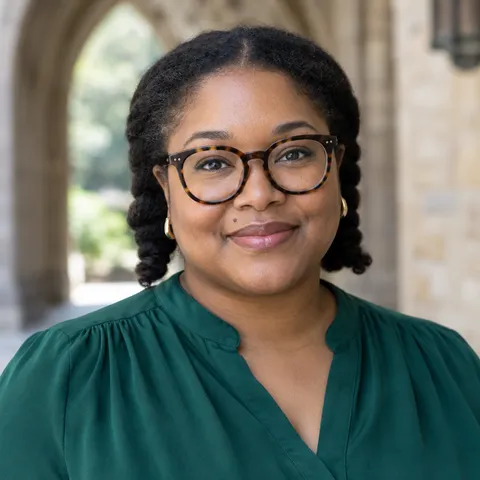
Dr. Simone Ferris
Assistant Professor of Management
Instructor for MGT 320, Fall 2026
- Office
- Tidewell Hall 324
- sferris
@university.alkimi.ai
MGT 320 · Business Administration
Individual and group behavior in organizations: personality, perception, motivation, job attitudes, team dynamics, power and politics, organizational culture, and evidence-based management.
Fall 2026 · At a glance
300-level courses: advanced, upper-division courses requiring prior foundational preparation. Counts toward the 36 upper-division credits every bachelor's degree requires (Undergraduate Catalog §2.3). Details: Undergraduate Catalog §9.12.
Assistant Professor of Management
Instructor for MGT 320, Fall 2026
Questions about a major or your plan: Academic Advising Center, Lovell Hall 101, (555) 555-0158.
Class meetings
Tue & Thu, 11:00 a.m.–12:15 p.m.
Tidewell Hall 130
Final exam
Wednesday, December 16, 2026
1:30–3:30 p.m., Tidewell Hall 130
Office hours
Tue & Wed, 9:30–11:00 a.m.
Tidewell Hall 324
Fri, 2:00–3:00 p.m.
Virtual (Zoom link in Canvas)
You may use generative AI tools to brainstorm organizational behavior case perspectives, review behavioral definitions, and check the grammar or formatting of draft case analyses. You may not use AI tools during examinations, nor may you submit AI-generated diagnostic case analyses, team evaluation memos, or personal reflection essays as your own work.
From the syllabus
Grading
Letter grades follow the university scale (Student Handbook §4.1).
Key dates
First day of classes Past
Midterm Examination 1 Past
Midterm Examination 2 Next
Organizational Diagnostic Case Project
Required materials
Stephen P. Robbins and Timothy A. Judge. Organizational Behavior. 19th ed., Pearson, 2023.
Approx. $60 digital rental, $130 print purchase.
Alkimi Organizational Behavior Case Packet.
Free digital case materials provided on Canvas.
Degree planning
What to take first, what this course opens up, and the requirements it can satisfy, from the Undergraduate Catalog.
No other catalog course lists MGT 320 as a prerequisite.
Every course also counts toward the 120 credits needed for a bachelor's degree. Confirm your plan with your advisor or the Academic Advising Center.
No AP exam awards credit for MGT 320 (Undergraduate Catalog §3.11).
Registration
MGT 320 is offered in the fall semester. Register through AlkimiHub self-service registration, which opens by credit standing. Until the add deadline, you don't need instructor permission as long as seats remain and you've met the prerequisites. Details: Student Handbook §3.3.
When a seat opens, AlkimiHub offers it to the first student on the waitlist and emails you. You have 24 hours to claim it before it goes to the next student. Details: Student Handbook §3.10.
Fall 2026 withdrawal deadline
Last day to withdraw with a W or elect Pass/No Pass.
Fall 2027 registration opens
By credit standing, in AlkimiHub.
The Fall 2026 add deadline passed on Sep 2, 2026.
All dates: academic calendar. Registration help: Office of the Registrar.
Official course syllabus
The syllabus as filed with the department and posted in Canvas for Fall 2026.
Term: Fall 2026
Credits: 3.0
Lecture Times & Location: Tuesday & Thursday 11:00 a.m.–12:15 p.m., Tidewell Hall 130
Modality: In-Person
sferris@university.alkimi.ai
Individual and group behavior in organizations: personality, perception, motivation, job attitudes, team dynamics, power and politics, organizational culture, and evidence-based management. MGT 320 provides a comprehensive, research-based exploration of human behavior in organizational settings across individual, interpersonal, and systemic levels. Students examine how personality, emotional intelligence, job attitudes, and perceptual biases influence managerial decision-making and workplace performance. Moving from individual dynamics to group processes, the course investigates team development, psychological safety, leadership paradigms, negotiation strategies, organizational culture, and change management through evidence-based managerial research and real-world corporate case studies.
MGT 301.
Upon successful completion of MGT 320, students will be able to:
In accordance with Alkimi University Academic Policies (Student Handbook §5.8), MGT 320 operates under AI Level 2.
| Week | Dates | Topics & Readings | Assignments & Deadlines |
|---|---|---|---|
| Week 1 | Aug 27 | Introduction to Organizational Behavior and Evidence-Based Management: Defining organizational behavior; evidence-based management vs. intuition; systematic study; behavioral science disciplines contributing to OB. Reading: Robbins & Judge, Ch. 1 | First day of classes: Wed Aug 26. |
| Week 2 | Sep 1, 3 | Workplace Diversity and Individual Differences: Surface-level vs. deep-level diversity, discrimination in the workplace, biographical characteristics, ability, and managing diversity effectively. Reading: Robbins & Judge, Ch. 2 | Wed Sep 2: Add/section change deadline. |
| Week 3 | Sep 8, 10 | Attitudes and Job Satisfaction: Components of attitudes (cognitive, affective, behavioral); cognitive dissonance; job satisfaction, employee engagement, and organizational commitment. Reading: Robbins & Judge, Ch. 3 | Mon Sep 7: Labor Day (no classes). Wed Sep 9: Census date (last day to drop without a W). |
| Week 4 | Sep 15, 17 | Emotions and Moods in Organizations: Differentiating emotions and moods; emotional labor; emotional intelligence (EI) models; emotion regulation strategies; Case Brief 1 due Friday. Reading: Robbins & Judge, Ch. 4 | — |
| Week 5 | Sep 22, 24 | Personality, Values, and Midterm Exam 1: Big Five personality model, Myers-Briggs Type Indicator, Dark Triad, values and Schwartz's value theory; Midterm Examination 1 in class. Reading: Robbins & Judge, Ch. 5 | Midterm Examination 1 (in class). |
| Week 6 | Sep 29, Oct 1 | Perception and Individual Decision-Making: Factors influencing perception, attribution theory, fundamental attribution error, self-serving bias, and bounded rationality in decision-making. Reading: Robbins & Judge, Ch. 6 | — |
| Week 7 | Oct 6, 8 | Motivation Concepts and Theories: Early theories of motivation (Maslow, Herzberg, McClelland); contemporary theories (self-determination, goal-setting, self-efficacy, equity). Reading: Robbins & Judge, Ch. 7 | — |
| Week 8 | Oct 15 | Motivation: From Concepts to Applications (Fall Break Week): Job characteristics model, job redesign, flextime, telecommuting, and employee involvement programs (Fall Break week); Case Brief 2 due Friday. Reading: Robbins & Judge, Ch. 8 | Oct 12–Oct 13: Fall break (no classes). |
| Week 9 | Oct 20, 22 | Foundations of Group Behavior: Classifying groups, stages of group development, group properties (roles, norms, status, size, cohesiveness, diversity), and group decision-making. Reading: Robbins & Judge, Ch. 9 | — |
| Week 10 | Oct 27, 29 | Understanding Work Teams and Midterm Exam 2: Differences between groups and teams; types of teams; creating effective teams; team composition, processes, and psychological safety; Midterm Exam 2. Reading: Robbins & Judge, Ch. 10 | Midterm Examination 2 (in class). |
| Week 11 | Nov 3, 5 | Communication in Modern Organizations: Communication functions, direction of communication, interpersonal channels, information overload, barriers to effective communication, and active listening. Reading: Robbins & Judge, Ch. 11 | Fri Nov 6: Last day to withdraw (W) or elect Pass/No Pass. |
| Week 12 | Nov 10, 12 | Leadership Styles, Theories, and Ethics: Trait, behavioral, and contingency theories of leadership; transformational vs. transactional leadership; ethical and servant leadership; Case Brief 3. Reading: Robbins & Judge, Ch. 12 | — |
| Week 13 | Nov 17, 19 | Power, Politics, and Influence in Organizations: Bases of power (formal vs. personal), dependence, power tactics, sexual harassment, organizational politics, and impression management; Project due. Reading: Robbins & Judge, Ch. 13 | Organizational Diagnostic Case Project due Fri Nov 20 at 11:59 p.m. |
| Week 14 | Nov 24 | Conflict Management and Negotiation (Thanksgiving Week): Conflict transitions, conflict process, distributive vs. integrative bargaining, and negotiation stages (Thanksgiving week). Reading: Robbins & Judge, Ch. 14 | Nov 25–Nov 27: Thanksgiving break (no classes). |
| Week 15 | Dec 1, 3 | Organizational Structure and Organizational Culture: Elements of organizational structure; institutional culture, strong vs. weak cultures, culture creation, and socialization processes. Reading: Robbins & Judge, Ch. 15–16 | — |
| Week 16 | Dec 8 | Organizational Change, Well-Being, and Course Synthesis: Forces for change, overcoming resistance to change, Lewin's three-step model, workplace stress management, and comprehensive final review. Reading: Robbins & Judge, Ch. 17–18 and Review | Wed Dec 9: Last day of classes. Thu Dec 10: Reading Day. |
| Finals | Dec 16 | Comprehensive Final Examination: Wednesday, December 16, 2026, 1:30–3:30 p.m., Tidewell Hall 130. | Scheduled during the university final examination period in Tidewell Hall 130. |
Regular attendance in Tidewell Hall 130 is required. Class meetings are structured around experiential exercises, case discussions, and team simulations that cannot be replicated outside class. Missing more than two unexcused sessions will adversely impact your participation grade. Inform Dr. Ferris promptly of any excused absences. Students who miss the first two class meetings without notifying the instructor may be dropped. Students may miss class for religious observance without penalty if they notify the instructor in writing within the first two weeks of the semester (by Wednesday, September 9, 2026). Absences for university-sponsored activities (athletics, performances, conferences) are excused with a letter from the sponsoring office at least one week in advance.
Case briefs and the Organizational Diagnostic Case Project incur a 10% penalty for each calendar day late and are not accepted after three days past the deadline. In-class simulation exercises cannot be made up without an approved excused absence.
The final examination (Wednesday, December 16, 2026, 1:30–3:30 p.m.) is scheduled by the University Registrar and can't be moved without the Dean's written approval (Faculty Handbook §5.5). A student with three or more final exams on the same calendar day may reschedule one of them. Requests go to the instructor of the middle exam by the last day of classes. For this term, send the request by Wednesday, December 9, 2026 (Student Handbook §6.4).
Alkimi University is an academic community devoted to rigorous scholarship, open intellectual inquiry, and uncompromising ethical conduct. All students are subject to the regulations of the Alkimi University Academic Integrity Policy. Academic dishonesty—including plagiarism, cheating on examinations, unauthorized collaboration, fabrication of empirical data, and unauthorized submission of academic work generated by artificial intelligence—undermines the integrity of the university and carries severe disciplinary sanctions. Sanctions range from a failing grade on an assignment or exam to an administrative course failure recorded as an 'XF' on the official transcript, academic suspension, or expulsion. Suspected violations are formally investigated and resolved through the Office of Academic Integrity in accordance with Faculty Handbook §6. For detailed information, consult the Office of Academic Integrity, Lovell Hall 315, (555) 555-0163, integrity@university.alkimi.ai.
Alkimi University is committed to providing equitable educational access and reasonable accommodations for all students with documented disabilities, including physical, sensory, psychological, learning, and chronic health conditions. Students requesting academic accommodations must formally register with the Office of Accessibility Services, Harlan Hall 204, (555) 555-0155, access@university.alkimi.ai. Once approved, students will receive an official Faculty Accommodation Letter detailing approved accommodations. Students should present this letter to the instructor as early in the semester as possible, and at least one week prior to any exam or assignment requiring accommodation. Accommodations cannot be applied retroactively.
Your physical health, psychological well-being, and mental health are essential to your academic success. If you experience heightened stress, anxiety, depressive symptoms, personal trauma, or academic burnout, free, confidential counseling and medical care are available through the Hollis Health & Counseling Center, located in the Hollis Center. Routine appointments are available Monday–Friday 8:00 a.m.–6:00 p.m. and Saturday 10:00 a.m.–2:00 p.m. during the semester by calling (555) 555-0190 or emailing health@university.alkimi.ai. Urgent, 24/7 crisis psychological counseling is accessible immediately at (555) 555-0199.
advising@university.alkimi.ai
askalibrarian@university.alkimi.ai
health@university.alkimi.ai
BUS, ACCT, COMM, FIN, MGT, MKT courses