
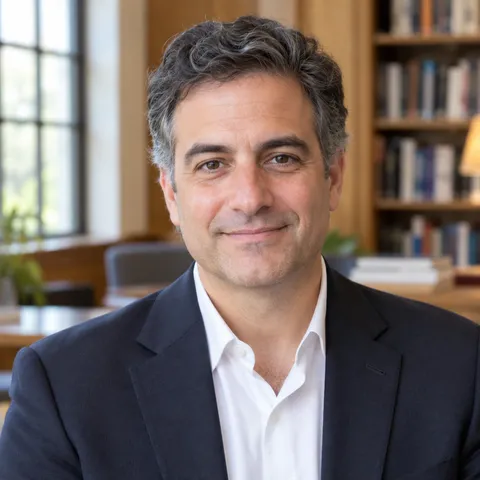
Dr. Marcus Rossi
Associate Professor of Finance
Instructor for FIN 340, Fall 2026
- Office
- Tidewell Hall 312
- mrossi
@university.alkimi.ai
FIN 340 · Business Administration
Commercial banks, credit unions, insurers, investment banks, and funds; interest rate determination, the Federal Reserve, bank regulation and capital requirements, and managing interest rate and credit risk.
Fall 2026 · At a glance
300-level courses: advanced, upper-division courses requiring prior foundational preparation. Counts toward the 36 upper-division credits every bachelor's degree requires (Undergraduate Catalog §2.3). Details: Undergraduate Catalog §9.12.
Associate Professor of Finance
Instructor for FIN 340, Fall 2026
Questions about a major or your plan: Academic Advising Center, Lovell Hall 101, (555) 555-0158.
Class meetings
Tue & Thu, 11:00 a.m.–12:15 p.m.
Lovell Hall 210
Final exam
Wednesday, December 16, 2026
1:30–3:30 p.m., Lovell Hall 210
Office hours
Wed & Thu, 9:00–10:30 a.m.
Tidewell Hall 312
Tue, 4:00–5:00 p.m.
Virtual (Zoom link in Canvas)
You may use generative AI tools to review central bank monetary policy definitions, look up historical interest rate regimes, and check spreadsheet formulas for duration gap calculations. You may not use AI tools during in-class examinations, nor may you submit AI-generated bank financial analysis reports, regulatory briefs, or asset-liability management solutions as your own work.
From the syllabus
Grading
Letter grades follow the university scale (Student Handbook §4.1).
Key dates
First day of classes Past
Midterm Examination 1 Past
Midterm Examination 2 Next
Bank Asset-Liability Management (ALM) Project
Required materials
Anthony Saunders, Marcia Millon Cornett, and Erhemjamts Otgontsetseg. Financial Markets and Institutions. 8th ed., McGraw Hill, 2024.
Approx. $70 digital rental, $145 print purchase.
Federal Reserve Bank Case Studies and Regulatory Policy Readings.
Free digital access provided via Canvas.
Degree planning
What to take first, what this course opens up, and the requirements it can satisfy, from the Undergraduate Catalog.
Catalog wording: FIN 301.
Every course also counts toward the 120 credits needed for a bachelor's degree. Confirm your plan with your advisor or the Academic Advising Center.
No AP exam awards credit for FIN 340 (Undergraduate Catalog §3.11).
Registration
FIN 340 is offered in the fall semester. Register through AlkimiHub self-service registration, which opens by credit standing. Until the add deadline, you don't need instructor permission as long as seats remain and you've met the prerequisites. Details: Student Handbook §3.3.
When a seat opens, AlkimiHub offers it to the first student on the waitlist and emails you. You have 24 hours to claim it before it goes to the next student. Details: Student Handbook §3.10.
Fall 2026 withdrawal deadline
Last day to withdraw with a W or elect Pass/No Pass.
Fall 2027 registration opens
By credit standing, in AlkimiHub.
The Fall 2026 add deadline passed on Sep 2, 2026.
All dates: academic calendar. Registration help: Office of the Registrar.
Official course syllabus
The syllabus as filed with the department and posted in Canvas for Fall 2026.
Term: Fall 2026
Credits: 3.0
Lecture Times & Location: Tuesday & Thursday 11:00 a.m.–12:15 p.m., Lovell Hall 210
Modality: In-Person
mrossi@university.alkimi.ai
Commercial banks, credit unions, insurers, investment banks, and funds; interest rate determination, the Federal Reserve, bank regulation and capital requirements, and managing interest rate and credit risk. FIN 340 provides an in-depth analysis of the operations, regulatory environment, and risk management practices of modern financial intermediaries. The course explores commercial banking, thrifts, credit unions, insurance companies, investment banks, and asset management funds within the context of Federal Reserve monetary policy and global capital markets. Students learn to measure and manage critical institutional vulnerabilities—including interest rate risk, credit risk, liquidity risk, and foreign exchange risk—using duration gap analysis, credit scoring models, stress testing, and Basel III regulatory capital requirements.
FIN 301.
Upon successful completion of FIN 340, students will be able to:
In accordance with Alkimi University Academic Policies (Student Handbook §5.8), FIN 340 operates under AI Level 2.
| Week | Dates | Topics & Readings | Assignments & Deadlines |
|---|---|---|---|
| Week 1 | Aug 27 | The Special Nature of Financial Intermediaries: Why financial intermediaries exist: transaction costs, information asymmetry, liquidity provision, and asset transformation services. Reading: Saunders et al., Ch. 1 | First day of classes: Wed Aug 26. |
| Week 2 | Sep 1, 3 | Interest Rate Determination and Term Structure: Supply and demand for loanable funds, inflation expectations, term structure theories, and the yield curve as a macroeconomic predictor. Reading: Saunders et al., Ch. 2–3 | Wed Sep 2: Add/section change deadline. |
| Week 3 | Sep 8, 10 | The Federal Reserve and Monetary Policy: Federal Reserve structure, monetary policy instruments, open market operations, discount window lending, and reserve requirements. Reading: Saunders et al., Ch. 4 | Mon Sep 7: Labor Day (no classes). Wed Sep 9: Census date (last day to drop without a W). |
| Week 4 | Sep 15, 17 | Commercial Bank Operations and Balance Sheets: Bank balance sheet structure, loans, securities, deposits, non-deposit liabilities, off-balance-sheet activities, and shadow banking. Reading: Saunders et al., Ch. 11 | — |
| Week 5 | Sep 22, 24 | Bank Financial Performance and Midterm Exam 1: Bank financial statements, ROE breakdown, net interest margin, efficiency ratio, and CAMELS rating framework; Midterm Examination 1 in class. Reading: Saunders et al., Ch. 12 | Midterm Examination 1 (in class). |
| Week 6 | Sep 29, Oct 1 | Other Depository and Lending Institutions: Savings associations, mutual savings banks, credit unions, and finance companies: structural differences, tax treatment, and competitive pressures. Reading: Saunders et al., Ch. 13 | — |
| Week 7 | Oct 6, 8 | Insurance Companies and Pension Funds: Life and property-casualty insurance underwriting, loss ratios, combined ratios, reinsurance, and private/public pension fund funding. Reading: Saunders et al., Ch. 14–15 | — |
| Week 8 | Oct 15 | Securities Firms and Investment Banks (Fall Break Week): Investment banking functions, underwriting IPOs and seasoned equity offerings, market making, and venture capital financing (Fall Break week). Reading: Saunders et al., Ch. 16 | Oct 12–Oct 13: Fall break (no classes). |
| Week 9 | Oct 20, 22 | Mutual Funds, Hedge Funds, and Asset Management: Mutual fund structures (open-end vs. closed-end), ETFs, hedge fund strategies, private equity funds, and systemic stability implications. Reading: Saunders et al., Ch. 17 | — |
| Week 10 | Oct 27, 29 | Interest Rate Risk: Repricing Model and Midterm 2: Sources of interest rate risk, repricing gap model, rate-sensitive assets and liabilities, and cumulative gap analysis; Midterm Examination 2 in class. Reading: Saunders et al., Ch. 18 | Midterm Examination 2 (in class). |
| Week 11 | Nov 3, 5 | Managing Interest Rate Risk: Duration Gap Analysis: Duration gap model, leverage-adjusted duration gap, immunization of bank equity value, and hedging with interest rate derivatives. Reading: Saunders et al., Ch. 19 | Fri Nov 6: Last day to withdraw (W) or elect Pass/No Pass. |
| Week 12 | Nov 10, 12 | Credit Risk Measurement and Management: Credit underwriting, the 5 Cs of credit, Altman's Z-score, credit metrics, loan covenants, and loan portfolio credit risk diversification. Reading: Saunders et al., Ch. 20 | — |
| Week 13 | Nov 17, 19 | Liquidity Risk and Bank Run Dynamics: Causes of liquidity risk, liability management, asset liquidity, deposit runs, and liquidity coverage ratios; ALM Project due Friday. Reading: Saunders et al., Ch. 21 | Bank Asset-Liability Management (ALM) Project due Fri Nov 20 at 11:59 p.m. |
| Week 14 | Nov 24 | Foreign Exchange and Sovereign Risk (Thanksgiving Week): Foreign exchange trading, currency risk exposure, sovereign lending risk, and international debt restructuring (Thanksgiving week). Reading: Saunders et al., Ch. 22 | Nov 25–Nov 27: Thanksgiving break (no classes). |
| Week 15 | Dec 1, 3 | Bank Capital Regulation and Basel Accords: History of US banking regulation, Dodd-Frank Act, Basel I/II/III capital adequacy accords, risk-weighted assets, and CCAR stress testing. Reading: Saunders et al., Ch. 23 | — |
| Week 16 | Dec 8 | Deposit Insurance, Systemic Risk, and Course Synthesis: Deposit insurance reform, FDIC resolution mechanics, systemic risk designation, financial technology (Fintech) disruptions, and final review. Reading: Saunders et al., Review | Wed Dec 9: Last day of classes. Thu Dec 10: Reading Day. |
| Finals | Dec 16 | Comprehensive Final Examination: Wednesday, December 16, 2026, 1:30–3:30 p.m., Lovell Hall 210. | Scheduled during the university final examination period in Lovell Hall 210. |
Consistent attendance in Lovell Hall 210 is essential for engaging in institutional case discussions and mastering quantitative balance sheet models. If you need to miss class for an excusable reason, notify Dr. Rossi as early as possible and arrange to review notes with a peer. Students who miss the first two class meetings without notifying the instructor may be dropped. Students may miss class for religious observance without penalty if they notify the instructor in writing within the first two weeks of the semester (by Wednesday, September 9, 2026). Absences for university-sponsored activities (athletics, performances, conferences) are excused with a letter from the sponsoring office at least one week in advance.
Problem sets and the Bank ALM Project are penalized 10% per calendar day late and will not be accepted after three days past the deadline. Canvas concept quizzes close at the deadline and cannot be completed late.
The final examination (Wednesday, December 16, 2026, 1:30–3:30 p.m.) is scheduled by the University Registrar and can't be moved without the Dean's written approval (Faculty Handbook §5.5). A student with three or more final exams on the same calendar day may reschedule one of them. Requests go to the instructor of the middle exam by the last day of classes. For this term, send the request by Wednesday, December 9, 2026 (Student Handbook §6.4).
Alkimi University is an academic community devoted to rigorous scholarship, open intellectual inquiry, and uncompromising ethical conduct. All students are subject to the regulations of the Alkimi University Academic Integrity Policy. Academic dishonesty—including plagiarism, cheating on examinations, unauthorized collaboration, fabrication of empirical data, and unauthorized submission of academic work generated by artificial intelligence—undermines the integrity of the university and carries severe disciplinary sanctions. Sanctions range from a failing grade on an assignment or exam to an administrative course failure recorded as an 'XF' on the official transcript, academic suspension, or expulsion. Suspected violations are formally investigated and resolved through the Office of Academic Integrity in accordance with Faculty Handbook §6. For detailed information, consult the Office of Academic Integrity, Lovell Hall 315, (555) 555-0163, integrity@university.alkimi.ai.
Alkimi University is committed to providing equitable educational access and reasonable accommodations for all students with documented disabilities, including physical, sensory, psychological, learning, and chronic health conditions. Students requesting academic accommodations must formally register with the Office of Accessibility Services, Harlan Hall 204, (555) 555-0155, access@university.alkimi.ai. Once approved, students will receive an official Faculty Accommodation Letter detailing approved accommodations. Students should present this letter to the instructor as early in the semester as possible, and at least one week prior to any exam or assignment requiring accommodation. Accommodations cannot be applied retroactively.
Your physical health, psychological well-being, and mental health are essential to your academic success. If you experience heightened stress, anxiety, depressive symptoms, personal trauma, or academic burnout, free, confidential counseling and medical care are available through the Hollis Health & Counseling Center, located in the Hollis Center. Routine appointments are available Monday–Friday 8:00 a.m.–6:00 p.m. and Saturday 10:00 a.m.–2:00 p.m. during the semester by calling (555) 555-0190 or emailing health@university.alkimi.ai. Urgent, 24/7 crisis psychological counseling is accessible immediately at (555) 555-0199.
advising@university.alkimi.ai
askalibrarian@university.alkimi.ai
health@university.alkimi.ai
BUS, ACCT, COMM, FIN, MGT, MKT courses