
EE 460 · Electrical Engineering
Autonomous Robotics & Sensor Fusion
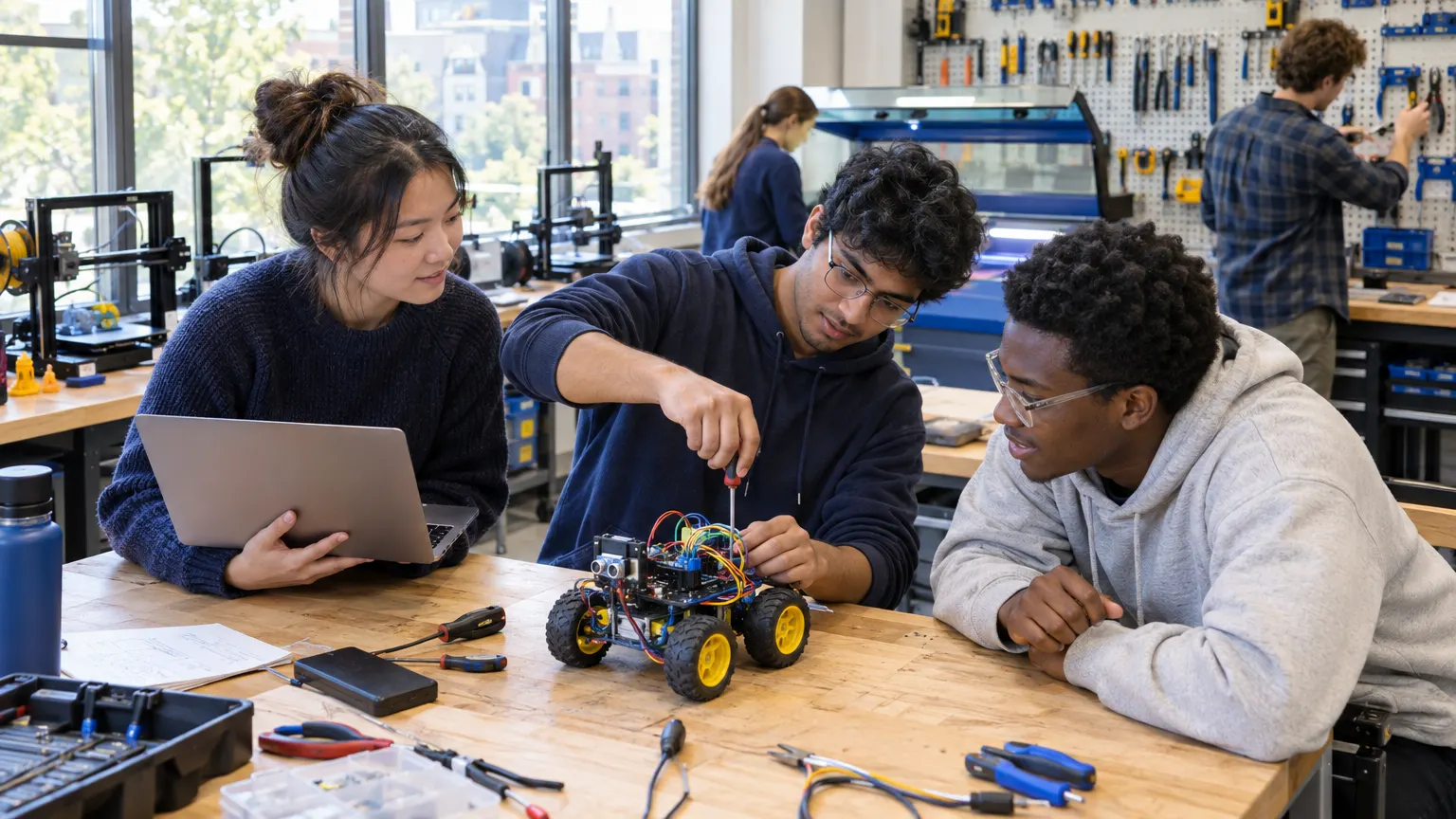
Mobile robotics architectures, kinematic modeling, state estimation, Extended Kalman Filtering, multisensor fusion across LiDAR, camera, and IMU data, and simultaneous localization and mapping (SLAM).
Catalog overview
Course Essentials
- Credits
- 3
- Level
- 400 upper division
- Typically offered
- Spring, even years
400-level courses: advanced capstone, senior research, and specialized seminars. Counts toward the 36 upper-division credits every bachelor's degree requires (Undergraduate Catalog §2.3). Details: Undergraduate Catalog §9.21.
Department of Electrical & Computer Engineering
Department page →Questions about a major or your plan: Academic Advising Center, Lovell Hall 101, (555) 555-0158.
EE 460 runs on a two-year rotation and isn't offered in 2026–27; it's next scheduled for Spring 2028. Department chairs make teaching assignments each year (Faculty Handbook §5.1), and every instructor posts the syllabus in Canvas by the first day of classes (Faculty Handbook §5.2).
Generative AI in this course
Every syllabus must state one of three levels: Level 1 (AI not permitted for graded work), Level 2 (AI permitted with disclosure for specified tasks), Level 3 (AI permitted broadly with disclosure). Check your section's syllabus in Canvas. Unless it says otherwise, the university default applies: generative AI tools may be used for brainstorming, studying, and feedback on your own drafts, but not to produce work you submit for a grade.
Details: Student Handbook §5.7 and Student Handbook §5.8. See what each AI level allows.
Degree planning
Where EE 460 fits
What to take first, what this course opens up, and the requirements it can satisfy, from the Undergraduate Catalog.
Take first
Leads to
All Electrical Engineering courses →No other catalog course lists EE 460 as a prerequisite.
Counts toward
All programs →- Elective Electrical Engineering (BS) Can count toward: Two 400-Level Electrical Engineering Electives. Undergraduate Catalog §10.13
Every course also counts toward the 120 credits needed for a bachelor's degree. Confirm your plan with your advisor or the Academic Advising Center.
AP credit
AP equivalency table →No AP exam awards credit for EE 460 (Undergraduate Catalog §3.11).
Registration
How to enroll in EE 460
-
Add it in AlkimiHub
EE 460 is offered in the spring semester of even-numbered years; the next offering is Spring 2028. Register through AlkimiHub self-service registration, which opens by credit standing. Until the add deadline, you don't need instructor permission as long as seats remain and you've met the prerequisites. Details: Student Handbook §3.3.
-
If the section is full, join the waitlist
When a seat opens, AlkimiHub offers it to the first student on the waitlist and emails you. You have 24 hours to claim it before it goes to the next student. Details: Student Handbook §3.10.
All dates: academic calendar. Registration help: Office of the Registrar.
EE courses
More in Electrical Engineering
- EE 201 Electric Circuits I
- EE 202 Electric Circuits II
- EE 205 Principles of Electrical Circuits for Engineers
- EE 210 Digital Logic & Computer Systems
- EE 301 Signals & Linear Systems
- EE 310 Electronic Circuit Design
- EE 320 Electromagnetic Fields & Waves
- EE 330 Microprocessor Systems & Embedded Interfacing
- EE 340 Feedback Control Systems
- EE 350 Electric Power & Energy Conversion
- EE 420 Wireless Communications & RF Design
- EE 430 Digital Signal Processing
- EE 440 Power Electronics & Renewable Grid Systems
- EE 450 VLSI Design & Semiconductor Fabrication
- EE 460 Autonomous Robotics & Sensor Fusion (this course)
- EE 490 Senior Electrical Engineering Design I
- EE 491 Senior Electrical Engineering Design II