
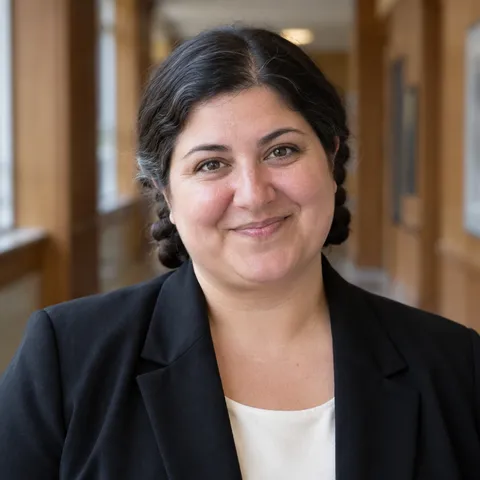
Dr. Elif Kaya
Associate Professor of Electrical & Computer Engineering
Instructor for EE 320, Fall 2026
- Office
- Rowan Engineering Center 216
- ekaya
@university.alkimi.ai
EE 320 · Electrical Engineering
Static electric and magnetic fields, Maxwell's equations, plane waves, transmission lines, waveguides, and antennas.
Fall 2026 · At a glance
300-level courses: advanced, upper-division courses requiring prior foundational preparation. Counts toward the 36 upper-division credits every bachelor's degree requires (Undergraduate Catalog §2.3). Details: Undergraduate Catalog §9.21.
Associate Professor of Electrical & Computer Engineering
Instructor for EE 320, Fall 2026
Questions about a major or your plan: Academic Advising Center, Lovell Hall 101, (555) 555-0158.
Class meetings
Tue & Thu, 4:00–5:15 p.m.
Rowan Engineering Center 120
Final exam
Thursday, December 17, 2026
3:30–5:30 p.m., Rowan Engineering Center 120
Office hours
Mon & Thu, 1:00–2:30 p.m.
Rowan Engineering Center 216
Fri, 4:00–5:00 p.m.
Virtual (Zoom link in Canvas)
Students may use AI tools to generate MATLAB or Python code for visualizing 3D electrostatic and magnetic vector fields, plotting radiation patterns, and automating transmission line Smith chart calculations. AI models must not be used to perform analytical vector calculus proofs, derive boundary condition equations, solve Poisson's equations, or complete graded problem sets without independent derivation.
From the syllabus
Grading
Letter grades follow the university scale (Student Handbook §4.1).
Key dates
First day of classes Past
Midterm Exam 1 (Electrostatics & Magnetostatics) Next
Midterm Exam 2 (Maxwell's Equations & Plane Waves)
Computational Electromagnetics & Wave Matching Project
Required materials
Ulaby, Fawwaz T., and Umberto Ravaioli. Fundamentals of Applied Electromagnetics. 8th ed., Pearson, 2020.
Approx. $75 digital rental ($180 purchase; reserve copies available in Alkimi Library).
MATLAB PDE Toolbox and Python Electromagnetics Visualization Modules.
Free educational access provided through university site licensing.
Degree planning
What to take first, what this course opens up, and the requirements it can satisfy, from the Undergraduate Catalog.
Every course also counts toward the 120 credits needed for a bachelor's degree. Confirm your plan with your advisor or the Academic Advising Center.
No AP exam awards credit for EE 320 (Undergraduate Catalog §3.11).
Registration
EE 320 is offered in the fall semester. Register through AlkimiHub self-service registration, which opens by credit standing. Until the add deadline, you don't need instructor permission as long as seats remain and you've met the prerequisites. Details: Student Handbook §3.3.
When a seat opens, AlkimiHub offers it to the first student on the waitlist and emails you. You have 24 hours to claim it before it goes to the next student. Details: Student Handbook §3.10.
Fall 2026 withdrawal deadline
Last day to withdraw with a W or elect Pass/No Pass.
Fall 2027 registration opens
By credit standing, in AlkimiHub.
The Fall 2026 add deadline passed on Sep 2, 2026.
All dates: academic calendar. Registration help: Office of the Registrar.
Official course syllabus
The syllabus as filed with the department and posted in Canvas for Fall 2026.
Term: Fall 2026
Credits: 3.0
Lecture Times & Location: Tuesday & Thursday 4:00–5:15 p.m., Rowan Engineering Center 120
Modality: In-Person
ekaya@university.alkimi.ai
Static electric and magnetic fields, Maxwell's equations, plane waves, transmission lines, waveguides, and antennas. EE 320 provides a comprehensive introduction to classical electrodynamics and high-frequency wave phenomena essential for RF, microwave, and wireless communications engineering. Beginning with vector calculus formulations of static electric and magnetic fields in dielectric and magnetic media, the course builds to Maxwell's time-varying equations and electromagnetic boundary conditions. Students analyze uniform plane wave propagation, reflection, refraction, transmission line dynamics using the Smith chart, and fundamental concepts of waveguides and antennas.
PHYS 122 and MATH 240.
Upon successful completion of EE 320, students will be able to:
In accordance with Alkimi University Academic Policies (Student Handbook §5.8), EE 320 operates under AI Level 2.
| Week | Dates | Topics & Readings | Assignments & Deadlines |
|---|---|---|---|
| Week 1 | Aug 27 | Vector Calculus and Coordinate Systems: Orthogonal coordinate systems (Cartesian, cylindrical, spherical), differential lengths, areas, and volumes; gradient, divergence, curl, and Stokes' and divergence theorems. Reading: Ulaby & Ravaioli Ch. 3.1–3.7 | First day of classes: Wed Aug 26. |
| Week 2 | Sep 1, 3 | Electrostatics: Coulomb's Law and Electric Field: Coulomb's law, electric field intensity due to continuous line, surface, and volume charge distributions, and electric flux density (D). Reading: Ulaby & Ravaioli Ch. 4.1–4.3 | Wed Sep 2: Add/section change deadline. |
| Week 3 | Sep 8, 10 | Gauss's Law, Electric Potential, and Energy: Gauss's law in integral and point forms, conservative nature of electrostatic fields, electric scalar potential, and electrostatic energy density. Reading: Ulaby & Ravaioli Ch. 4.4–4.6 | Mon Sep 7: Labor Day (no classes). Wed Sep 9: Census date (last day to drop without a W). |
| Week 4 | Sep 15, 17 | Conductors, Dielectrics, and Boundary Conditions: Current density, continuity equation, conductor properties, dielectric polarization, permittivity, dielectric boundary conditions, and capacitance formulations. Reading: Ulaby & Ravaioli Ch. 4.7–4.10 | — |
| Week 5 | Sep 22, 24 | Poisson's and Laplace's Equations: Derivation of Poisson's and Laplace's equations, uniqueness theorem, one-dimensional boundary-value problems, and method of images. Reading: Ulaby & Ravaioli Ch. 4.11–4.12 | — |
| Week 6 | Sep 29, Oct 1 | Magnetostatics and Midterm Exam 1: Biot-Savart law, Ampère's circuital law in integral and differential forms, curl of B, and administration of Midterm Exam 1 during Thursday class. Reading: Ulaby & Ravaioli Ch. 5.1–5.3 | Midterm Exam 1 (Electrostatics & Magnetostatics) (in class). |
| Week 7 | Oct 6, 8 | Magnetic Vector Potential, Inductance, and Forces: Magnetic flux, vector magnetic potential (A), Lorentz force equation, magnetic torque, self and mutual inductance, and stored magnetic energy. Reading: Ulaby & Ravaioli Ch. 5.4–5.7 | — |
| Week 8 | Oct 15 | Magnetic Materials and Boundary Conditions: Magnetization, magnetic susceptibility and permeability, ferromagnetism and hysteresis loops, magnetic boundary conditions, and magnetic circuits. Reading: Ulaby & Ravaioli Ch. 5.8–5.9 | Oct 12–Oct 13: Fall break (no classes). |
| Week 9 | Oct 20, 22 | Time-Varying Fields and Maxwell's Equations: Faraday's law of induction, motional EMF, displacement current, Maxwell's equations in differential and integral forms, and time-harmonic representations. Reading: Ulaby & Ravaioli Ch. 6.1–6.6 | — |
| Week 10 | Oct 27, 29 | Plane Wave Propagation in Unbounded Media: Wave equations for E and H, Helmholtz equations, uniform plane waves in lossless dielectrics, lossy media, skin depth, and good conductors. Reading: Ulaby & Ravaioli Ch. 7.1–7.4 | — |
| Week 11 | Nov 3, 5 | Wave Polarization, Poynting Vector, and Midterm Exam 2: Linear, circular, and elliptical polarization, Poynting's theorem and time-average power density, and administration of Midterm Exam 2 in Thursday class. Reading: Ulaby & Ravaioli Ch. 7.5–7.6 | Fri Nov 6: Last day to withdraw (W) or elect Pass/No Pass. Midterm Exam 2 (Maxwell's Equations & Plane Waves) (in class). |
| Week 12 | Nov 10, 12 | Reflection and Transmission at Planar Interfaces: Normal and oblique incidence, Snell's laws, reflection and transmission coefficients, total internal reflection, Brewster angle, and surface waves. Reading: Ulaby & Ravaioli Ch. 8.1–8.4 | — |
| Week 13 | Nov 17, 19 | Transmission Lines: Distributed Circuit Analysis: Telegrapher's equations, characteristic impedance, propagation constant, input impedance of terminated lines, voltage standing wave ratio (VSWR); Project due Friday. Reading: Ulaby & Ravaioli Ch. 2.1–2.6 | Computational Electromagnetics & Wave Matching Project due Fri Nov 20 at 11:59 p.m. |
| Week 14 | Nov 24 | The Smith Chart and Impedance Matching: Smith chart conformal mapping, normalized impedance and admittance, quarter-wave transformers, and single-stub shunt matching networks. Reading: Ulaby & Ravaioli Ch. 2.7–2.11 | Nov 25–Nov 27: Thanksgiving break (no classes). |
| Week 15 | Dec 1, 3 | Waveguides and Introduction to Antennas: Rectangular metallic waveguides, TE and TM cutoff frequencies, group and phase velocity, Hertzian dipole radiation, antenna gain, and effective aperture. Reading: Ulaby & Ravaioli Ch. 8.6–8.9, 9.1–9.3 | — |
| Week 16 | Dec 8 | Course Synthesis and Final Examination Review: Comprehensive integration of static and dynamic Maxwell's formulations, wave reflection principles, transmission line matching, and final exam synthesis. Reading: Review Ulaby & Ravaioli Ch. 3–8 | Wed Dec 9: Last day of classes. Thu Dec 10: Reading Day. |
| Finals | Dec 17 | Comprehensive Final Examination: Thursday, December 17, 2026, 3:30–5:30 p.m., Rowan Engineering Center 120. | Comprehensive. |
Class attendance at every lecture is required. Vector calculus applied to electromagnetic field problems is conceptually intricate, and following blackboard derivations in class is essential for developing physical intuition. If an unavoidable illness or university business conflict arises, notify Dr. Kaya in advance. Students who miss the first two class meetings without notifying the instructor may be dropped. Students may miss class for religious observance without penalty if they notify the instructor in writing within the first two weeks of the semester (by Wednesday, September 9, 2026). Absences for university-sponsored activities (athletics, performances, conferences) are excused with a letter from the sponsoring office at least one week in advance.
Homework problem sets submitted after the deadline will incur a 15% deduction per 24 hours up to 48 hours late, after which solutions will be published and zero credit awarded. The lowest homework grade and lowest quiz grade will be dropped to accommodate unforeseen illnesses.
The final examination (Thursday, December 17, 2026, 3:30–5:30 p.m.) is scheduled by the University Registrar and can't be moved without the Dean's written approval (Faculty Handbook §5.5). A student with three or more final exams on the same calendar day may reschedule one of them. Requests go to the instructor of the middle exam by the last day of classes. For this term, send the request by Wednesday, December 9, 2026 (Student Handbook §6.4).
Alkimi University is an academic community devoted to rigorous scholarship, open intellectual inquiry, and uncompromising ethical conduct. All students are subject to the regulations of the Alkimi University Academic Integrity Policy. Academic dishonesty—including plagiarism, cheating on examinations, unauthorized collaboration, fabrication of empirical data, and unauthorized submission of academic work generated by artificial intelligence—undermines the integrity of the university and carries severe disciplinary sanctions. Sanctions range from a failing grade on an assignment or exam to an administrative course failure recorded as an 'XF' on the official transcript, academic suspension, or expulsion. Suspected violations are formally investigated and resolved through the Office of Academic Integrity in accordance with Faculty Handbook §6. For detailed information, consult the Office of Academic Integrity, Lovell Hall 315, (555) 555-0163, integrity@university.alkimi.ai.
Alkimi University is committed to providing equitable educational access and reasonable accommodations for all students with documented disabilities, including physical, sensory, psychological, learning, and chronic health conditions. Students requesting academic accommodations must formally register with the Office of Accessibility Services, Harlan Hall 204, (555) 555-0155, access@university.alkimi.ai. Once approved, students will receive an official Faculty Accommodation Letter detailing approved accommodations. Students should present this letter to the instructor as early in the semester as possible, and at least one week prior to any exam or assignment requiring accommodation. Accommodations cannot be applied retroactively.
Your physical health, psychological well-being, and mental health are essential to your academic success. If you experience heightened stress, anxiety, depressive symptoms, personal trauma, or academic burnout, free, confidential counseling and medical care are available through the Hollis Health & Counseling Center, located in the Hollis Center. Routine appointments are available Monday–Friday 8:00 a.m.–6:00 p.m. and Saturday 10:00 a.m.–2:00 p.m. during the semester by calling (555) 555-0190 or emailing health@university.alkimi.ai. Urgent, 24/7 crisis psychological counseling is accessible immediately at (555) 555-0199.
advising@university.alkimi.ai
askalibrarian@university.alkimi.ai
health@university.alkimi.ai
EE courses