
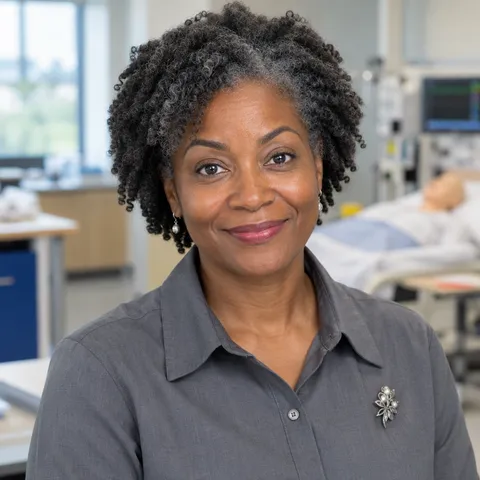
Dr. Andrea Clarke, RN
Professor of Nursing
Assigns first-year advisors and approves program changes (Graduate Handbook §4.1, §2.9).
School of Nursing & Health Sciences · Master's degree
The MSN prepares registered nurses who hold a bachelor's degree for advanced roles in nursing education and nursing leadership. Courses meet in a hybrid format so students can keep working, and each track includes a supervised practicum.
MSN · 36 credits
The MSN prepares registered nurses who hold a bachelor's degree for advanced roles in nursing education and nursing leadership. Courses meet in a hybrid format so students can keep working, and each track includes a supervised practicum.
Program requirements, the Graduate Program Director, and tuition for this degree are set out in Graduate Handbook §12.10: Master of Science in Nursing (MSN).
| Requirement | Credits |
|---|---|
| Core courses: advanced pathophysiology, health policy, research and evidence-based practice, and nursing informatics | 15 |
| Nursing education or nursing leadership track, including a supervised practicum | 15 |
| Capstone project | 6 |
| Total | 36 |
Evidence-based practice capstone project in the final semester.
At a glance
Program: Graduate Handbook §12.10 · Time limits: Graduate Handbook §3.5
Graduate Program Director
Professor of Nursing
Assigns first-year advisors and approves program changes (Graduate Handbook §4.1, §2.9).
Department
36 credits
The courses that count toward each part of the MSN curriculum, with the terms each is usually offered.
NURS 510 Advanced Pathophysiology 3 credits Fall
Examines disease processes across the body systems and how they change assessment findings and treatment decisions. Students work through case studies drawn from adult, older adult, and pediatric care.
NURS 520 Health Policy and Advocacy 3 credits Fall, Spring
Covers how federal and state health policy is made, financed, and regulated, and how nurses shape it. Students write a policy brief on an issue in their own practice setting.
NURS 530 Research Methods for Nursing 3 credits Fall, Spring
Introduces quantitative, qualitative, and mixed-methods designs and how to appraise published nursing research. Students draft a focused clinical question and a search of the literature.
NURS 531 Evidence-Based Practice 3 credits Spring
Teaches how to grade evidence, synthesize studies, and turn findings into practice or teaching changes. Students build an evidence summary that becomes the starting point for the capstone.
NURS 540 Nursing Informatics 3 credits Summer
Covers electronic health records, clinical decision support, data privacy, and the use of patient data to improve care. Students evaluate a health information system from their own workplace.
NURS 550 Curriculum Design in Nursing Education 3 credits Fall
Covers learning outcomes, course sequencing, and accreditation standards for nursing programs and staff education. Students design a course or unit with objectives and assessments.
NURS 551 Teaching and Learning Strategies 3 credits Fall
Compares lecture, case-based, flipped, and clinical teaching methods for adult learners. Students teach short sessions and receive peer and faculty feedback.
NURS 552 Assessment and Evaluation in Nursing Education 3 credits Fall, Spring
Covers writing exam items, scoring clinical performance, and using program data to improve teaching. Students build a test blueprint and a clinical evaluation rubric.
NURS 553 Simulation and Clinical Teaching 3 credits Fall, Spring
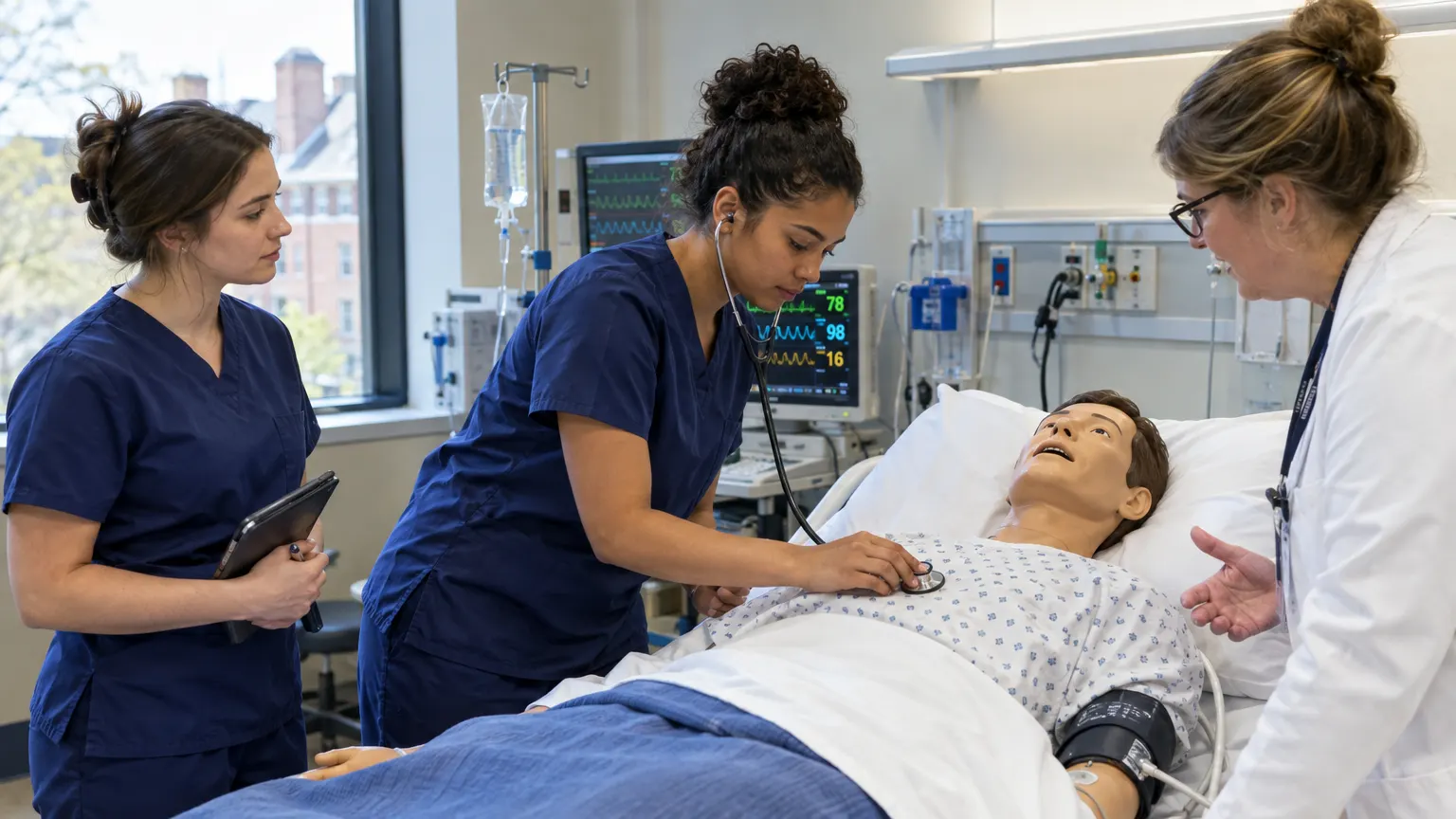
Students plan, run, and debrief simulation scenarios in the health sciences simulation lab. The course also covers coaching students during clinical shifts.
NURS 560 Nursing Leadership and Organizational Behavior 3 credits Fall, Spring
Covers leadership styles, team dynamics, conflict, and change management on nursing units. Students analyze a leadership problem in their own organization.
NURS 561 Healthcare Finance and Resource Management 3 credits Spring
Teaches unit budgeting, staffing models, reimbursement, and cost-benefit analysis for nurse managers. Students prepare a budget proposal for a hospital or clinic unit.
NURS 562 Quality Improvement and Patient Safety 3 credits Fall, Spring
Introduces root cause analysis, plan-do-study-act cycles, and safety reporting systems. Students analyze a real safety event and propose a fix.
NURS 590 Advanced Nursing Practicum 3 credits Summer
A supervised placement of about 150 hours in a nursing education or nursing leadership setting, matched to the student's track. A preceptor and a faculty member oversee the work.
NURS 598 Evidence-Based Practice Capstone 6 credits Fall
Students carry out an evidence-based practice project on a problem in their workplace and present the results to faculty and practice partners. A written report is due at the end of the semester.
Sample Roadmap
A representative term-by-term sequence for the MSN. “Elective” is one 3-credit course chosen from the program's elective list above, with your advisor.
Graduate Handbook
Every master's program at Alkimi follows the same Graduate School milestones. Each links to the handbook section that governs it.
Format review and ProQuest submission
Graduate Handbook §5.6: Thesis and Dissertation Format Review and ProQuest Submission
Intent to Graduate and degree audit
Graduate Handbook §11.1: Filing the Intent to Graduate and Degree Audits
Graduate students must keep a cumulative GPA of 3.000 or higher to stay in good standing and to graduate (Graduate Handbook §3.1).
The Graduate Program Director or a designated capstone coordinator is your permanent advisor (Graduate Handbook §4.1).
2026–27
Graduate tuition
$1,450
Per credit hour, plus $300 in mandatory fees per semester. 36 credits come to $52,200 in tuition at 2026–27 rates.
Assistantship stipend
$21,000
9-month stipend for a master's teaching, research, or graduate assistant.
Rates: Graduate Handbook §6.2
Assistantships in this program
Most MSN students work as registered nurses while enrolled part-time, so assistantships are limited.
A 20-hour assistantship includes a full tuition waiver of up to 12 credits per semester and covers mandatory fees (Graduate Handbook §6.3).
People
Chair: Dr. Siobhan Katsaros, DNP, RN
Nursing prepares students for professional practice through coursework, simulation labs in the Calder Health Sciences Building, and clinical placements.