

Dr. Dana Fairbanks, DNP, RN
Professor of Nursing
Assigns first-year advisors and approves program changes (Graduate Handbook §4.1, §2.9).
School of Nursing & Health Sciences · Doctoral degree
The DNP is a practice doctorate for nurses who hold a master's degree in nursing. Students lead quality improvement and health systems change in their own organizations, attend on-campus residency intensives each semester, and complete a practice-focused DNP project.
DNP · 36 credits
The DNP is a practice doctorate for nurses who hold a master's degree in nursing. Students lead quality improvement and health systems change in their own organizations, attend on-campus residency intensives each semester, and complete a practice-focused DNP project.
Program requirements, the Graduate Program Director, and tuition for this degree are set out in Graduate Handbook §12.11: Doctor of Nursing Practice (DNP).
| Requirement | Credits |
|---|---|
| Doctoral core courses: health systems leadership, quality and safety, population health, health policy, and translational research | 21 |
| Clinical scholarship residency | 6 |
| DNP project work | 9 |
| Total | 36 |
Practice-focused DNP project, defended in a public oral examination.
At a glance
Program: Graduate Handbook §12.11 · Time limits: Graduate Handbook §3.5
Graduate Program Director
Professor of Nursing
Assigns first-year advisors and approves program changes (Graduate Handbook §4.1, §2.9).
Department
36 credits
The courses that count toward each part of the DNP curriculum, with the terms each is usually offered.
NURS 520 Health Policy and Advocacy 3 credits Fall, Spring
Covers how federal and state health policy is made, financed, and regulated, and how nurses shape it. Students write a policy brief on an issue in their own practice setting.
NURS 610 Health Systems Leadership 3 credits Fall
Examines how health systems are organized and led, with attention to strategy, governance, and organizational change. Students assess the structure of their own organization.
NURS 620 Quality, Safety, and Systems Improvement 3 credits Spring
Covers improvement science, safety culture, and measurement for system-level change. Students choose a quality problem at their organization and map its causes.
NURS 630 Population Health for Advanced Practice 3 credits Spring
Uses epidemiologic data and social determinants of health to plan care for defined populations. Students profile the population served by their own practice.
NURS 640 Translational Research 3 credits Fall
Covers frameworks for moving research findings into practice and for evaluating the results. Students write a translation plan that will shape their DNP project proposal.
NURS 650 Biostatistics and Data Analytics for Practice 3 credits Fall
Reviews the statistics needed to read outcomes research and to analyze practice data. Students run analyses on a dataset from a health care setting.
NURS 660 Ethics and Health Equity in Advanced Practice 3 credits Fall
Examines ethical problems in leading practice change and how bias and access shape patient outcomes. Students prepare an equity review of a policy or program at their organization.
NURS 670 Clinical Scholarship Residency I 3 credits Fall, Spring
A supervised scholarly practice experience of about 125 hours in the student's own organization, plus an on-campus residency intensive. Students identify the problem their DNP project will address.
NURS 671 Clinical Scholarship Residency II 3 credits Fall, Spring
A second supervised practice experience of about 125 hours focused on implementing and sustaining the project intervention, plus an on-campus residency intensive. A practice mentor reviews progress each month.
NURS 690 DNP Project I: Proposal 3 credits Fall, Spring
Students write the DNP project proposal, including the problem statement, literature review, and evaluation plan. The proposal is presented at the on-campus residency intensive.
NURS 691 DNP Project II: Implementation 3 credits Fall, Spring
Students carry out the approved project in their organization and collect outcome data. They meet regularly with the project chair.
NURS 692 DNP Project III: Evaluation and Defense 3 credits Fall, Spring
Students analyze results, write the final DNP project report, and defend it in a public oral examination.
Sample Roadmap
A representative term-by-term sequence for the DNP. “Elective” is one 3-credit course chosen from the program's elective list above, with your advisor.
Graduate Handbook
Every doctoral program at Alkimi follows the same Graduate School milestones. Each links to the handbook section that governs it.
Doctoral residency
Diagnostic and qualifying examinations
Graduate Handbook §5.2: Doctoral Diagnostic and Qualifying Examinations
Admission to candidacy
Dissertation prospectus
Graduate Handbook §5.4: The Dissertation Prospectus and Proposal Defense
Format review and ProQuest submission
Graduate Handbook §5.6: Thesis and Dissertation Format Review and ProQuest Submission
Graduate students must keep a cumulative GPA of 3.000 or higher to stay in good standing and to graduate (Graduate Handbook §3.1).
Choose a major professor by the end of your second semester. Your four-member Doctoral Dissertation Committee administers the qualifying examination and the defense (Graduate Handbook §4.1, Graduate Handbook §4.3).
2026–27
Graduate tuition
$1,450
Per credit hour, plus $300 in mandatory fees per semester. 36 credits come to $52,200 in tuition at 2026–27 rates.
Assistantship stipend
$26,000
9-month stipend before candidacy, rising to $28,000 after admission to candidacy.
Rates: Graduate Handbook §6.2
Assistantships in this program
DNP students are practicing nurses enrolled part-time, so assistantships are limited.
A 20-hour assistantship includes a full tuition waiver of up to 12 credits per semester and covers mandatory fees (Graduate Handbook §6.3).
People
Chair: Dr. Siobhan Katsaros, DNP, RN
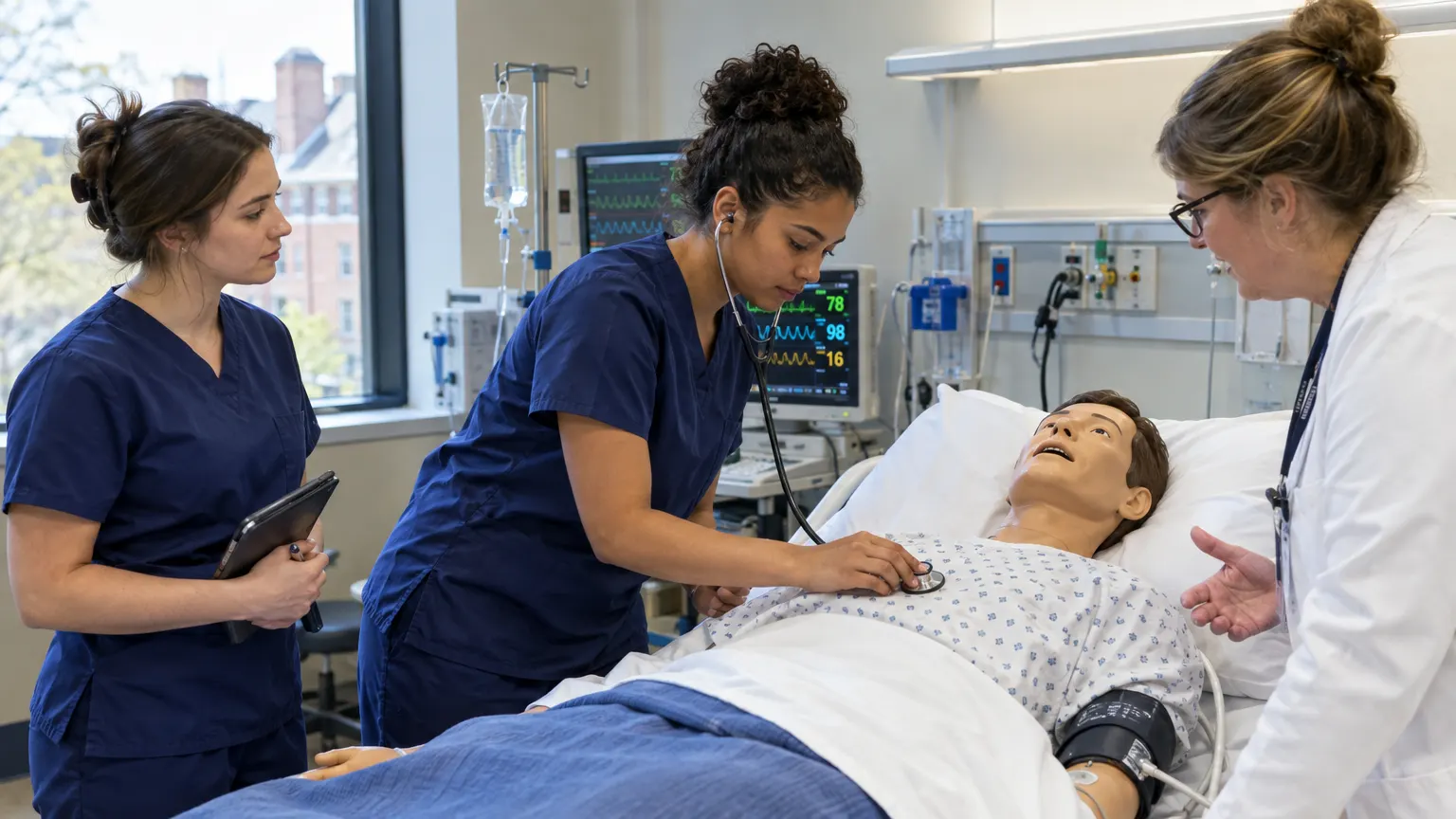
Nursing prepares students for professional practice through coursework, simulation labs in the Calder Health Sciences Building, and clinical placements.