
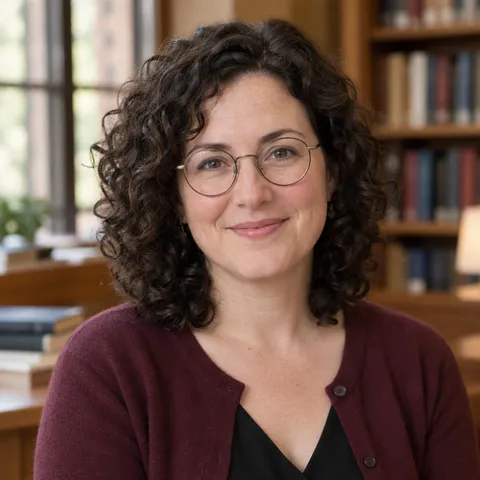
Dr. Miriam Adler
Assistant Professor of Philosophy
Instructor for PHIL 305, Fall 2026
- Office
- Lovell Hall 244
- madler
@university.alkimi.ai
PHIL 305 · Philosophy
Consequentialism, deontology, virtue ethics, contractualism, and metaethics, applied to contemporary moral problems in medicine, technology, and public policy.
Fall 2026 · At a glance
300-level courses: advanced, upper-division courses requiring prior foundational preparation. Counts toward the 36 upper-division credits every bachelor's degree requires (Undergraduate Catalog §2.3). Details: Undergraduate Catalog §9.15.
Assistant Professor of Philosophy
Instructor for PHIL 305, Fall 2026
Questions about a major or your plan: Academic Advising Center, Lovell Hall 101, (555) 555-0158.
Class meetings
Tue & Thu, 8:00–9:15 a.m.
Lovell Hall 320
Final exam
Thursday, December 17, 2026
10:30 a.m.–12:30 p.m., Lovell Hall 320
Office hours
Tue & Thu, 3:30–5:00 p.m.
Lovell Hall 244
Mon, 4:00–5:00 p.m.
Virtual (Zoom link in Canvas)
You may use generative AI tools to look up encyclopedia definitions of normative ethical terminology or check citation formatting for bibliography entries. You may not use generative AI to construct ethical arguments, write moral dilemma analyses, draft research paper sections, or generate answers on examinations.
From the syllabus
Grading
Letter grades follow the university scale (Student Handbook §4.1).
Key dates
First day of classes Past
Normative Theory Paper Past
Midterm Examination Next
Applied Ethics Term Essay
Required materials
Russ Shafer-Landau, ed. Ethical Theory: An Anthology. 3rd ed., Wiley-Blackwell, 2018.
Approx. $45 digital rental, $80 print purchase.
Alkimi Applied Ethics Case Packet and Contemporary Readings.
Free digital case materials provided on Canvas.
Degree planning
What to take first, what this course opens up, and the requirements it can satisfy, from the Undergraduate Catalog.
Every course also counts toward the 120 credits needed for a bachelor's degree. Confirm your plan with your advisor or the Academic Advising Center.
No AP exam awards credit for PHIL 305 (Undergraduate Catalog §3.11).
Registration
PHIL 305 is offered in the fall semester. Register through AlkimiHub self-service registration, which opens by credit standing. Until the add deadline, you don't need instructor permission as long as seats remain and you've met the prerequisites. Details: Student Handbook §3.3.
When a seat opens, AlkimiHub offers it to the first student on the waitlist and emails you. You have 24 hours to claim it before it goes to the next student. Details: Student Handbook §3.10.
Fall 2026 withdrawal deadline
Last day to withdraw with a W or elect Pass/No Pass.
Fall 2027 registration opens
By credit standing, in AlkimiHub.
The Fall 2026 add deadline passed on Sep 2, 2026.
All dates: academic calendar. Registration help: Office of the Registrar.
Official course syllabus
The syllabus as filed with the department and posted in Canvas for Fall 2026.
Term: Fall 2026
Credits: 3.0
Lecture Times & Location: Tuesday & Thursday 8:00–9:15 a.m., Lovell Hall 320
Modality: In-Person
madler@university.alkimi.ai
Consequentialism, deontology, virtue ethics, contractualism, and metaethics, applied to contemporary moral problems in medicine, technology, and public policy. PHIL 305 provides an advanced, analytically rigorous investigation of normative ethical theory, metaethics, and contemporary applied moral problems. Students examine consequentialism, Kantian deontology, Rossian intuitionism, contractualism, and virtue ethics to interrogate the fundamental foundations of moral obligation, value, and character. In the metaethical domain, the course explores moral realism, error theory, expressivism, and moral knowledge. These theoretical frameworks are systematically applied to urgent real-world dilemmas in biomedical ethics, artificial intelligence, climate justice, and global inequality.
PHIL 101 or PHIL 205.
Upon successful completion of PHIL 305, students will be able to:
In accordance with Alkimi University Academic Policies (Student Handbook §5.8), PHIL 305 operates under AI Level 1.
| Week | Dates | Topics & Readings | Assignments & Deadlines |
|---|---|---|---|
| Week 1 | Aug 27 | The Nature of Ethical Theory and Moral Methodology: The architecture of moral philosophy; normative ethics, metaethics, applied ethics; moral intuitions, thought experiments, and reflective equilibrium. Reading: Shafer-Landau, Part I (pp. 1–35) | First day of classes: Wed Aug 26. |
| Week 2 | Sep 1, 3 | Consequentialism: Principles and Varieties: Classical utilitarianism, hedonism, maximizing aggregate welfare, act vs. rule utilitarianism, and expected vs. actual consequences. Reading: Shafer-Landau, Part V (Bentham, Mill, Smart) | Wed Sep 2: Add/section change deadline. |
| Week 3 | Sep 8, 10 | Consequentialism: Objections and Refinements: Challenges to consequentialism: the demandingness objection, partiality, moral integrity (Bernard Williams), and the problem of rights violations. Reading: Shafer-Landau, Part V (Williams, Railton) | Mon Sep 7: Labor Day (no classes). Wed Sep 9: Census date (last day to drop without a W). |
| Week 4 | Sep 15, 17 | Deontology: Kantian Duty and Respect for Persons: Kant's moral philosophy: the good will, duty, the Categorical Imperative (Formula of Universal Law and Formula of Humanity), and moral autonomy. Reading: Shafer-Landau, Part VI (Kant, O'Neill) | — |
| Week 5 | Sep 22, 24 | Prima Facie Duties, Moral Rights, and Normative Paper: Non-absolutist deontology: W.D. Ross's prima facie duties, intuitionism, and rights-based constraints; Normative Theory Paper due Friday. Reading: Shafer-Landau, Part VI (Ross, Thomson) | Normative Theory Paper due Fri Sep 25 at 11:59 p.m. |
| Week 6 | Sep 29, Oct 1 | Contractarianism, Contractualism, and Midterm Exam: Social contract theory, Hobbesian contractarianism (Gauthier), and Kantian contractualism (Scanlon, Rawls); Midterm Examination in class. Reading: Shafer-Landau, Part VII (Hobbes, Scanlon) | Midterm Examination (in class). |
| Week 7 | Oct 6, 8 | Virtue Ethics: Character, Flourishing, and Action Guidance: Aristotelian virtue ethics revived: Philippa Foot, Rosalind Hursthouse, the doctrine of the mean, moral character, and situationist critiques. Reading: Shafer-Landau, Part VIII (Foot, Hursthouse) | — |
| Week 8 | Oct 15 | Feminist Ethics and the Ethics of Care (Fall Break Week): Feminist ethics, Carol Gilligan, Virginia Held, relational ontology, and the ethics of care vs. justice frameworks (Fall Break week). Reading: Shafer-Landau, Part IX (Gilligan, Held) | Oct 12–Oct 13: Fall break (no classes). |
| Week 9 | Oct 20, 22 | Metaethics: Moral Realism vs. Error Theory: Metaethics: J.L. Mackie's moral skepticism and error theory; arguments from relativity and queerness; moral realism and objective values. Reading: Shafer-Landau, Part II (Mackie, Brink) | — |
| Week 10 | Oct 27, 29 | Metaethics: Expressivism and Non-Cognitivism: Expressivism and non-cognitivism: A.J. Ayer's emotivism, Simon Blackburn's quasi-realism, and the Frege-Geach embedding problem. Reading: Shafer-Landau, Part III (Ayer, Blackburn) | — |
| Week 11 | Nov 3, 5 | Applied Ethics: Bioethics and Patient Autonomy: Biomedical ethics: informed consent, patient autonomy, paternalism, genetic modification, and triage allocation of medical resources. Reading: Case Packet, Section 1 | Fri Nov 6: Last day to withdraw (W) or elect Pass/No Pass. |
| Week 12 | Nov 10, 12 | Applied Ethics: Artificial Intelligence and Technology: Ethics of technology and AI: algorithmic bias, autonomous weapons, machine moral decision-making, and digital privacy surveillance. Reading: Case Packet, Section 2 | — |
| Week 13 | Nov 17, 19 | Applied Ethics: Climate Justice and Non-Human Animals: Environmental ethics, intergenerational justice, climate change responsibilities, and animal rights; Applied Ethics Term Essay due Friday. Reading: Shafer-Landau, Part XII (Singer, Regan); Case Packet | Applied Ethics Term Essay due Fri Nov 20 at 11:59 p.m. |
| Week 14 | Nov 24 | Applied Ethics: Global Poverty and Borders (Thanksgiving Week): Global justice, extreme poverty, Peter Singer's drowning child argument, cosmopolitanism, and national borders (Thanksgiving week). Reading: Case Packet, Section 4 | Nov 25–Nov 27: Thanksgiving break (no classes). |
| Week 15 | Dec 1, 3 | Moral Disagreement and Epistemic Peerhood: Moral disagreement, peer disagreement, epistemic peerhood, moral progress, and cultural moral evolution. Reading: Shafer-Landau, Part IV (Selected essays) | — |
| Week 16 | Dec 8 | Ethical Synthesis and Final Examination Review: Ethical pluralism, synthesizing normative and metaethical frameworks, moral deliberation in democratic societies, and final review. Reading: Review readings | Wed Dec 9: Last day of classes. Thu Dec 10: Reading Day. |
| Finals | Dec 17 | Comprehensive Final Examination: Thursday, December 17, 2026, 10:30 a.m.–12:30 p.m., Lovell Hall 320. | Scheduled during the university final examination period in Lovell Hall 320. |
Upper-level moral philosophy seminars require active, thoughtful, and consistent student participation in Lovell Hall 320. Attendance is required for all meetings. Students are allowed up to two unexcused absences; each subsequent absence lowers the course grade by one-third of a letter grade. Missing more than five sessions results in failure of the course. Students who miss the first two class meetings without notifying the instructor may be dropped. Students may miss class for religious observance without penalty if they notify the instructor in writing within the first two weeks of the semester (by Wednesday, September 9, 2026). Absences for university-sponsored activities (athletics, performances, conferences) are excused with a letter from the sponsoring office at least one week in advance.
Formal essays lose one-third of a letter grade per calendar day overdue and will not be accepted more than four days after the deadline. Reading responses must be posted prior to the seminar discussion to receive credit.
The final examination (Thursday, December 17, 2026, 10:30 a.m.–12:30 p.m.) is scheduled by the University Registrar and can't be moved without the Dean's written approval (Faculty Handbook §5.5). A student with three or more final exams on the same calendar day may reschedule one of them. Requests go to the instructor of the middle exam by the last day of classes. For this term, send the request by Wednesday, December 9, 2026 (Student Handbook §6.4).
Alkimi University is an academic community devoted to rigorous scholarship, open intellectual inquiry, and uncompromising ethical conduct. All students are subject to the regulations of the Alkimi University Academic Integrity Policy. Academic dishonesty—including plagiarism, cheating on examinations, unauthorized collaboration, fabrication of empirical data, and unauthorized submission of academic work generated by artificial intelligence—undermines the integrity of the university and carries severe disciplinary sanctions. Sanctions range from a failing grade on an assignment or exam to an administrative course failure recorded as an 'XF' on the official transcript, academic suspension, or expulsion. Suspected violations are formally investigated and resolved through the Office of Academic Integrity in accordance with Faculty Handbook §6. For detailed information, consult the Office of Academic Integrity, Lovell Hall 315, (555) 555-0163, integrity@university.alkimi.ai.
Alkimi University is committed to providing equitable educational access and reasonable accommodations for all students with documented disabilities, including physical, sensory, psychological, learning, and chronic health conditions. Students requesting academic accommodations must formally register with the Office of Accessibility Services, Harlan Hall 204, (555) 555-0155, access@university.alkimi.ai. Once approved, students will receive an official Faculty Accommodation Letter detailing approved accommodations. Students should present this letter to the instructor as early in the semester as possible, and at least one week prior to any exam or assignment requiring accommodation. Accommodations cannot be applied retroactively.
Your physical health, psychological well-being, and mental health are essential to your academic success. If you experience heightened stress, anxiety, depressive symptoms, personal trauma, or academic burnout, free, confidential counseling and medical care are available through the Hollis Health & Counseling Center, located in the Hollis Center. Routine appointments are available Monday–Friday 8:00 a.m.–6:00 p.m. and Saturday 10:00 a.m.–2:00 p.m. during the semester by calling (555) 555-0190 or emailing health@university.alkimi.ai. Urgent, 24/7 crisis psychological counseling is accessible immediately at (555) 555-0199.
advising@university.alkimi.ai
askalibrarian@university.alkimi.ai
health@university.alkimi.ai
PHIL courses