

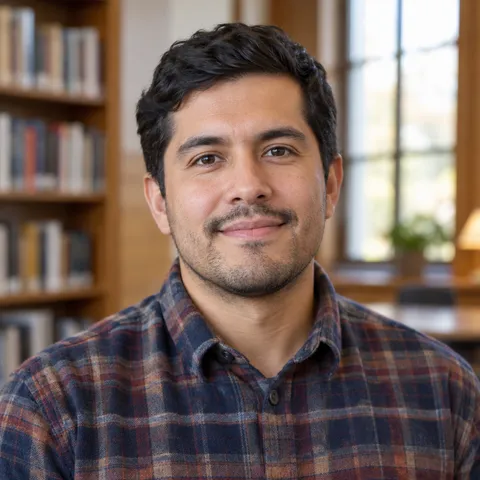
Dr. Tomás Rivera
Assistant Professor of Computer Science
Instructor for DS 210, Fall 2026
- Office
- Ashby Hall 215
- trivera
@university.alkimi.ai
DS 210 · Data Science
Ethical, legal, and social dimensions of data collection, algorithmic decision-making, and artificial intelligence, with emphasis on algorithmic bias, data privacy, surveillance capitalism, and governance frameworks. Examination of technical choices, normative values, and societal impacts through philosophical analysis and practical case studies.
Fall 2026 · At a glance
200-level courses: intermediate, lower-division courses suitable for sophomores and above. Details: Undergraduate Catalog §9.5.
Assistant Professor of Computer Science
Instructor for DS 210, Fall 2026
Questions about a major or your plan: Academic Advising Center, Lovell Hall 101, (555) 555-0158.
Class meetings
Tue & Thu, 1:00–2:15 p.m.
Ashby Hall 220
Final exam
No exam in the finals period. The final project deadline is listed under key dates.
Office hours
Mon & Wed, 3:30–5:00 p.m.
Ashby Hall 215
Fri, 10:00–11:00 a.m.
Virtual (Zoom link in Canvas)
You may use generative AI tools to assist in debugging Python auditing scripts, explore alternative formulations of statistical fairness definitions, and brainstorm potential edge cases for algorithmic impact evaluations. You may not use generative AI to write case study analyses, generate fictional audit data, synthesize policy briefs, or complete midterm examination questions.
From the syllabus
Grading
Letter grades follow the university scale (Student Handbook §4.1).
Key dates
First day of classes Past
Midterm Examination Next
Algorithmic Impact Capstone Project
Required materials
Solon Barocas, Moritz Hardt, and Arvind Narayanan. Fairness and Machine Learning: Limitations and Opportunities. MIT Press, 2023.
Free digital open access at fairmlbook.org; optional print edition approx. $35.
Alkimi Data Ethics Coursepack: Classic Articles, Legal Statutes, and Sociotechnical Case Studies.
Free digital access provided via Canvas.
Degree planning
What to take first, what this course opens up, and the requirements it can satisfy, from the Undergraduate Catalog.
Catalog wording: CS 150 or sophomore standing. PHIL 305 recommended.
Every course also counts toward the 120 credits needed for a bachelor's degree. Confirm your plan with your advisor or the Academic Advising Center.
No AP exam awards credit for DS 210 (Undergraduate Catalog §3.11).
Registration
DS 210 is offered in the fall semester. Register through AlkimiHub self-service registration, which opens by credit standing. Until the add deadline, you don't need instructor permission as long as seats remain and you've met the prerequisites. Details: Student Handbook §3.3.
When a seat opens, AlkimiHub offers it to the first student on the waitlist and emails you. You have 24 hours to claim it before it goes to the next student. Details: Student Handbook §3.10.
Fall 2026 withdrawal deadline
Last day to withdraw with a W or elect Pass/No Pass.
Fall 2027 registration opens
By credit standing, in AlkimiHub.
The Fall 2026 add deadline passed on Sep 2, 2026.
All dates: academic calendar. Registration help: Office of the Registrar.
Official course syllabus
The syllabus as filed with the department and posted in Canvas for Fall 2026.
Term: Fall 2026
Credits: 3.0
Lecture Times & Location: Tuesday & Thursday 1:00–2:15 p.m., Ashby Hall 220
Modality: In-Person
trivera@university.alkimi.ai
Ethical, legal, and social dimensions of data collection, algorithmic decision-making, and artificial intelligence, with emphasis on algorithmic bias, data privacy, surveillance capitalism, and governance frameworks. Examination of technical choices, normative values, and societal impacts through philosophical analysis and practical case studies. DS 210 provides an interdisciplinary investigation into the ethical, legal, and social dimensions of data collection, algorithmic decision-making, and artificial intelligence. Expanding upon introductory programming and analytical concepts, students examine how technical choices in data curation, objective formulation, and model deployment embody normative values and generate disparate impacts across marginalized populations. Through rigorous philosophical critique, quantitative fairness auditing, and authentic case studies, students evaluate surveillance capitalism, intellectual property in foundation models, and emerging regulatory governance frameworks.
CS 150 or sophomore standing. PHIL 305 recommended.
Upon successful completion of DS 210, students will be able to:
In accordance with Alkimi University Academic Policies (Student Handbook §5.8), DS 210 operates under AI Level 2.
| Week | Dates | Topics & Readings | Assignments & Deadlines |
|---|---|---|---|
| Week 1 | Aug 27 | The Sociotechnical Perspective and Ethical Foundations: Introduction to sociotechnical systems, normative values embedded in code, and the moral responsibilities of data scientists and software engineers. Reading: Barocas et al., Ch. 1; Shannon Vallor, *Technology and the Virtues (excerpt)* | First day of classes: Wed Aug 26. |
| Week 2 | Sep 1, 3 | Philosophical Frameworks: Deontology, Consequentialism, and Justice: Utilitarianism, deontology (Kant), virtue ethics, and John Rawls's theory of justice as fairness applied to automated decision systems. Reading: Alkimi Coursepack: Ethical Theories Primer; Michael Sandel, *Justice (excerpt)* | Wed Sep 2: Add/section change deadline. |
| Week 3 | Sep 8, 10 | Statistical Fairness Criteria: Definitions and Measures: Defining and calculating group fairness metrics: demographic parity, equal opportunity, equalized odds, and predictive value parity. Reading: Barocas et al., Ch. 2; Case Study 1 Assigned | Mon Sep 7: Labor Day (no classes). Wed Sep 9: Census date (last day to drop without a W). |
| Week 4 | Sep 15, 17 | Impossibility Theorems and Inherent Fairness Tradeoffs: Kleinberg's impossibility theorem, Chouldechova's proof, and the mathematical and philosophical incompatibilities among fairness criteria. Reading: Barocas et al., Ch. 3; Kleinberg et al. (2016) | — |
| Week 5 | Sep 22, 24 | Criminal Justice and Risk Assessment: The COMPAS Case: Analysis of COMPAS and predictive recidivism algorithms; racial disparity, feedback loops, and judicial discretion. Reading: Angwin et al. (ProPublica, 2016); Flores et al. (2016); Bias Audit 1 Assigned | — |
| Week 6 | Sep 29, Oct 1 | Automated Hiring, Lending, and Disparate Impact: Credit scoring algorithms, resume screening, natural language bias in recruiting, and disparate impact under US civil rights law. Reading: Barocas et al., Ch. 4; O'Neil, *Weapons of Math Destruction (Ch. 8)* | — |
| Week 7 | Oct 6, 8 | Healthcare Diagnostics, Triage, and Proxy Variables: Algorithmic triage in commercial healthcare, racially biased proxy variables, and health equity in diagnostic AI models. Reading: Obermeyer et al. (Science, 2019); Case Study 2 Assigned | — |
| Week 8 | Oct 15 | Midterm Examination and Synthesis (Fall Break Week): Comprehensive conceptual review of weeks 1–7 followed by in-class midterm examination covering philosophical theories, fairness metrics, and legal cases. Reading: Study guide and review materials; Midterm Examination in class | Oct 12–Oct 13: Fall break (no classes). Fri Oct 16: Midterm grades due. Midterm Examination (in class). |
| Week 9 | Oct 20, 22 | Data Privacy: Re-identification, Linkage Attacks, and k-Anonymity: De-identification, linkage attacks, the Latanya Sweeney medical record study, k-anonymity, l-diversity, and t-closeness. Reading: Barocas et al., Ch. 5; Sweeney (2002); Bias Audit 2 Assigned | — |
| Week 10 | Oct 27, 29 | Differential Privacy and Privacy-Preserving Analytics: Formal mathematical definitions of differential privacy, privacy budgets (epsilon), randomized response, and the 2020 US Census implementation. Reading: Dwork & Roth (2014, excerpts); Abowd (2018) | — |
| Week 11 | Nov 3, 5 | Surveillance Capitalism and Behavioral Data Harvesting: The extraction of behavioral surplus, targeted advertising ecosystems, data broker pipelines, and smart device telemetry. Reading: Shoshana Zuboff, *The Age of Surveillance Capitalism (Ch. 1–3); Case Study 3 Assigned* | Fri Nov 6: Last day to withdraw (W) or elect Pass/No Pass. |
| Week 12 | Nov 10, 12 | Facial Recognition, Biometrics, and Civil Liberties: Biometric surveillance, error disparities across race and gender in computer vision, spatial tracking, and Fourth Amendment jurisprudence. Reading: Buolamwini & Gebru (Gender Shades, 2018); Joy Buolamwini, *Unmasking AI* | — |
| Week 13 | Nov 17, 19 | Generative AI, Web Scraping, and Intellectual Property: Large language models, web scraping without consent, copyright lawsuits, hallucination, and intellectual property claims in generative AI. Reading: Bender et al. (Stochastic Parrots, 2021); Bias Audit 3 Assigned | — |
| Week 14 | Nov 24 | Labor Exploitation and Environmental Costs of AI (Thanksgiving Week): Global ghost work, data labeling annotation sweatshops, energy consumption of training runs, and water cooling demands of data centers. Reading: Gray & Suri, *Ghost Work (Ch. 2); Kate Crawford, Atlas of AI (Ch. 1–2)* | Nov 25–Nov 27: Thanksgiving break (no classes). |
| Week 15 | Dec 1, 3 | Algorithmic Governance, Auditing Standards, and Regulatory Policy: The European Union AI Act risk tiers, FTC enforcement actions against algorithmic deception, and algorithmic impact assessment frameworks. Reading: EU AI Act summary; NIST AI Risk Management Framework; Case Study 4 Assigned | — |
| Week 16 | Dec 8 | Professional Responsibility, Whistleblowing, and Capstone Synthesis: Technical whistleblowing, worker organizing, professional codes of ethics (ACM/IEEE), and student presentation of capstone audit findings. Reading: ACM Code of Ethics; Capstone Project due during finals period | Wed Dec 9: Last day of classes. Thu Dec 10: Reading Day. |
| Finals | Dec 14 | Algorithmic Impact Capstone Project due by the end of the scheduled final exam period, Monday, December 14, 2026, 1:00–3:00 p.m. | No final examination. |
Because DS 210 functions as an interdisciplinary seminar and hands-on case discussion, regular and punctual attendance is essential. You are permitted two unexcused absences during the semester without academic penalty. Each additional unexcused absence will reduce your final course grade by one third of a letter grade. Missing more than five class sessions will result in an automatic failing grade for the course. Students who miss the first two class meetings without notifying the instructor may be dropped. Students may miss class for religious observance without penalty if they notify the instructor in writing within the first two weeks of the semester (by Wednesday, September 9, 2026). Absences for university-sponsored activities (athletics, performances, conferences) are excused with a letter from the sponsoring office at least one week in advance.
Written case analyses and auditing notebook projects lose 10% per calendar day overdue and will not be accepted after three days past the deadline. In-class exercises and examinations cannot be submitted late without advance written approval for an excused absence.
DS 210 has no final examination. The algorithmic impact capstone project takes its place. Nothing is due on Reading Day (Thursday, December 10, 2026).
Alkimi University is an academic community devoted to rigorous scholarship, open intellectual inquiry, and uncompromising ethical conduct. All students are subject to the regulations of the Alkimi University Academic Integrity Policy. Academic dishonesty—including plagiarism, cheating on examinations, unauthorized collaboration, fabrication of empirical data, and unauthorized submission of academic work generated by artificial intelligence—undermines the integrity of the university and carries severe disciplinary sanctions. Sanctions range from a failing grade on an assignment or exam to an administrative course failure recorded as an 'XF' on the official transcript, academic suspension, or expulsion. Suspected violations are formally investigated and resolved through the Office of Academic Integrity in accordance with Faculty Handbook §6. For detailed information, consult the Office of Academic Integrity, Lovell Hall 315, (555) 555-0163, integrity@university.alkimi.ai.
Alkimi University is committed to providing equitable educational access and reasonable accommodations for all students with documented disabilities, including physical, sensory, psychological, learning, and chronic health conditions. Students requesting academic accommodations must formally register with the Office of Accessibility Services, Harlan Hall 204, (555) 555-0155, access@university.alkimi.ai. Once approved, students will receive an official Faculty Accommodation Letter detailing approved accommodations. Students should present this letter to the instructor as early in the semester as possible, and at least one week prior to any exam or assignment requiring accommodation. Accommodations cannot be applied retroactively.
Your physical health, psychological well-being, and mental health are essential to your academic success. If you experience heightened stress, anxiety, depressive symptoms, personal trauma, or academic burnout, free, confidential counseling and medical care are available through the Hollis Health & Counseling Center, located in the Hollis Center. Routine appointments are available Monday–Friday 8:00 a.m.–6:00 p.m. and Saturday 10:00 a.m.–2:00 p.m. during the semester by calling (555) 555-0190 or emailing health@university.alkimi.ai. Urgent, 24/7 crisis psychological counseling is accessible immediately at (555) 555-0199.
advising@university.alkimi.ai
askalibrarian@university.alkimi.ai
health@university.alkimi.ai
DATA, DS courses