

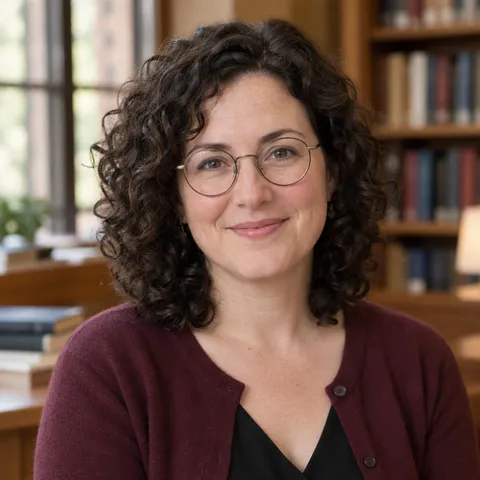
Dr. Miriam Adler
Assistant Professor of Philosophy
Instructor for PHIL 210, Fall 2026
- Office
- Lovell Hall 244
- madler
@university.alkimi.ai
PHIL 210 · Philosophy
The Presocratics, Plato, Aristotle, Hellenistic schools, Augustine, and Aquinas, examining metaphysics, ethics, and the relationship between faith and reason.
Fall 2026 · At a glance
200-level courses: intermediate, lower-division courses suitable for sophomores and above. Details: Undergraduate Catalog §9.15.
Assistant Professor of Philosophy
Instructor for PHIL 210, Fall 2026
Questions about a major or your plan: Academic Advising Center, Lovell Hall 101, (555) 555-0158.
Class meetings
Tue & Thu, 11:00 a.m.–12:15 p.m.
Lovell Hall 140
Final exam
Wednesday, December 16, 2026
1:30–3:30 p.m., Lovell Hall 140
Office hours
Tue & Thu, 3:30–5:00 p.m.
Lovell Hall 244
Mon, 4:00–5:00 p.m.
Virtual (Zoom link in Canvas)
You may use generative AI tools to look up Greek and Latin etymologies of philosophical terms or review historical chronological timelines of the ancient Mediterranean. You may not use generative AI to write close textual analyses, compose thesis statements, draft paper paragraphs, or answer examination essay questions.
From the syllabus
Grading
Letter grades follow the university scale (Student Handbook §4.1).
Key dates
First day of classes Past
Textual Analysis Paper 1: Ancient Metaphysics Past
Midterm Examination Next
Research Essay 2: Medieval Faith and Reason
Required materials
Forrest E. Baird, ed. Philosophic Classics, Volume I: Ancient Philosophy. 6th ed., Routledge, 2010.
Approx. $40 print purchase.
Forrest E. Baird, ed. Philosophic Classics, Volume II: Medieval Philosophy. 6th ed., Routledge, 2010.
Approx. $35 print purchase.
Degree planning
What to take first, what this course opens up, and the requirements it can satisfy, from the Undergraduate Catalog.
Catalog wording: PHIL 101.
Every course also counts toward the 120 credits needed for a bachelor's degree. Confirm your plan with your advisor or the Academic Advising Center.
No AP exam awards credit for PHIL 210 (Undergraduate Catalog §3.11).
Registration
PHIL 210 is offered in the fall semester. Register through AlkimiHub self-service registration, which opens by credit standing. Until the add deadline, you don't need instructor permission as long as seats remain and you've met the prerequisites. Details: Student Handbook §3.3.
When a seat opens, AlkimiHub offers it to the first student on the waitlist and emails you. You have 24 hours to claim it before it goes to the next student. Details: Student Handbook §3.10.
Fall 2026 withdrawal deadline
Last day to withdraw with a W or elect Pass/No Pass.
Fall 2027 registration opens
By credit standing, in AlkimiHub.
The Fall 2026 add deadline passed on Sep 2, 2026.
All dates: academic calendar. Registration help: Office of the Registrar.
Official course syllabus
The syllabus as filed with the department and posted in Canvas for Fall 2026.
Term: Fall 2026
Credits: 3.0
Lecture Times & Location: Tuesday & Thursday 11:00 a.m.–12:15 p.m., Lovell Hall 140
Modality: In-Person
madler@university.alkimi.ai
The Presocratics, Plato, Aristotle, Hellenistic schools, Augustine, and Aquinas, examining metaphysics, ethics, and the relationship between faith and reason. PHIL 210 surveys the development of classical Western philosophical thought from the Presocratic inquiries into the fundamental nature of the cosmos through the Hellenistic schools and the Christian, Islamic, and Jewish scholastic syntheses of the High Middle Ages. Students engage deeply with primary texts from Plato, Aristotle, Epicurus, the Stoics, Augustine of Hippo, and Thomas Aquinas. The course investigates enduring questions concerning metaphysics, teleology, epistemic certainty, human flourishing (eudaimonia), the problem of evil, and the profound reconciliation of faith with classical philosophical reason.
PHIL 101.
Upon successful completion of PHIL 210, students will be able to:
In accordance with Alkimi University Academic Policies (Student Handbook §5.8), PHIL 210 operates under AI Level 1.
| Week | Dates | Topics & Readings | Assignments & Deadlines |
|---|---|---|---|
| Week 1 | Aug 27 | The Presocratics: Arche, Flux, and Being: From mythos to logos; Milesian natural philosophy (Thales, Anaximander), Heraclitus on flux and logos, and Parmenides' radical monism of Being. Reading: Baird, Vol. I, pp. 1–35 | First day of classes: Wed Aug 26. |
| Week 2 | Sep 1, 3 | Socrates and the Early Platonic Dialogues: The Socratic quest for definitions, piety, and virtue; elenchus and aporia in Plato's Euthyphro and Meno. Reading: Baird, Vol. I, pp. 36–85 | Wed Sep 2: Add/section change deadline. |
| Week 3 | Sep 8, 10 | Plato's Metaphysics: The Theory of Forms: The Theory of Forms, the Sun analogy, the Divided Line, and the dialectic of knowledge in Plato's Republic (Books V–VI). Reading: Baird, Vol. I, pp. 150–195 | Mon Sep 7: Labor Day (no classes). Wed Sep 9: Census date (last day to drop without a W). |
| Week 4 | Sep 15, 17 | Plato's Epistemology and Political Philosophy: The Allegory of the Cave, the education of the philosopher-king, the tripartition of the soul, and justice in the Republic (Books VII–VIII). Reading: Baird, Vol. I, pp. 196–240 | — |
| Week 5 | Sep 22, 24 | Aristotle: Substance, Categories, and Hylomorphism: Aristotle's Categories, critique of separate Forms, substance (ousia), matter and form (hylomorphism); Paper 1 due Friday. Reading: Baird, Vol. I, pp. 280–320 | Textual Analysis Paper 1: Ancient Metaphysics due Fri Sep 25 at 11:59 p.m. |
| Week 6 | Sep 29, Oct 1 | Aristotle's Physics, Metaphysics, and the Prime Mover: Aristotle's Physics and Metaphysics: the Four Causes, change, potentiality and actuality (dynamis and energeia), and the Unmoved Mover. Reading: Baird, Vol. I, pp. 321–365 | — |
| Week 7 | Oct 6, 8 | Aristotelian Ethics, Virtue, and Midterm Exam: Aristotle's Nicomachean Ethics: eudaimonia, the function argument, moral and intellectual virtue, the doctrine of the mean; Midterm Exam in class. Reading: Baird, Vol. I, pp. 366–410 | Midterm Examination (in class). |
| Week 8 | Oct 15 | Hellenistic Philosophy: Epicurean Hedonism (Fall Break Week): Epicureanism: material atomism, the swerve, mortal soul, natural and necessary desires, and tranquil mind (ataraxia) (Fall Break week). Reading: Baird, Vol. I, pp. 450–485 | Oct 12–Oct 13: Fall break (no classes). Fri Oct 16: Midterm grades due. |
| Week 9 | Oct 20, 22 | Hellenistic Stoicism and Virtue as Self-Sufficiency: Early and late Stoicism (Epictetus, Marcus Aurelius): cosmic providence, the ruling center, living according to nature, and the passions. Reading: Baird, Vol. I, pp. 486–530 | — |
| Week 10 | Oct 27, 29 | Pyrrhonian Skepticism and Plotinian Neoplatonism: Pyrrhonian skepticism (Sextus Empiricus), suspension of judgment (epoche), and Plotinian Neoplatonism: the One, Intellect, and Soul. Reading: Baird, Vol. I, pp. 531–570 | — |
| Week 11 | Nov 3, 5 | Augustine: Grace, Free Will, and the Privation of Evil: Augustine of Hippo: Confessions, divine illumination, the nature of time, original sin, and the privation theory of evil. Reading: Baird, Vol. II, pp. 1–55 | Fri Nov 6: Last day to withdraw (W) or elect Pass/No Pass. |
| Week 12 | Nov 10, 12 | Boethius, Providence, and Apophatic Theology: Early medieval thought: Boethius's Consolation of Philosophy, divine foreknowledge and human freedom, and Pseudo-Dionysius's apophatic theology. Reading: Baird, Vol. II, pp. 56–105 | — |
| Week 13 | Nov 17, 19 | Islamic and Jewish Scholasticism: Averroes and Maimonides: The Arabic and Jewish renaissance of Aristotelianism: Avicenna, Averroes (the double truth debate), and Maimonides; Paper 2 due Friday. Reading: Baird, Vol. II, pp. 150–205 | Research Essay 2: Medieval Faith and Reason due Fri Nov 20 at 11:59 p.m. |
| Week 14 | Nov 24 | Anselm: Faith Seeking Understanding (Thanksgiving Week): Anselm's Proslogion, the ontological argument, Gaunilo's lost island objection, and Anselm's reply (Thanksgiving week). Reading: Baird, Vol. II, pp. 106–145 | Nov 25–Nov 27: Thanksgiving break (no classes). |
| Week 15 | Dec 1, 3 | Thomas Aquinas: The Synthesis of Faith and Reason: Thomas Aquinas: Summa Theologiae, nature and grace, the Five Ways to prove God's existence, analogy, and natural law theory. Reading: Baird, Vol. II, pp. 260–330 | — |
| Week 16 | Dec 8 | Late Medieval Nominalism and Course Synthesis: Late medieval challenges: Duns Scotus, William of Ockham's nominalism, the decline of scholasticism, and comprehensive final review. Reading: Baird, Vol. II, pp. 400–445 and Review | Wed Dec 9: Last day of classes. Thu Dec 10: Reading Day. |
| Finals | Dec 16 | Comprehensive Final Examination: Wednesday, December 16, 2026, 1:30–3:30 p.m., Lovell Hall 140. | Scheduled during the university final examination period in Lovell Hall 140. |
Class discussion in Lovell Hall 140 is the vital core of historical philosophical inquiry. You are expected to attend every session prepared to analyze primary texts. You may take up to two unexcused absences without penalty; subsequent absences lower your final grade by one-third of a letter grade. Missing more than five classes results in a failing grade. Students who miss the first two class meetings without notifying the instructor may be dropped. Students may miss class for religious observance without penalty if they notify the instructor in writing within the first two weeks of the semester (by Wednesday, September 9, 2026). Absences for university-sponsored activities (athletics, performances, conferences) are excused with a letter from the sponsoring office at least one week in advance.
Textual analysis papers submitted late lose one-third of a letter grade per calendar day and will not be accepted after four days past the deadline. Weekly reading reflections must be submitted on time to support class discussion.
The final examination (Wednesday, December 16, 2026, 1:30–3:30 p.m.) is scheduled by the University Registrar and can't be moved without the Dean's written approval (Faculty Handbook §5.5). A student with three or more final exams on the same calendar day may reschedule one of them. Requests go to the instructor of the middle exam by the last day of classes. For this term, send the request by Wednesday, December 9, 2026 (Student Handbook §6.4).
Alkimi University is an academic community devoted to rigorous scholarship, open intellectual inquiry, and uncompromising ethical conduct. All students are subject to the regulations of the Alkimi University Academic Integrity Policy. Academic dishonesty—including plagiarism, cheating on examinations, unauthorized collaboration, fabrication of empirical data, and unauthorized submission of academic work generated by artificial intelligence—undermines the integrity of the university and carries severe disciplinary sanctions. Sanctions range from a failing grade on an assignment or exam to an administrative course failure recorded as an 'XF' on the official transcript, academic suspension, or expulsion. Suspected violations are formally investigated and resolved through the Office of Academic Integrity in accordance with Faculty Handbook §6. For detailed information, consult the Office of Academic Integrity, Lovell Hall 315, (555) 555-0163, integrity@university.alkimi.ai.
Alkimi University is committed to providing equitable educational access and reasonable accommodations for all students with documented disabilities, including physical, sensory, psychological, learning, and chronic health conditions. Students requesting academic accommodations must formally register with the Office of Accessibility Services, Harlan Hall 204, (555) 555-0155, access@university.alkimi.ai. Once approved, students will receive an official Faculty Accommodation Letter detailing approved accommodations. Students should present this letter to the instructor as early in the semester as possible, and at least one week prior to any exam or assignment requiring accommodation. Accommodations cannot be applied retroactively.
Your physical health, psychological well-being, and mental health are essential to your academic success. If you experience heightened stress, anxiety, depressive symptoms, personal trauma, or academic burnout, free, confidential counseling and medical care are available through the Hollis Health & Counseling Center, located in the Hollis Center. Routine appointments are available Monday–Friday 8:00 a.m.–6:00 p.m. and Saturday 10:00 a.m.–2:00 p.m. during the semester by calling (555) 555-0190 or emailing health@university.alkimi.ai. Urgent, 24/7 crisis psychological counseling is accessible immediately at (555) 555-0199.
advising@university.alkimi.ai
askalibrarian@university.alkimi.ai
health@university.alkimi.ai
PHIL courses