
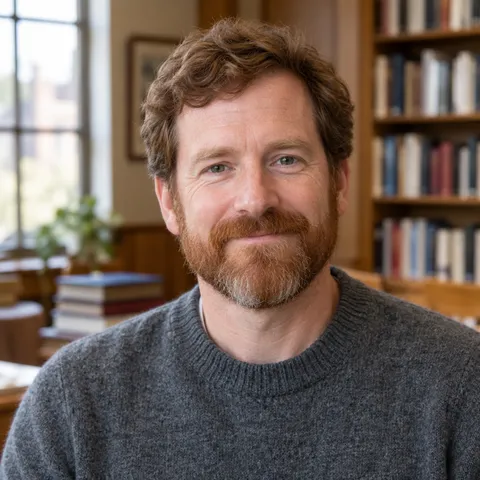
Dr. Brendan Walsh
Associate Professor of Philosophy
Instructor for PHIL 205, Fall 2026 and Spring 2027
- Office
- Lovell Hall 240
- bwalsh
@university.alkimi.ai
PHIL 205 · Philosophy
Argument analysis, informal fallacies, propositional logic, truth tables, natural deduction, and first-order predicate logic, with applications to scientific and legal reasoning.
Fall 2026 · At a glance
200-level courses: intermediate, lower-division courses suitable for sophomores and above. Details: Undergraduate Catalog §9.15.
Associate Professor of Philosophy
Instructor for PHIL 205, Fall 2026 and Spring 2027
Questions about a major or your plan: Academic Advising Center, Lovell Hall 101, (555) 555-0158.
Class meetings
Tue & Thu, 4:00–5:15 p.m.
Lovell Hall 140
Final exam
Thursday, December 17, 2026
3:30–5:30 p.m., Lovell Hall 140
Office hours
Wed & Fri, 10:00–11:30 a.m.
Lovell Hall 240
Thu, 3:00–4:00 p.m.
Virtual (Zoom link in Canvas)
You may use generative AI tools to look up historical definitions of informal logical fallacies or review typographical conventions for formal logic symbols. You may not use generative AI to solve translation problems, construct truth tables, compute natural deduction proofs, or answer examination and quiz questions.
From the syllabus
Grading
Letter grades follow the university scale (Student Handbook §4.1).
Key dates
First day of classes Past
Midterm Examination 1 Past
Midterm Examination 2 Next
Required materials
Patrick J. Hurley and Lori Watson. A Concise Introduction to Logic. 13th ed., Cengage Learning, 2018.
Approx. $55 digital rental, $110 print purchase.
Alkimi Logic Practice Workbook and Proof Verification Tools.
Free digital proof-checking software access on Canvas.
Degree planning
What to take first, what this course opens up, and the requirements it can satisfy, from the Undergraduate Catalog.
No catalog course is required first.
Catalog wording: None.
Every course also counts toward the 120 credits needed for a bachelor's degree. Confirm your plan with your advisor or the Academic Advising Center.
No AP exam awards credit for PHIL 205 (Undergraduate Catalog §3.11).
Registration
None.
PHIL 205 is offered in both the fall and spring semesters. Register through AlkimiHub self-service registration, which opens by credit standing. Until the add deadline, you don't need instructor permission as long as seats remain and you've met the prerequisites. Details: Student Handbook §3.3.
When a seat opens, AlkimiHub offers it to the first student on the waitlist and emails you. You have 24 hours to claim it before it goes to the next student. Details: Student Handbook §3.10.
Spring 2027 registration opens
By credit standing, in AlkimiHub.
Fall 2026 withdrawal deadline
Last day to withdraw with a W or elect Pass/No Pass.
Spring 2027 add deadline
Last day to add a course or change sections (11:59 p.m.).
Fall 2027 registration opens
By credit standing, in AlkimiHub.
The Fall 2026 add deadline passed on Sep 2, 2026.
All dates: academic calendar. Registration help: Office of the Registrar.
Official course syllabus
The syllabus as filed with the department and posted in Canvas for Fall 2026.
Term: Fall 2026
Credits: 3.0
Lecture Times & Location: Tuesday & Thursday 4:00–5:15 p.m., Lovell Hall 140
Modality: In-Person
bwalsh@university.alkimi.ai
Argument analysis, informal fallacies, propositional logic, truth tables, natural deduction, and first-order predicate logic, with applications to scientific and legal reasoning. PHIL 205 provides a rigorous, systematic introduction to symbolic logic, deductive inference, and the formal analysis of reasoning. Students develop proficiency in translating natural language arguments into formal propositional notation, evaluating argument validity through truth tables, and constructing formal syntactic proofs using natural deduction rules. Moving beyond propositional logic, the course covers monadic and polyadic first-order predicate logic with quantifiers, concluding with practical applications to legal evidentiary structures and scientific hypothesis testing.
None.
Upon successful completion of PHIL 205, students will be able to:
In accordance with Alkimi University Academic Policies (Student Handbook §5.8), PHIL 205 operates under AI Level 1.
| Week | Dates | Topics & Readings | Assignments & Deadlines |
|---|---|---|---|
| Week 1 | Aug 27 | Basic Concepts of Logic and Argument Structure: Arguments, premises, and conclusions; identifying indicators; distinguishing deductive arguments from inductive arguments; validity, truth, and soundness. Reading: Hurley & Watson, Ch. 1 (1.1–1.4) | First day of classes: Wed Aug 26. |
| Week 2 | Sep 1, 3 | Argument Diagramming and the Counterexample Method: Inductive strength and cogency; argument diagramming techniques; counterexample method for demonstrating invalidity in natural language. Reading: Hurley & Watson, Ch. 1 (1.5–1.6) | Wed Sep 2: Add/section change deadline. |
| Week 3 | Sep 8, 10 | Informal Fallacies: Fallacies of Relevance: Fallacies of relevance: appeal to force, appeal to pity, appeal to the people, ad hominem, accident, straw man, missing the point, and red herring. Reading: Hurley & Watson, Ch. 3 (3.1–3.2) | Mon Sep 7: Labor Day (no classes). Wed Sep 9: Census date (last day to drop without a W). |
| Week 4 | Sep 15, 17 | Informal Fallacies: Weak Induction and Ambiguity: Fallacies of weak induction, presumption, ambiguity, and grammatical analogy (begging the question, false dichotomy, equivocation, amphiboly). Reading: Hurley & Watson, Ch. 3 (3.3–3.5) | — |
| Week 5 | Sep 22, 24 | Propositional Logic: Symbols, Translation, and Midterm 1: Logical operators, negation, conjunction, disjunction, material implication, biconditional; translation from English; Midterm Examination 1 in class. Reading: Hurley & Watson, Ch. 6 (6.1–6.2) | Midterm Examination 1 (in class). |
| Week 6 | Sep 29, Oct 1 | Truth Tables for Propositions and Semantic Equivalences: Computing truth values of compound propositions; constructing truth tables for statements: tautologous, contradictory, and contingent statements. Reading: Hurley & Watson, Ch. 6 (6.3–6.4) | — |
| Week 7 | Oct 6, 8 | Testing Validity with Truth Tables and Indirect Truth Tables: Testing argument validity with truth tables; indirect truth tables for multi-variable arguments; identifying inconsistent premise sets. Reading: Hurley & Watson, Ch. 6 (6.5–6.6) | — |
| Week 8 | Oct 15 | Natural Deduction: Implicational Rules of Inference: Rules of inference: Modus Ponens, Modus Tollens, Pure Hypothetical Syllogism, Disjunctive Syllogism, Constructive Dilemma (Fall Break week). Reading: Hurley & Watson, Ch. 7 (7.1) | Oct 12–Oct 13: Fall break (no classes). Fri Oct 16: Midterm grades due. |
| Week 9 | Oct 20, 22 | Natural Deduction: Equivalence and Replacement Rules: Rules of replacement: De Morgan's laws, commutativity, associativity, distributivity, double negation, contraposition, material implication. Reading: Hurley & Watson, Ch. 7 (7.2–7.4) | — |
| Week 10 | Oct 27, 29 | Conditional Proof, Indirect Proof, and Midterm Exam 2: Conditional proof (CP) and indirect proof (IP); subproof notation; discharging assumptions; Midterm Examination 2 in class. Reading: Hurley & Watson, Ch. 7 (7.5–7.7) | Midterm Examination 2 (in class). |
| Week 11 | Nov 3, 5 | Introduction to First-Order Predicate Logic: Limitations of propositional logic; symbols of predicate logic, individual constants and variables, predicates, and translating categorical statements. Reading: Hurley & Watson, Ch. 8 (8.1) | Fri Nov 6: Last day to withdraw (W) or elect Pass/No Pass. |
| Week 12 | Nov 10, 12 | Quantification and Categorical Translations: Universal and existential quantifiers, translation of overlapping quantifiers, and formalizing the traditional Square of Opposition. Reading: Hurley & Watson, Ch. 8 (8.2–8.3) | — |
| Week 13 | Nov 17, 19 | Natural Deduction Proofs with Quantifiers: Universal Instantiation (UI), Universal Generalization (UG), Existential Instantiation (EI), and Existential Generalization (EG) rules and restrictions. Reading: Hurley & Watson, Ch. 8 (8.4) | — |
| Week 14 | Nov 24 | Relational Predicates and Multiple Quantifiers: Relational predicates, multiple quantifiers, change of quantifier rules, and conditional proofs in predicate logic (Thanksgiving week). Reading: Hurley & Watson, Ch. 8 (8.5–8.6) | Nov 25–Nov 27: Thanksgiving break (no classes). |
| Week 15 | Dec 1, 3 | Applications to Legal and Scientific Reasoning: Applying formal logic to legal arguments (statutory construction, precedent) and scientific confirmation (hypothetico-deductive model). Reading: Supplementary readings on Canvas | — |
| Week 16 | Dec 8 | Metatheory and Comprehensive Course Review: Soundness and completeness of formal systems, limitations of formalization, Gödel's theorems overview, and final examination review. Reading: Hurley & Watson, Review | Wed Dec 9: Last day of classes. Thu Dec 10: Reading Day. |
| Finals | Dec 17 | Comprehensive Final Examination: Thursday, December 17, 2026, 3:30–5:30 p.m., Lovell Hall 140. | Scheduled during the university final examination period in Lovell Hall 140. |
Mastery of formal symbolic logic requires active, regular in-class practice and guided proof construction in Lovell Hall 140. Attendance is required at all lecture sessions. If you cannot attend due to illness or official university business, contact Dr. Walsh in advance and review the online proof walkthroughs on Canvas. Students who miss the first two class meetings without notifying the instructor may be dropped. Students may miss class for religious observance without penalty if they notify the instructor in writing within the first two weeks of the semester (by Wednesday, September 9, 2026). Absences for university-sponsored activities (athletics, performances, conferences) are excused with a letter from the sponsoring office at least one week in advance.
Weekly formal logic problem sets submitted late lose 10% per calendar day and will not be accepted after three days past the deadline. In-class deduction quizzes cannot be made up unless an excused absence has been approved in writing.
The final examination (Thursday, December 17, 2026, 3:30–5:30 p.m.) is scheduled by the University Registrar and can't be moved without the Dean's written approval (Faculty Handbook §5.5). A student with three or more final exams on the same calendar day may reschedule one of them. Requests go to the instructor of the middle exam by the last day of classes. For this term, send the request by Wednesday, December 9, 2026 (Student Handbook §6.4).
Alkimi University is an academic community devoted to rigorous scholarship, open intellectual inquiry, and uncompromising ethical conduct. All students are subject to the regulations of the Alkimi University Academic Integrity Policy. Academic dishonesty—including plagiarism, cheating on examinations, unauthorized collaboration, fabrication of empirical data, and unauthorized submission of academic work generated by artificial intelligence—undermines the integrity of the university and carries severe disciplinary sanctions. Sanctions range from a failing grade on an assignment or exam to an administrative course failure recorded as an 'XF' on the official transcript, academic suspension, or expulsion. Suspected violations are formally investigated and resolved through the Office of Academic Integrity in accordance with Faculty Handbook §6. For detailed information, consult the Office of Academic Integrity, Lovell Hall 315, (555) 555-0163, integrity@university.alkimi.ai.
Alkimi University is committed to providing equitable educational access and reasonable accommodations for all students with documented disabilities, including physical, sensory, psychological, learning, and chronic health conditions. Students requesting academic accommodations must formally register with the Office of Accessibility Services, Harlan Hall 204, (555) 555-0155, access@university.alkimi.ai. Once approved, students will receive an official Faculty Accommodation Letter detailing approved accommodations. Students should present this letter to the instructor as early in the semester as possible, and at least one week prior to any exam or assignment requiring accommodation. Accommodations cannot be applied retroactively.
Your physical health, psychological well-being, and mental health are essential to your academic success. If you experience heightened stress, anxiety, depressive symptoms, personal trauma, or academic burnout, free, confidential counseling and medical care are available through the Hollis Health & Counseling Center, located in the Hollis Center. Routine appointments are available Monday–Friday 8:00 a.m.–6:00 p.m. and Saturday 10:00 a.m.–2:00 p.m. during the semester by calling (555) 555-0190 or emailing health@university.alkimi.ai. Urgent, 24/7 crisis psychological counseling is accessible immediately at (555) 555-0199.
advising@university.alkimi.ai
askalibrarian@university.alkimi.ai
health@university.alkimi.ai
PHIL courses