
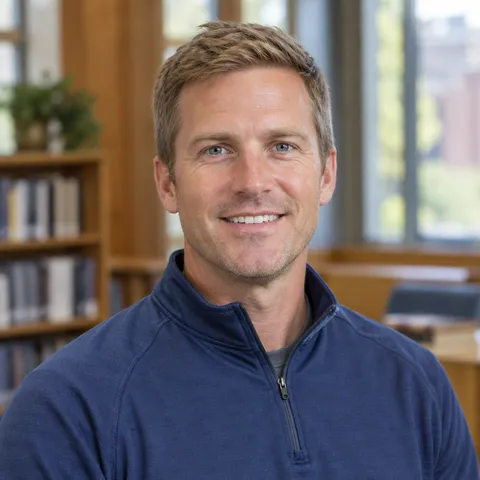
Dr. Tyler Harwood
Assistant Teaching Professor of Kinesiology
Instructor for KINE 410, Fall 2026
- Office
- Calder Health Sciences Building 322
- tharwood
@university.alkimi.ai
KINE 410 · Kinesiology and Nutrition
Exercise testing and training for people with cardiovascular, pulmonary, metabolic, musculoskeletal, and neuromuscular conditions, with case-based practice.
Fall 2026 · At a glance
400-level courses: advanced capstone, senior research, and specialized seminars. Counts toward the 36 upper-division credits every bachelor's degree requires (Undergraduate Catalog §2.3). Details: Undergraduate Catalog §9.24.
Assistant Teaching Professor of Kinesiology
Instructor for KINE 410, Fall 2026
Questions about a major or your plan: Academic Advising Center, Lovell Hall 101, (555) 555-0158.
Class meetings
Tue & Thu, 9:30–10:45 a.m.
Lovell Hall 310
Final exam
Tuesday, December 15, 2026
8:00–10:00 a.m., Lovell Hall 310
Office hours
Tue & Thu, 11:30 a.m.–1:00 p.m.
Calder Health Sciences Building 322
Wed, 10:00–11:00 a.m.
Virtual (Zoom link in Canvas)
You may use generative AI tools to explore broad differential considerations for chronic disease interactions, generate hypothetical physiological symptom timelines, and review draft clinical exercise prescriptions for typographic clarity. You may not use generative AI to interpret clinical electrocardiogram (ECG) rhythm strips, calculate target heart rate intensities for high-risk patients, formulate final clinical exercise prescriptions, or complete examination questions.
From the syllabus
Grading
Letter grades follow the university scale (Student Handbook §4.1).
Key dates
First day of classes Past
Clinical Examination 1 (Cardiovascular & Pulmonary) Next
Cardiac Rehabilitation Case Study & Exercise Prescription
Clinical Examination 2 (Metabolic & Neuromuscular)
Multi-Morbidity Grand Rounds Clinical Project
Required materials
Ehrman, Jonathan K., et al. Clinical Exercise Physiology. 5th ed., Human Kinetics, 2022.
Approx. $105 print, $65 digital rental.
American College of Sports Medicine. ACSM's Guidelines for Exercise Testing and Prescription. 11th ed., Wolters Kluwer, 2021.
Approx. $55 print or digital.
Degree planning
What to take first, what this course opens up, and the requirements it can satisfy, from the Undergraduate Catalog.
No other catalog course lists KINE 410 as a prerequisite.
Every course also counts toward the 120 credits needed for a bachelor's degree. Confirm your plan with your advisor or the Academic Advising Center.
No AP exam awards credit for KINE 410 (Undergraduate Catalog §3.11).
Registration
KINE 410 is offered in the fall semester. Register through AlkimiHub self-service registration, which opens by credit standing. Until the add deadline, you don't need instructor permission as long as seats remain and you've met the prerequisites. Details: Student Handbook §3.3.
When a seat opens, AlkimiHub offers it to the first student on the waitlist and emails you. You have 24 hours to claim it before it goes to the next student. Details: Student Handbook §3.10.
Fall 2026 withdrawal deadline
Last day to withdraw with a W or elect Pass/No Pass.
Fall 2027 registration opens
By credit standing, in AlkimiHub.
The Fall 2026 add deadline passed on Sep 2, 2026.
All dates: academic calendar. Registration help: Office of the Registrar.
Official course syllabus
The syllabus as filed with the department and posted in Canvas for Fall 2026.
Term: Fall 2026
Credits: 3.0
Seminar Times & Location: Tuesday & Thursday 9:30–10:45 a.m., Lovell Hall 310
Modality: In-Person Seminar
tharwood@university.alkimi.ai
Exercise testing and training for people with cardiovascular, pulmonary, metabolic, musculoskeletal, and neuromuscular conditions, with case-based practice. KINE 410 prepares future clinical exercise physiologists to evaluate, test, and prescribe exercise for individuals diagnosed with chronic cardiovascular, pulmonary, metabolic, musculoskeletal, and neuromuscular diseases. Emphasizing clinical decision-making, pathophysiology, and pharmacological interactions, students learn to stratify clinical risk, monitor 12-lead ECG responses during graded exercise testing, and modify exercise prescriptions to optimize functional independence and reduce morbidity. Case-based clinical simulations align with certification standards established by the American College of Sports Medicine (ACSM).
KINE 301 and KINE 330.
Upon successful completion of KINE 410, students will be able to:
In accordance with Alkimi University Academic Policies (Student Handbook §5.8), KINE 410 operates under AI Level 2.
| Week | Dates | Topics & Readings | Assignments & Deadlines |
|---|---|---|---|
| Week 1 | Aug 27 | Scope of Practice and Clinical Pre-Exercise Screening: Role of the clinical exercise physiologist, health history appraisal, risk stratification, and informed consent in clinical populations. Reading: Ehrman et al., Ch. 1; ACSM Guidelines, Ch. 1–2 | First day of classes: Wed Aug 26. |
| Week 2 | Sep 1, 3 | Clinical Electrocardiography and Graded Exercise Testing: 12-lead ECG review, normal and abnormal cardiac rhythms, ST-segment shifts, and indications for terminating exercise testing. Reading: Ehrman et al., Ch. 2; ACSM Guidelines, Ch. 5 | Wed Sep 2: Add/section change deadline. |
| Week 3 | Sep 8, 10 | Atherosclerotic Cardiovascular Disease and Acute Coronary Syndromes: Pathophysiology of myocardial infarction, stable and unstable angina, revascularization procedures (PCI, CABG), and medication effects. Reading: Ehrman et al., Ch. 12 | Mon Sep 7: Labor Day (no classes). Wed Sep 9: Census date (last day to drop without a W). |
| Week 4 | Sep 15, 17 | Cardiac Rehabilitation: Phases I through IV: Inpatient mobilization, outpatient telemetry monitoring, exercise progression, risk factor modification, and secondary prevention. Reading: Ehrman et al., Ch. 13 | — |
| Week 5 | Sep 22, 24 | Heart Failure and Peripheral Artery Disease: Systolic and diastolic heart failure, reduced versus preserved ejection fraction, ventricular assist devices, claudication treadmill protocols. Reading: Ehrman et al., Ch. 14–15 | — |
| Week 6 | Sep 29, Oct 1 | Hypertension and Cardiac Dysrhythmias: Hemodynamic responses to antihypertensive agents (beta blockers, ACE inhibitors), atrial fibrillation, pacemakers, and ICDs; Clinical Examination 1 in class. Reading: Ehrman et al., Ch. 16 | Clinical Examination 1 (Cardiovascular & Pulmonary) (in class). |
| Week 7 | Oct 6, 8 | Chronic Obstructive Pulmonary Disease (COPD): Chronic bronchitis, emphysema, flow-volume loops, dyspnea scales, pursed-lip breathing, and pulmonary rehabilitation programming. Reading: Ehrman et al., Ch. 17 | — |
| Week 8 | Oct 15 | Asthma and Restrictive Lung Diseases: Exercise-induced bronchoconstriction, interstitial lung disease, supplemental oxygen titration, and pulse oximetry monitoring. Reading: Ehrman et al., Ch. 18 | Oct 12–Oct 13: Fall break (no classes). |
| Week 9 | Oct 20, 22 | Diabetes Mellitus and Metabolic Syndrome: Pathophysiology of Type 1 and Type 2 diabetes, insulin dynamics, hypoglycemia prevention, exercise timing, and glycemic control. Reading: Ehrman et al., Ch. 6 | Cardiac Rehabilitation Case Study & Exercise Prescription due Fri Oct 23 at 11:59 p.m. |
| Week 10 | Oct 27, 29 | Obesity and Chronic Kidney Disease: Adiposity-driven inflammation, bariatric surgical considerations, end-stage renal disease, hemodialysis scheduling, and exercise safety. Reading: Ehrman et al., Ch. 7, 9 | — |
| Week 11 | Nov 3, 5 | Cancer and Hematologic Disorders: Exercise oncology guidelines, managing cancer-related fatigue, lymphedema precautions, bone metastases, and chemotherapy cardiotoxicity. Reading: Ehrman et al., Ch. 10 | Fri Nov 6: Last day to withdraw (W) or elect Pass/No Pass. |
| Week 12 | Nov 10, 12 | Musculoskeletal Conditions: Osteoporosis and Arthritis: Bone remodeling under mechanical loading, fracture risk assessment, osteoarthritis, rheumatoid arthritis; Clinical Examination 2 in class. Reading: Ehrman et al., Ch. 21–22 | Clinical Examination 2 (Metabolic & Neuromuscular) (in class). |
| Week 13 | Nov 17, 19 | Neuromuscular Disorders: Stroke and Spinal Cord Injury: Hemiparesis rehabilitation, spasticity, autonomic dysreflexia, functional electrical stimulation, and adaptive equipment. Reading: Ehrman et al., Ch. 23 | Multi-Morbidity Grand Rounds Clinical Project due Fri Nov 20 at 11:59 p.m. |
| Week 14 | Nov 24 | Neurodegenerative Diseases: Parkinson's and Multiple Sclerosis: Tremor, gait freezing, Uhthoff phenomenon in MS, thermoregulatory cooling strategies, and fall prevention balance training. Reading: Ehrman et al., Ch. 24–25 | Nov 25–Nov 27: Thanksgiving break (no classes). |
| Week 15 | Dec 1, 3 | Pediatric and Geriatric Clinical Exercise Considerations: Congenital heart disease, juvenile idiopathic arthritis, frailty syndromes, cognitive decline, and polypharmacy in older adults. Reading: Ehrman et al., Ch. 26 | — |
| Week 16 | Dec 8 | Clinical Grand Rounds and ACSM-CEP Board Review: Interprofessional grand rounds case presentations, transition to clinical practicum, ACSM-CEP examination blueprint synthesis. Reading: Course review packet | Wed Dec 9: Last day of classes. Thu Dec 10: Reading Day. |
| Finals | Dec 15 | Final Comprehensive Clinical Examination: Tuesday, December 15, 2026, 8:00–10:00 a.m., Lovell Hall 310. | Comprehensive examination aligning with ACSM-CEP clinical competency domains. |
Class attendance and active participation in clinical case discussions are mandatory. The seminar format requires collaborative risk analysis, mock clinical patient intakes, and ECG interpretation that depend directly on peer interaction. If you anticipate missing a session due to illness or clinical field interview, notify Dr. Harwood prior to class. Students who miss the first two class meetings without notifying the instructor may be dropped. Students may miss class for religious observance without penalty if they notify the instructor in writing within the first two weeks of the semester (by Wednesday, September 9, 2026). Absences for university-sponsored activities (athletics, performances, conferences) are excused with a letter from the sponsoring office at least one week in advance.
Clinical case assignments submitted after the deadline will be penalized 10% per calendar day for up to 72 hours. Assignments submitted more than three days late will receive a grade of zero. Weekly clinical vignettes must be submitted by the posted Canvas deadline.
In accordance with Department of Kinesiology clinical safety standards, all students enrolled in KINE 410 must possess current American Heart Association (AHA) or American Red Cross Basic Life Support (BLS) CPR and AED certification.
Course assessments are structured around the clinical exercise physiology performance domains of the American College of Sports Medicine. Students must earn a grade of C or higher to satisfy requirements for the Kinesiology BS degree.
The final examination (Tuesday, December 15, 2026, 8:00–10:00 a.m.) is scheduled by the University Registrar and can't be moved without the Dean's written approval (Faculty Handbook §5.5). A student with three or more final exams on the same calendar day may reschedule one of them. Requests go to the instructor of the middle exam by the last day of classes. For this term, send the request by Wednesday, December 9, 2026 (Student Handbook §6.4).
Alkimi University is an academic community devoted to rigorous scholarship, open intellectual inquiry, and uncompromising ethical conduct. All students are subject to the regulations of the Alkimi University Academic Integrity Policy. Academic dishonesty—including plagiarism, cheating on examinations, unauthorized collaboration, fabrication of empirical data, and unauthorized submission of academic work generated by artificial intelligence—undermines the integrity of the university and carries severe disciplinary sanctions. Sanctions range from a failing grade on an assignment or exam to an administrative course failure recorded as an 'XF' on the official transcript, academic suspension, or expulsion. Suspected violations are formally investigated and resolved through the Office of Academic Integrity in accordance with Faculty Handbook §6. For detailed information, consult the Office of Academic Integrity, Lovell Hall 315, (555) 555-0163, integrity@university.alkimi.ai.
Alkimi University is committed to providing equitable educational access and reasonable accommodations for all students with documented disabilities, including physical, sensory, psychological, learning, and chronic health conditions. Students requesting academic accommodations must formally register with the Office of Accessibility Services, Harlan Hall 204, (555) 555-0155, access@university.alkimi.ai. Once approved, students will receive an official Faculty Accommodation Letter detailing approved accommodations. Students should present this letter to the instructor as early in the semester as possible, and at least one week prior to any exam or assignment requiring accommodation. Accommodations cannot be applied retroactively.
Your physical health, psychological well-being, and mental health are essential to your academic success. If you experience heightened stress, anxiety, depressive symptoms, personal trauma, or academic burnout, free, confidential counseling and medical care are available through the Hollis Health & Counseling Center, located in the Hollis Center. Routine appointments are available Monday–Friday 8:00 a.m.–6:00 p.m. and Saturday 10:00 a.m.–2:00 p.m. during the semester by calling (555) 555-0190 or emailing health@university.alkimi.ai. Urgent, 24/7 crisis psychological counseling is accessible immediately at (555) 555-0199.
advising@university.alkimi.ai
askalibrarian@university.alkimi.ai
health@university.alkimi.ai
KINE, NUTR courses