
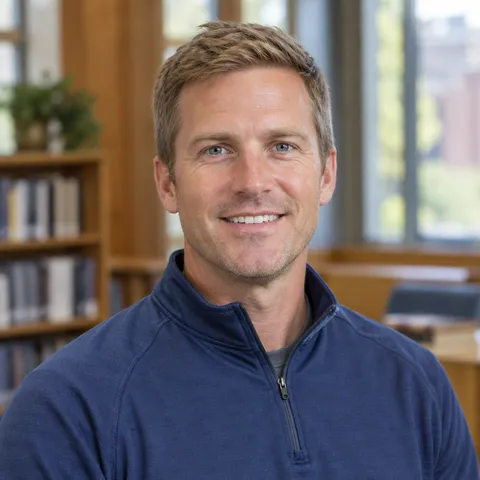
Dr. Tyler Harwood
Assistant Teaching Professor of Kinesiology
Instructor for KINE 201, Fall 2026
- Office
- Calder Health Sciences Building 322
- tharwood
@university.alkimi.ai
KINE 201 · Kinesiology and Nutrition
The skeletal, articular, and muscular systems and their roles in human movement, joint mechanics, and movement analysis, with a weekly three-hour laboratory in palpation and anatomical models.
Fall 2026 · At a glance
200-level courses: intermediate, lower-division courses suitable for sophomores and above. Details: Undergraduate Catalog §9.24.
Assistant Teaching Professor of Kinesiology
Instructor for KINE 201, Fall 2026
Questions about a major or your plan: Academic Advising Center, Lovell Hall 101, (555) 555-0158.
Class meetings
Lecture
Mon, Wed, Fri, 3:00–3:50 p.m.
Calder Health Sciences Building 150
Lab
Tue, 1:00–3:50 p.m.
Calder Health Sciences Building 130
Final exam
Wednesday, December 16, 2026
11:30 a.m.–1:30 p.m., Calder Health Sciences Building 150
Office hours
Tue & Thu, 11:30 a.m.–1:00 p.m.
Calder Health Sciences Building 322
Wed, 10:00–11:00 a.m.
Virtual (Zoom link in Canvas)
You may use generative AI tools to generate anatomical study questions, clarify joint motion terminology, explain biomechanical lever mechanics, and review draft text of your movement analysis project for clarity and grammar. You may not use generative AI during laboratory practical examinations, nor may you use AI to fabricate palpation observations, generate joint kinematic calculations, or complete weekly anatomy quizzes.
From the syllabus
Grading
Letter grades follow the university scale (Student Handbook §4.1).
Key dates
First day of classes Past
Lecture Examination 1 Past
Laboratory Practical 1 (Osteology and Upper Extremity Palpation) Next
Lecture Examination 2
Qualitative Movement Analysis Project
Laboratory Practical 2 (Lower Extremity, Trunk, and Movement Analysis)
Required materials
Floyd, R. T. Manual of Structural Kinesiology. 21st ed., McGraw Hill, 2021.
Approx. $90 print, $55 digital rental.
Biel, Andrew. Trail Guide to the Body: How to Locate Muscles, Bones and More. 6th ed., Books of Discovery, 2019.
Approx. $65 print.
KINE 201 Laboratory Manual: Palpation, Articular Mechanics, and Movement Analysis. Alkimi University Copy Center, 2026.
Approx. $20.
Degree planning
What to take first, what this course opens up, and the requirements it can satisfy, from the Undergraduate Catalog.
Catalog wording: BIO 101.
Every course also counts toward the 120 credits needed for a bachelor's degree. Confirm your plan with your advisor or the Academic Advising Center.
No AP exam awards credit for KINE 201 (Undergraduate Catalog §3.11).
Registration
KINE 201 is offered in the fall semester. Register through AlkimiHub self-service registration, which opens by credit standing. Until the add deadline, you don't need instructor permission as long as seats remain and you've met the prerequisites. Details: Student Handbook §3.3.
When a seat opens, AlkimiHub offers it to the first student on the waitlist and emails you. You have 24 hours to claim it before it goes to the next student. Details: Student Handbook §3.10.
Fall 2026 withdrawal deadline
Last day to withdraw with a W or elect Pass/No Pass.
Fall 2027 registration opens
By credit standing, in AlkimiHub.
The Fall 2026 add deadline passed on Sep 2, 2026.
All dates: academic calendar. Registration help: Office of the Registrar.
Official course syllabus
The syllabus as filed with the department and posted in Canvas for Fall 2026.
Term: Fall 2026
Credits: 4.0
Lecture Times & Location: Monday, Wednesday, Friday 3:00–3:50 p.m., Calder Health Sciences Building 150
Laboratory Time & Location: Tuesday 1:00–3:50 p.m., Calder Health Sciences Building 130
Modality: In-Person Lecture and Laboratory
tharwood@university.alkimi.ai
The skeletal, articular, and muscular systems and their roles in human movement, joint mechanics, and movement analysis, with a weekly three-hour laboratory in palpation and anatomical models. KINE 201 bridges structural anatomy and the mechanical analysis of human motion. Students examine the osteology, articular structures, and neuromuscular architecture of the upper extremity, lower extremity, spine, and pelvis. Through weekly laboratory sessions in palpation, surface anatomy, and anatomical models, students learn to identify bony landmarks, trace muscle origins and insertions, determine planes and axes of motion, and diagnose functional movement patterns and muscular imbalances.
BIO 101.
Upon successful completion of KINE 201, students will be able to:
In accordance with Alkimi University Academic Policies (Student Handbook §5.8), KINE 201 operates under AI Level 2.
| Week | Dates | Topics & Readings | Laboratory | Assignments & Deadlines |
|---|---|---|---|---|
| Week 1 | Aug 26, 28 | Foundations of Structural Kinesiology: Anatomical reference positions, directional terms, planes and axes of motion, and classifications of movement. Reading: Floyd, Ch. 1 | No lab meetings this week. | First day of classes: Wed Aug 26. |
| Week 2 | Aug 31–Sep 4 | Neuromuscular Fundamentals and Lever Systems: Skeletal muscle architecture, contraction types, length-tension relationships, and first-, second-, and third-class mechanical levers. Reading: Floyd, Ch. 2–3 | Lab 1: Skeletal Landmarks, Movement Planes, and Lever Mechanics | Wed Sep 2: Add/section change deadline. |
| Week 3 | Sep 9, 11 | The Shoulder Girdle: Sternoclavicular, acromioclavicular, and scapulothoracic joints; scapular movements and stabilizing musculature. Reading: Floyd, Ch. 4; Biel, Ch. 2 | Lab 2: Scapulothoracic Osteology and Palpation of Shoulder Girdle Muscles | Mon Sep 7: Labor Day (no classes). Wed Sep 9: Census date (last day to drop without a W). |
| Week 4 | Sep 14–18 | The Glenohumeral Joint: Glenohumeral mechanics, rotator cuff anatomy, scapulohumeral rhythm, and muscle actions in overhead throwing and pushing. Reading: Floyd, Ch. 5; Biel, Ch. 3 | Lab 3: Rotator Cuff Palpation and Glenohumeral Joint Kinematics | — |
| Week 5 | Sep 21–25 | The Elbow and Radioulnar Joints: Hinge mechanics of the elbow, pronation-supination kinetics, flexors, extensors, and valgus stress syndromes; Lecture Examination 1 in class. Reading: Floyd, Ch. 6; Biel, Ch. 4 | Lab 4: Palpation of the Elbow Complex and Forearm Compartments | Lecture Examination 1 (in class). |
| Week 6 | Sep 28–Oct 2 | The Wrist and Hand: Radiocarpal joint, carpal tunnel anatomy, intrinsic versus extrinsic muscles of the hand, and prehension patterns. Reading: Floyd, Ch. 7; Biel, Ch. 4 | Lab 5: Hand/Wrist Palpation and Functional Grip Biomechanics | — |
| Week 7 | Oct 5–9 | Upper Extremity Movement Analysis and Practical 1: Synthesis of upper extremity kinetic chains in push-ups, pull-ups, and throwing motions; Laboratory Practical 1 in lab. Reading: Floyd, Ch. 8 | Lab 6: Laboratory Practical 1 (Osteology and Upper Extremity Palpation) | Laboratory Practical 1 (Osteology and Upper Extremity Palpation) (in lab section). |
| Week 8 | Oct 14, 16 | The Pelvic Girdle and Hip Joint: Pelvic alignment, acetabulofemoral articulation, ligamentous support, and hip flexor/extensor biomechanics. Reading: Floyd, Ch. 9; Biel, Ch. 5 | No lab meetings this week (holiday). | Oct 12–Oct 13: Fall break (no classes). Fri Oct 16: Midterm grades due. |
| Week 9 | Oct 19–23 | Muscles of the Hip and Thigh: Gluteal complex, adductors, hamstrings, quadriceps, and pelvic stability during single-leg stance. Reading: Floyd, Ch. 9; Biel, Ch. 5 | Lab 7: Pelvic Landmarks and Hip Musculature Palpation | — |
| Week 10 | Oct 26–30 | The Knee Joint Complex: Tibiofemoral and patellofemoral mechanics, meniscal roles, cruciate and collateral ligaments, and screw-home mechanism. Reading: Floyd, Ch. 10; Biel, Ch. 6 | Lab 8: Knee Joint Ligamentous Stress Models and Patellofemoral Tracking | — |
| Week 11 | Nov 2–6 | The Ankle and Foot Complex: Talocrural and subtalar joints, arches of the foot, plantar fascia, and triceps surae mechanics; Lecture Examination 2 in class. Reading: Floyd, Ch. 11; Biel, Ch. 7 | Lab 9: Palpation of Lower Leg Compartments, Ankle, and Foot Complex | Fri Nov 6: Last day to withdraw (W) or elect Pass/No Pass. Lecture Examination 2 (in class). |
| Week 12 | Nov 9–13 | The Vertebral Column and Thorax: Cervical, thoracic, and lumbar spine kinetics, intervertebral discs, erector spinae, and spinal stabilizing subsystems. Reading: Floyd, Ch. 12; Biel, Ch. 8 | Lab 10: Palpation of the Spine, Paraspinal Musculature, and Rib Cage | — |
| Week 13 | Nov 16–20 | The Abdominal Wall and Core Stability: Rectus abdominis, obliques, transversus abdominis, intra-abdominal pressure mechanics, and lifting biomechanics. Reading: Floyd, Ch. 12; Biel, Ch. 8 | Lab 11: Core Musculature Assessment and Spinal Loading Models | Qualitative Movement Analysis Project due Fri Nov 20 at 11:59 p.m. |
| Week 14 | Nov 23 | Functional Movement Assessment and Posture: Static postural assessment, plumb line analysis, lower crossed and upper crossed syndromes, and squat mechanics. Reading: Floyd, Ch. 13 | Lab 12: Postural Screening and Squat Movement Analysis | Nov 25–Nov 27: Thanksgiving break (no classes). |
| Week 15 | Nov 30–Dec 4 | Gait Analysis and Practical 2: Phases of the human gait cycle, kinematic events, ground reaction forces, and pathomechanics; Laboratory Practical 2 in lab. Reading: Floyd, Ch. 13 | Lab 13: Laboratory Practical 2 (Lower Extremity, Trunk, and Movement Analysis) | Laboratory Practical 2 (Lower Extremity, Trunk, and Movement Analysis) (in lab section). |
| Week 16 | Dec 7, 9 | Comprehensive Movement Analysis and Exam Review: Integrative movement analysis case studies, clinical applications in rehabilitation, and final exam synthesis. Reading: Course review packet | Lab 14: Capstone Movement Analysis Workshop and Open Practical Review | Wed Dec 9: Last day of classes. Thu Dec 10: Reading Day. |
| Finals | Dec 16 | Final Comprehensive Examination: Wednesday, December 16, 2026, 11:30 a.m.–1:30 p.m., Calder Health Sciences Building 150. | — | Cumulative examination emphasizing muscle origins/insertions, joint kinematics, and functional movement analysis. |
Lecture attendance is expected, and laboratory attendance is mandatory. In the laboratory, you develop palpation skills and hands-on movement assessment techniques with partners and specialized anatomical models. Missed laboratory sessions cannot be replicated outside class. Missing more than two laboratory sessions will result in a failing grade for the course. Students who miss the first two class meetings without notifying the instructor may be dropped. Students may miss class for religious observance without penalty if they notify the instructor in writing within the first two weeks of the semester (by Wednesday, September 9, 2026). Absences for university-sponsored activities (athletics, performances, conferences) are excused with a letter from the sponsoring office at least one week in advance.
Written project reports submitted past the designated due date will be penalized 10% per day for up to three calendar days. After 72 hours, late submissions will receive a grade of zero unless accompanied by documentation from Student Health Services or Academic Advising.
Students must wear appropriate athletic apparel (shorts and T-shirts or tank tops) during laboratory sessions to facilitate palpation of anatomical landmarks. Students are expected to maintain professional conduct, communicate respectfully with peer partners, and respect personal boundaries at all times during surface palpation.
Kinesiology majors must achieve a grade of C or higher in KINE 201 to satisfy degree requirements and advance to KINE 310 Biomechanics. Pass/No Pass grading is not permitted for courses required in the major.
The final examination (Wednesday, December 16, 2026, 11:30 a.m.–1:30 p.m.) is scheduled by the University Registrar and can't be moved without the Dean's written approval (Faculty Handbook §5.5). A student with three or more final exams on the same calendar day may reschedule one of them. Requests go to the instructor of the middle exam by the last day of classes. For this term, send the request by Wednesday, December 9, 2026 (Student Handbook §6.4).
Alkimi University is an academic community devoted to rigorous scholarship, open intellectual inquiry, and uncompromising ethical conduct. All students are subject to the regulations of the Alkimi University Academic Integrity Policy. Academic dishonesty—including plagiarism, cheating on examinations, unauthorized collaboration, fabrication of empirical data, and unauthorized submission of academic work generated by artificial intelligence—undermines the integrity of the university and carries severe disciplinary sanctions. Sanctions range from a failing grade on an assignment or exam to an administrative course failure recorded as an 'XF' on the official transcript, academic suspension, or expulsion. Suspected violations are formally investigated and resolved through the Office of Academic Integrity in accordance with Faculty Handbook §6. For detailed information, consult the Office of Academic Integrity, Lovell Hall 315, (555) 555-0163, integrity@university.alkimi.ai.
Alkimi University is committed to providing equitable educational access and reasonable accommodations for all students with documented disabilities, including physical, sensory, psychological, learning, and chronic health conditions. Students requesting academic accommodations must formally register with the Office of Accessibility Services, Harlan Hall 204, (555) 555-0155, access@university.alkimi.ai. Once approved, students will receive an official Faculty Accommodation Letter detailing approved accommodations. Students should present this letter to the instructor as early in the semester as possible, and at least one week prior to any exam or assignment requiring accommodation. Accommodations cannot be applied retroactively.
Your physical health, psychological well-being, and mental health are essential to your academic success. If you experience heightened stress, anxiety, depressive symptoms, personal trauma, or academic burnout, free, confidential counseling and medical care are available through the Hollis Health & Counseling Center, located in the Hollis Center. Routine appointments are available Monday–Friday 8:00 a.m.–6:00 p.m. and Saturday 10:00 a.m.–2:00 p.m. during the semester by calling (555) 555-0190 or emailing health@university.alkimi.ai. Urgent, 24/7 crisis psychological counseling is accessible immediately at (555) 555-0199.
advising@university.alkimi.ai
askalibrarian@university.alkimi.ai
health@university.alkimi.ai
KINE, NUTR courses