
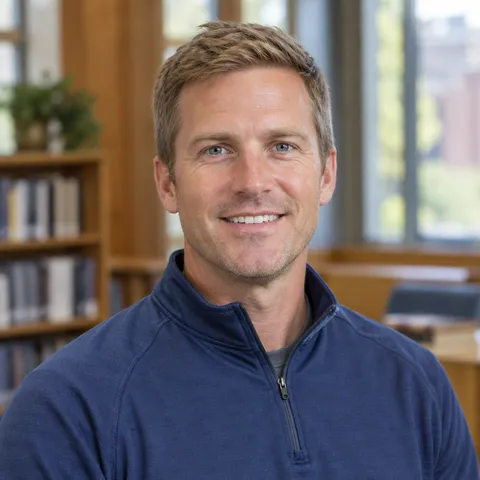
Dr. Tyler Harwood
Assistant Teaching Professor of Kinesiology
Instructor for KINE 101, Fall 2026
- Office
- Calder Health Sciences Building 322
- tharwood
@university.alkimi.ai
KINE 101 · Kinesiology and Nutrition
The subdisciplines of kinesiology, the history and philosophy of physical activity, careers in health and fitness, and physical activity guidelines across the lifespan.
Fall 2026 · At a glance
100-level courses: introductory, lower-division courses primarily for first-year students. Details: Undergraduate Catalog §9.24.
Assistant Teaching Professor of Kinesiology
Instructor for KINE 101, Fall 2026
Questions about a major or your plan: Academic Advising Center, Lovell Hall 101, (555) 555-0158.
Class meetings
Tue & Thu, 4:00–5:15 p.m.
Calder Health Sciences Building 160
Final exam
Thursday, December 17, 2026
3:30–5:30 p.m., Calder Health Sciences Building 160
Office hours
Tue & Thu, 11:30 a.m.–1:00 p.m.
Calder Health Sciences Building 322
Wed, 10:00–11:00 a.m.
Virtual (Zoom link in Canvas)
You may use generative AI tools (such as Alkimi AI or Claude) to brainstorm career interview questions, explore prospective professional certifications, find ideas for physical activity case scenarios, and review your own drafted writing for grammar and conciseness. You may not use generative AI to write draft text or final submissions for the career interview paper, generate case study analyses, or produce responses for exams and quizzes.
From the syllabus
Grading
Letter grades follow the university scale (Student Handbook §4.1).
Key dates
First day of classes Past
Midterm Examination 1 Next
Career Exploration & Professional Interview Paper
Midterm Examination 2
Lifespan Physical Activity Case Analysis
Required materials
Hoffman, Shirl J., and Duane V. Knudson. Introduction to Kinesiology: Studying Physical Activity. 6th ed., Human Kinetics, 2023.
Approx. $85 print, $50 digital rental.
American College of Sports Medicine. ACSM's Guidelines for Exercise Testing and Prescription. 11th ed., Wolters Kluwer, 2021.
Approx. $55 print or digital.
Degree planning
What to take first, what this course opens up, and the requirements it can satisfy, from the Undergraduate Catalog.
No catalog course is required first.
Catalog wording: None.
Every course also counts toward the 120 credits needed for a bachelor's degree. Confirm your plan with your advisor or the Academic Advising Center.
No AP exam awards credit for KINE 101 (Undergraduate Catalog §3.11).
Registration
None.
KINE 101 is offered in the fall semester. Register through AlkimiHub self-service registration, which opens by credit standing. Until the add deadline, you don't need instructor permission as long as seats remain and you've met the prerequisites. Details: Student Handbook §3.3.
When a seat opens, AlkimiHub offers it to the first student on the waitlist and emails you. You have 24 hours to claim it before it goes to the next student. Details: Student Handbook §3.10.
Fall 2026 withdrawal deadline
Last day to withdraw with a W or elect Pass/No Pass.
Fall 2027 registration opens
By credit standing, in AlkimiHub.
The Fall 2026 add deadline passed on Sep 2, 2026.
All dates: academic calendar. Registration help: Office of the Registrar.
Official course syllabus
The syllabus as filed with the department and posted in Canvas for Fall 2026.
Term: Fall 2026
Credits: 3.0
Lecture Times & Location: Tuesday & Thursday 4:00–5:15 p.m., Calder Health Sciences Building 160
Modality: In-Person
tharwood@university.alkimi.ai
The subdisciplines of kinesiology, the history and philosophy of physical activity, careers in health and fitness, and physical activity guidelines across the lifespan. KINE 101 introduces students to the interdisciplinary study of human movement and physical activity. We examine the core subdisciplines—including exercise physiology, biomechanics, motor behavior, and sport psychology—while exploring professional career pathways such as physical therapy, occupational therapy, athletic training, and clinical exercise physiology. Students analyze the evolution of physical activity across cultures and apply evidence-based national physical activity guidelines across the human lifespan to promote health and prevent chronic disease.
None.
Upon successful completion of KINE 101, students will be able to:
In accordance with Alkimi University Academic Policies (Student Handbook §5.8), KINE 101 operates under AI Level 2.
| Week | Dates | Topics & Readings | Assignments & Deadlines |
|---|---|---|---|
| Week 1 | Aug 27 | Welcome to Kinesiology: Course orientation, definitions of physical activity and movement, nature of kinesiology as an academic discipline. Reading: Hoffman & Knudson, Ch. 1 | First day of classes: Wed Aug 26. |
| Week 2 | Sep 1, 3 | Experiencing Physical Activity: Direct participation, subjective experiences of movement, intrinsic and extrinsic values of play and exercise. Reading: Hoffman & Knudson, Ch. 2–3 | Wed Sep 2: Add/section change deadline. |
| Week 3 | Sep 8, 10 | Historical Foundations of Physical Activity: Evolution of physical education, collegiate athletics, modern fitness movements, and the emergence of exercise science. Reading: Hoffman & Knudson, Ch. 4 | Mon Sep 7: Labor Day (no classes). Wed Sep 9: Census date (last day to drop without a W). |
| Week 4 | Sep 15, 17 | Philosophy and Ethics in Physical Activity: Ethical frameworks, sportsmanship, fair play, equity in athletics, and philosophical perspectives on the active human body. Reading: Hoffman & Knudson, Ch. 5 | — |
| Week 5 | Sep 22, 24 | Sociology and Culture of Physical Activity: Social determinants of physical activity, cultural diversity in sport, socioeconomic disparities, and gender equity. Reading: Hoffman & Knudson, Ch. 6 | — |
| Week 6 | Sep 29, Oct 1 | Motor Behavior: Control, Learning, and Development: Foundations of motor skill acquisition, neural control of movement, developmental stages of motor skill; Midterm Examination 1 in class. Reading: Hoffman & Knudson, Ch. 7 | Midterm Examination 1 (in class). |
| Week 7 | Oct 6, 8 | Biomechanics of Human Movement: Basic mechanical principles, levers, balance, forces acting on the musculoskeletal system, and injury prevention mechanisms. Reading: Hoffman & Knudson, Ch. 8 | — |
| Week 8 | Oct 15 | Physiology of Physical Activity: Acute responses and chronic adaptations to cardiovascular and resistance training; bioenergetic energy systems. Reading: Hoffman & Knudson, Ch. 9 | Oct 12–Oct 13: Fall break (no classes). Fri Oct 16: Midterm grades due. |
| Week 9 | Oct 20, 22 | Sport and Exercise Psychology: Motivation, self-efficacy, stress and arousal control, behavior change models, and adherence to physical activity. Reading: Hoffman & Knudson, Ch. 10 | Career Exploration & Professional Interview Paper due Fri Oct 23 at 11:59 p.m. |
| Week 10 | Oct 27, 29 | National Physical Activity Guidelines across the Lifespan: ACSM and federal physical activity recommendations for youth, adults, older adults, and special populations. Reading: ACSM Guidelines, Ch. 1–2 | — |
| Week 11 | Nov 3, 5 | Physical Activity and Chronic Disease Prevention: Role of physical activity in mitigating cardiovascular disease, type 2 diabetes, obesity, metabolic syndrome, and mental health disorders. Reading: ACSM Guidelines, Ch. 3 | Fri Nov 6: Last day to withdraw (W) or elect Pass/No Pass. |
| Week 12 | Nov 10, 12 | Health and Fitness Professions: Personal training, strength and conditioning, wellness coaching, and clinical fitness facility roles; Midterm Examination 2 in class. Reading: Hoffman & Knudson, Ch. 11 | Midterm Examination 2 (in class). |
| Week 13 | Nov 17, 19 | Therapeutic Exercise and Allied Health Pathways: Physical therapy, occupational therapy, athletic training, and clinical exercise physiology scopes of practice and graduate preparation. Reading: Hoffman & Knudson, Ch. 12 | Lifespan Physical Activity Case Analysis due Fri Nov 20 at 11:59 p.m. |
| Week 14 | Nov 24 | Teaching and Coaching Physical Activity: Pedagogical principles, physical education standards, youth sports coaching ethics, and youth athletic development models. Reading: Hoffman & Knudson, Ch. 13 | Nov 25–Nov 27: Thanksgiving break (no classes). |
| Week 15 | Dec 1, 3 | Professional Organizations and Credentialing: Professional credentials (ACSM, NSCA), code of ethics, continuing education, and emerging trends in technology and wearable fitness sensors. Reading: Hoffman & Knudson, Ch. 14 | — |
| Week 16 | Dec 8 | Course Synthesis and Capstone Reflection: Integration of kinesiology subdisciplines, future directions in human movement science, and comprehensive final exam review. Reading: Course review packet | Wed Dec 9: Last day of classes. Thu Dec 10: Reading Day. |
| Finals | Dec 17 | Final Examination: Thursday, December 17, 2026, 3:30–5:30 p.m., Calder Health Sciences Building 160. | Comprehensive exam covering subdisciplines, historical foundations, and lifespan physical activity guidelines. |
Attendance and active participation in lecture sessions are vital for mastering kinesiology foundations and engaging in collaborative case discussions. Students who miss more than three unexcused classes may see their final grade lowered by one letter step. Please inform Dr. Harwood in advance if university athletics or illness causes an unavoidable absence. Students who miss the first two class meetings without notifying the instructor may be dropped. Students may miss class for religious observance without penalty if they notify the instructor in writing within the first two weeks of the semester (by Wednesday, September 9, 2026). Absences for university-sponsored activities (athletics, performances, conferences) are excused with a letter from the sponsoring office at least one week in advance.
Written assignments submitted after the deadline will incur a deduction of 10% per 24-hour period late, up to three calendar days. After 72 hours, late submissions will no longer be accepted without prior documentation from Academic Advising or Student Health Services.
Students are expected to adhere to the university honor code and demonstrate professional etiquette in all communications, peer discussions, and submitted assignments. All work must reflect original student synthesis.
The final examination (Thursday, December 17, 2026, 3:30–5:30 p.m.) is scheduled by the University Registrar and can't be moved without the Dean's written approval (Faculty Handbook §5.5). A student with three or more final exams on the same calendar day may reschedule one of them. Requests go to the instructor of the middle exam by the last day of classes. For this term, send the request by Wednesday, December 9, 2026 (Student Handbook §6.4).
Alkimi University is an academic community devoted to rigorous scholarship, open intellectual inquiry, and uncompromising ethical conduct. All students are subject to the regulations of the Alkimi University Academic Integrity Policy. Academic dishonesty—including plagiarism, cheating on examinations, unauthorized collaboration, fabrication of empirical data, and unauthorized submission of academic work generated by artificial intelligence—undermines the integrity of the university and carries severe disciplinary sanctions. Sanctions range from a failing grade on an assignment or exam to an administrative course failure recorded as an 'XF' on the official transcript, academic suspension, or expulsion. Suspected violations are formally investigated and resolved through the Office of Academic Integrity in accordance with Faculty Handbook §6. For detailed information, consult the Office of Academic Integrity, Lovell Hall 315, (555) 555-0163, integrity@university.alkimi.ai.
Alkimi University is committed to providing equitable educational access and reasonable accommodations for all students with documented disabilities, including physical, sensory, psychological, learning, and chronic health conditions. Students requesting academic accommodations must formally register with the Office of Accessibility Services, Harlan Hall 204, (555) 555-0155, access@university.alkimi.ai. Once approved, students will receive an official Faculty Accommodation Letter detailing approved accommodations. Students should present this letter to the instructor as early in the semester as possible, and at least one week prior to any exam or assignment requiring accommodation. Accommodations cannot be applied retroactively.
Your physical health, psychological well-being, and mental health are essential to your academic success. If you experience heightened stress, anxiety, depressive symptoms, personal trauma, or academic burnout, free, confidential counseling and medical care are available through the Hollis Health & Counseling Center, located in the Hollis Center. Routine appointments are available Monday–Friday 8:00 a.m.–6:00 p.m. and Saturday 10:00 a.m.–2:00 p.m. during the semester by calling (555) 555-0190 or emailing health@university.alkimi.ai. Urgent, 24/7 crisis psychological counseling is accessible immediately at (555) 555-0199.
advising@university.alkimi.ai
askalibrarian@university.alkimi.ai
health@university.alkimi.ai
KINE, NUTR courses