
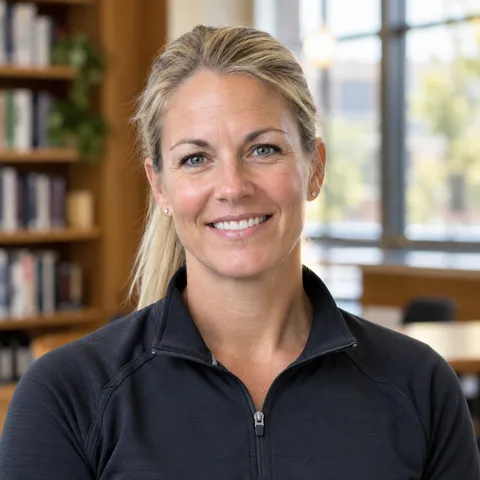
Dr. Karin Lund
Associate Professor of Kinesiology
Instructor for KINE 301, Fall 2026
- Office
- Calder Health Sciences Building 320
- klund
@university.alkimi.ai
KINE 301 · Kinesiology and Nutrition
Bioenergetics, neuromuscular, cardiovascular, and respiratory responses and adaptations to exercise, and environmental factors in performance, with a weekly three-hour laboratory in metabolic and performance testing.
Fall 2026 · At a glance
300-level courses: advanced, upper-division courses requiring prior foundational preparation. Counts toward the 36 upper-division credits every bachelor's degree requires (Undergraduate Catalog §2.3). Details: Undergraduate Catalog §9.24.
Associate Professor of Kinesiology
Instructor for KINE 301, Fall 2026
Questions about a major or your plan: Academic Advising Center, Lovell Hall 101, (555) 555-0158.
Class meetings
Lecture
Mon, Wed, Fri, 8:00–8:50 a.m.
Calder Health Sciences Building 160
Lab
Wed, 1:00–3:50 p.m.
Calder Health Sciences Building 130
Final exam
Monday, December 14, 2026
8:00–10:00 a.m., Calder Health Sciences Building 160
Office hours
Tue & Fri, 3:30–5:00 p.m.
Calder Health Sciences Building 320
Mon, 10:00–11:00 a.m.
Virtual (Zoom link in Canvas)
You may use generative AI tools to assist in generating practice calculation questions (such as respiratory exchange ratios or target heart rate zones), explaining complex biochemical pathways, and checking drafts of your lab report discussions for flow and clarity. You may not use generative AI to generate laboratory calculations, interpret metabolic or spirometric data collected in lab, write laboratory report sections, or complete quizzes and examinations.
From the syllabus
Grading
Letter grades follow the university scale (Student Handbook §4.1).
Key dates
First day of classes Past
Lecture Examination 1 Next
Laboratory Practical 1 (Metabolic Instrumentation & Submaximal Testing)
Lecture Examination 2
Laboratory Practical 2 (VO2max, Anaerobic Power, & Spirometry)
Required materials
Powers, Scott K., and Edward T. Howley. Exercise Physiology: Theory and Application to Fitness and Performance. 11th ed., McGraw Hill, 2021.
Approx. $95 print, $55 digital rental.
American College of Sports Medicine. ACSM's Guidelines for Exercise Testing and Prescription. 11th ed., Wolters Kluwer, 2021.
Approx. $55 print or digital.
KINE 301 Laboratory Manual: Metabolic and Performance Testing. Alkimi University Copy Center, 2026.
Approx. $20.
Degree planning
What to take first, what this course opens up, and the requirements it can satisfy, from the Undergraduate Catalog.
Every course also counts toward the 120 credits needed for a bachelor's degree. Confirm your plan with your advisor or the Academic Advising Center.
No AP exam awards credit for KINE 301 (Undergraduate Catalog §3.11).
Registration
KINE 301 is offered in the fall semester. Register through AlkimiHub self-service registration, which opens by credit standing. Until the add deadline, you don't need instructor permission as long as seats remain and you've met the prerequisites. Details: Student Handbook §3.3.
When a seat opens, AlkimiHub offers it to the first student on the waitlist and emails you. You have 24 hours to claim it before it goes to the next student. Details: Student Handbook §3.10.
Fall 2026 withdrawal deadline
Last day to withdraw with a W or elect Pass/No Pass.
Fall 2027 registration opens
By credit standing, in AlkimiHub.
The Fall 2026 add deadline passed on Sep 2, 2026.
All dates: academic calendar. Registration help: Office of the Registrar.
Official course syllabus
The syllabus as filed with the department and posted in Canvas for Fall 2026.
Term: Fall 2026
Credits: 4.0
Lecture Times & Location: Monday, Wednesday, Friday 8:00–8:50 a.m., Calder Health Sciences Building 160
Laboratory Time & Location: Wednesday 1:00–3:50 p.m., Calder Health Sciences Building 130
Modality: In-Person Lecture and Laboratory
klund@university.alkimi.ai
Bioenergetics, neuromuscular, cardiovascular, and respiratory responses and adaptations to exercise, and environmental factors in performance, with a weekly three-hour laboratory in metabolic and performance testing. KINE 301 investigates the physiological mechanisms through which the human body responds and adapts to acute exercise and chronic physical training. Grounded in cellular bioenergetics and systemic integration, the course explores cardiovascular, pulmonary, endocrine, and neuromuscular function during rest and exercise, as well as the physiological impacts of environmental stressors such as altitude and heat. In the weekly three-hour laboratory, students operate clinical metabolic carts, cycle ergometers, lactate analyzers, and spirometry systems to collect and evaluate human performance data.
BIO 201 and BIO 202.
Upon successful completion of KINE 301, students will be able to:
In accordance with Alkimi University Academic Policies (Student Handbook §5.8), KINE 301 operates under AI Level 2.
| Week | Dates | Topics & Readings | Laboratory | Assignments & Deadlines |
|---|---|---|---|---|
| Week 1 | Aug 26, 28 | Physiology of Exercise and Homeostasis: Control systems of the body, biological control loops, negative and positive feedback, and cellular adaptation to stress. Reading: Powers & Howley, Ch. 1–2 | No lab meetings this week. | First day of classes: Wed Aug 26. |
| Week 2 | Aug 31–Sep 4 | Bioenergetics and Cellular Energy Transfer: ATP synthesis, phosphagen system, glycolysis, Krebs cycle, electron transport chain, and rate-limiting regulatory enzymes. Reading: Powers & Howley, Ch. 3 | Lab 1: Laboratory Safety, Metabolic Calculations, and Energy Expenditure | Wed Sep 2: Add/section change deadline. |
| Week 3 | Sep 9, 11 | Exercise Metabolism and Substrate Utilization: Oxygen deficit, EPOC, respiratory exchange ratio (RER), crossover concept, carbohydrate and fat metabolism during varying workloads. Reading: Powers & Howley, Ch. 4 | Lab 2: Submaximal Ergometry and Indirect Calorimetry | Mon Sep 7: Labor Day (no classes). Wed Sep 9: Census date (last day to drop without a W). |
| Week 4 | Sep 14–18 | Hormonal Responses to Exercise: Endocrine control of blood glucose, catecholamines, insulin, glucagon, cortisol, and growth hormone during acute and chronic exertion. Reading: Powers & Howley, Ch. 5 | Lab 3: Blood Lactate Threshold and Anaerobic Shift Assessment | — |
| Week 5 | Sep 21–25 | Neuromuscular System and Motor Unit Recruitment: Action potentials, excitation-contraction coupling, muscle fiber types (Type I, IIa, IIx), size principle, and force regulation. Reading: Powers & Howley, Ch. 7–8 | Lab 4: Electromyography (EMG) and Muscle Fatigue Analysis | — |
| Week 6 | Sep 28–Oct 2 | Cardiovascular Function during Work: Cardiac output, stroke volume regulation, Frank-Starling law, peripheral vascular resistance, and arterial blood pressure dynamics; Lecture Examination 1 in class. Reading: Powers & Howley, Ch. 9 | Lab 5: Auscultatory Blood Pressure and Resting/Exercise Electrocardiography | Lecture Examination 1 (in class). |
| Week 7 | Oct 5–9 | Respiration and Gas Exchange: Pulmonary ventilation, alveolar gas exchange, oxyhemoglobin dissociation curve, ventilatory threshold, and control of breathing. Reading: Powers & Howley, Ch. 10 | Lab 6: Laboratory Practical 1 (Metabolic Instrumentation & Submaximal Testing) | Laboratory Practical 1 (Metabolic Instrumentation & Submaximal Testing) (in lab section). |
| Week 8 | Oct 14, 16 | Acid-Base Balance during Exercise: Hydrogen ion production, physiological buffers, respiratory and renal compensation, and lactate buffering dynamics. Reading: Powers & Howley, Ch. 11 | Lab 7: Pulmonary Function Testing and Static/Dynamic Spirometry | Oct 12–Oct 13: Fall break (no classes). |
| Week 9 | Oct 19–23 | Thermoregulation and Exercise in the Heat: Mechanisms of heat transfer, sweat rate dynamics, dehydration risks, heat illness spectrum, and heat acclimatization adaptations. Reading: Powers & Howley, Ch. 12 | Lab 8: Maximal Oxygen Uptake (VO2max) Bruce Treadmill Protocol | — |
| Week 10 | Oct 26–30 | Exercise in Cold and Hypobaric Environments: Physiological responses to cold, hypothermia, high altitude physiology, oxygen transport at altitude, and altitude acclimatization. Reading: Powers & Howley, Ch. 24 | Lab 9: Environmental Stress Simulation and Core Temperature Monitoring | — |
| Week 11 | Nov 2–6 | Physiology of Resistance Training: Neural adaptations versus hypertrophy, muscle protein synthesis, satellite cell activation, and detraining kinetics. Reading: Powers & Howley, Ch. 13 | Lab 10: Wingate Anaerobic Power and Muscle Power Testing | Fri Nov 6: Last day to withdraw (W) or elect Pass/No Pass. |
| Week 12 | Nov 9–13 | Physiology of Aerobic and Anaerobic Training: Mitochondrial biogenesis, capillary density expansion, enzymatic shifts, and endurance training adaptations; Lecture Examination 2 in class. Reading: Powers & Howley, Ch. 14 | Lab 11: Chronic Training Adaptation Profiling and Anaerobic Threshold | Lecture Examination 2 (in class). |
| Week 13 | Nov 16–20 | Body Composition and Exercise Ergonomics: Models of body composition, densitometry, bioelectrical impedance, skinfolds, and energetic costs of movement. Reading: Powers & Howley, Ch. 18 | Lab 12: Multi-Compartment Body Composition Assessment (Skinfolds & BIA) | — |
| Week 14 | Nov 23 | Exercise, Aging, and Chronic Disease Prevention: Cardiovascular disease, sarcopenia, insulin sensitivity, bone mineral density, and exercise as preventive medicine across adulthood. Reading: Powers & Howley, Ch. 17 | No lab meetings this week (holiday). | Nov 25–Nov 27: Thanksgiving break (no classes). |
| Week 15 | Nov 30–Dec 4 | Ergogenic Aids and Performance Optimization: Nutritional, pharmacological, and physiological ergogenic aids; ethical considerations and anti-doping policies in sport; Laboratory Practical 2 in lab. Reading: Powers & Howley, Ch. 25 | Lab 13: Laboratory Practical 2 (VO2max, Anaerobic Power, & Spirometry) | Laboratory Practical 2 (VO2max, Anaerobic Power, & Spirometry) (in lab section). |
| Week 16 | Dec 7, 9 | Integrative Exercise Physiology and Synthesis: Whole-body systemic integration under extreme exertion, emerging paradigms in exercise molecular biology, and final exam synthesis. Reading: Course review packet | Lab 14: Comprehensive Physiological Data Case Synthesis Workshop | Wed Dec 9: Last day of classes. Thu Dec 10: Reading Day. |
| Finals | Dec 14 | Final Comprehensive Examination: Monday, December 14, 2026, 8:00–10:00 a.m., Calder Health Sciences Building 160. | — | Cumulative examination covering bioenergetics, cardiopulmonary dynamics, neuromuscular adaptations, and environmental exercise physiology. |
Class attendance is expected, and laboratory attendance is mandatory. Practical laboratory exercises require direct operation of testing instruments and active peer participation. If you must miss a lab due to documented illness, contact Dr. Lund within 24 hours. Because equipment must be calibrated for specific experiments, missed laboratory sessions cannot be made up after the week has concluded. Students who miss the first two class meetings without notifying the instructor may be dropped. Students may miss class for religious observance without penalty if they notify the instructor in writing within the first two weeks of the semester (by Wednesday, September 9, 2026). Absences for university-sponsored activities (athletics, performances, conferences) are excused with a letter from the sponsoring office at least one week in advance.
Laboratory reports submitted after the posted deadline will be penalized 10% per calendar day late for up to three days. Assignments submitted more than 72 hours late will not be graded. Pre-lab quizzes close promptly at the deadline and cannot be reopened.
Students must arrive in athletic attire (running shoes, athletic shorts, T-shirt) prepared to participate as active testing subjects or technicians. Hydrate adequately prior to testing sessions. Inform the instructor immediately if you experience dizziness, chest pain, or excessive fatigue during any test.
Kinesiology majors must achieve a grade of C or higher in KINE 301 to satisfy prerequisite requirements for KINE 330 Exercise Testing & Prescription and KINE 410 Clinical Exercise Physiology.
The final examination (Monday, December 14, 2026, 8:00–10:00 a.m.) is scheduled by the University Registrar and can't be moved without the Dean's written approval (Faculty Handbook §5.5). A student with three or more final exams on the same calendar day may reschedule one of them. Requests go to the instructor of the middle exam by the last day of classes. For this term, send the request by Wednesday, December 9, 2026 (Student Handbook §6.4).
Alkimi University is an academic community devoted to rigorous scholarship, open intellectual inquiry, and uncompromising ethical conduct. All students are subject to the regulations of the Alkimi University Academic Integrity Policy. Academic dishonesty—including plagiarism, cheating on examinations, unauthorized collaboration, fabrication of empirical data, and unauthorized submission of academic work generated by artificial intelligence—undermines the integrity of the university and carries severe disciplinary sanctions. Sanctions range from a failing grade on an assignment or exam to an administrative course failure recorded as an 'XF' on the official transcript, academic suspension, or expulsion. Suspected violations are formally investigated and resolved through the Office of Academic Integrity in accordance with Faculty Handbook §6. For detailed information, consult the Office of Academic Integrity, Lovell Hall 315, (555) 555-0163, integrity@university.alkimi.ai.
Alkimi University is committed to providing equitable educational access and reasonable accommodations for all students with documented disabilities, including physical, sensory, psychological, learning, and chronic health conditions. Students requesting academic accommodations must formally register with the Office of Accessibility Services, Harlan Hall 204, (555) 555-0155, access@university.alkimi.ai. Once approved, students will receive an official Faculty Accommodation Letter detailing approved accommodations. Students should present this letter to the instructor as early in the semester as possible, and at least one week prior to any exam or assignment requiring accommodation. Accommodations cannot be applied retroactively.
Your physical health, psychological well-being, and mental health are essential to your academic success. If you experience heightened stress, anxiety, depressive symptoms, personal trauma, or academic burnout, free, confidential counseling and medical care are available through the Hollis Health & Counseling Center, located in the Hollis Center. Routine appointments are available Monday–Friday 8:00 a.m.–6:00 p.m. and Saturday 10:00 a.m.–2:00 p.m. during the semester by calling (555) 555-0190 or emailing health@university.alkimi.ai. Urgent, 24/7 crisis psychological counseling is accessible immediately at (555) 555-0199.
advising@university.alkimi.ai
askalibrarian@university.alkimi.ai
health@university.alkimi.ai
KINE, NUTR courses