

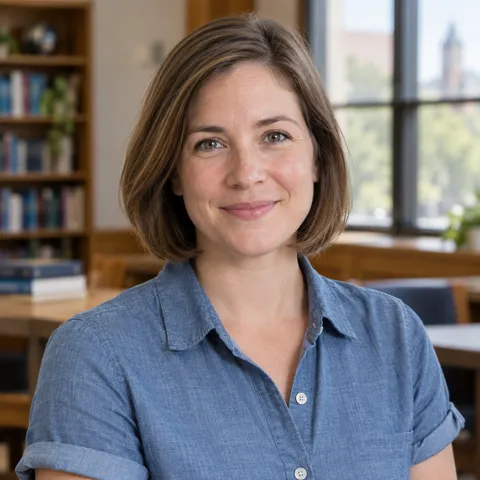
Dr. Megan Hollander
Assistant Teaching Professor of Physics; Director of Introductory Physics Laboratories
Course coordinator for all PHYS 111 sections, 2026–27
- Office
- Meridian Science Center 414
- mhollander
@university.alkimi.ai
PHYS 111 · Physics
Algebra- and trigonometry-based mechanics: kinematics, Newton's laws, work and energy, momentum, rotation, fluids, oscillations, and heat, with a weekly three-hour laboratory. Designed for life science, pre-health, and kinesiology students.
Fall 2026 · At a glance
100-level courses: introductory, lower-division courses primarily for first-year students. Details: Undergraduate Catalog §9.14.
Assistant Teaching Professor of Physics; Director of Introductory Physics Laboratories
Course coordinator for all PHYS 111 sections, 2026–27
Questions about a major or your plan: Academic Advising Center, Lovell Hall 101, (555) 555-0158.
Sections
PHYS 111 is a multi-section course. Each section's days, time, room, and instructor are listed in AlkimiHub; every section follows this syllabus.
Final exam
No exam in the finals period. The final project deadline is listed under key dates.
Coordinator office hours
Mon & Wed, 3:00–4:30 p.m.
Meridian Science Center 414
Tue, 11:00 a.m.–12:00 p.m.
Virtual (Zoom link in Canvas)
Your section instructor posts their own office hours in Canvas.
You may use AI tools for conceptual explanations, generating practice algebra problems, or clarifying physical intuition during your personal study outside of graded assignments. You may not use AI tools to solve, verify, or generate work for weekly homework assignments, pre-lab exercises, laboratory analysis, or the capstone project.
From the syllabus
Grading
Letter grades follow the university scale (Student Handbook §4.1).
Key dates
First day of classes Past
Midterm Exam 1 Past
Midterm Exam 2 Next
Biomechanics Capstone Final Project
Required materials
Serway, Raymond A., and Chris Vuille. College Physics. 11th ed., Cengage Learning, 2018.
Approx. $45 for digital rental; approx. $125 for print purchase.
OpenStax College Physics. Free digital access at openstax.org.
Free.
Scientific or graphing calculator (TI-30X, TI-84, or equivalent; smartphone calculators prohibited on exams).
Approx. $15 to $90.
Degree planning
What to take first, what this course opens up, and the requirements it can satisfy, from the Undergraduate Catalog.
Catalog wording: MATH 110 or placement.
Every course also counts toward the 120 credits needed for a bachelor's degree. Confirm your plan with your advisor or the Academic Advising Center.
No AP exam awards credit for PHYS 111 (Undergraduate Catalog §3.11).
Registration
MATH 110 or placement.
PHYS 111 is offered in both the fall and spring semesters. Register through AlkimiHub self-service registration, which opens by credit standing. Until the add deadline, you don't need instructor permission as long as seats remain and you've met the prerequisites. Details: Student Handbook §3.3.
When a seat opens, AlkimiHub offers it to the first student on the waitlist and emails you. You have 24 hours to claim it before it goes to the next student. Details: Student Handbook §3.10.
Spring 2027 registration opens
By credit standing, in AlkimiHub.
Fall 2026 withdrawal deadline
Last day to withdraw with a W or elect Pass/No Pass.
Spring 2027 add deadline
Last day to add a course or change sections (11:59 p.m.).
Fall 2027 registration opens
By credit standing, in AlkimiHub.
The Fall 2026 add deadline passed on Sep 2, 2026.
All dates: academic calendar. Registration help: Office of the Registrar.
Official course syllabus
The syllabus as filed with the department and posted in Canvas for Fall 2026.
Term: Fall 2026
Credits: 4.0
Meeting Times & Location: Multiple sections. Your section's days, time, room, and instructor are listed in AlkimiHub and on your Canvas course page.
Modality: In-Person
mhollander@university.alkimi.ai
Algebra- and trigonometry-based mechanics: kinematics, Newton's laws, work and energy, momentum, rotation, fluids, oscillations, and heat, with a weekly three-hour laboratory. Designed for life science, pre-health, and kinesiology students. PHYS 111 provides an algebra- and trigonometry-based introduction to classical mechanics and thermal physics tailored for students in the biological sciences, exercise science, and pre-health pathways. We explore translational and rotational kinematics, Newton's laws of motion, work-energy principles, impulse and linear momentum, fluid statics and dynamics, harmonic oscillations, and thermodynamic processes. Emphasis is placed on translating physical principles into quantitative models that explain physiological, anatomical, and biomechanical systems.
MATH 110 or placement.
Upon successful completion of PHYS 111, students will be able to:
In accordance with Alkimi University Academic Policies (Student Handbook §5.8), PHYS 111 operates under AI Level 1.
All sections follow this common weekly schedule. Section meeting days vary, so dates are shown by week; your section instructor posts exact class dates in Canvas.
| Week | Dates | Topics & Readings | Assignments & Deadlines |
|---|---|---|---|
| Week 1 | Aug 26–Aug 28 | Units, Measurements, and Vectors: SI units, dimensional analysis, scalar versus vector quantities, vector components, and trigonometric decomposition. Reading: Serway Ch. 1 | First day of classes: Wed Aug 26. |
| Week 2 | Aug 31–Sep 4 | One-Dimensional Kinematics: Position, displacement, average and instantaneous velocity, constant acceleration, and free-fall motion. Reading: Serway Ch. 2 | Wed Sep 2: Add/section change deadline. |
| Week 3 | Sep 8–Sep 11 | Two-Dimensional Motion and Projectiles: Vector addition, projectile motion trajectories, range equations, and independence of horizontal and vertical motions. Reading: Serway Ch. 3 | Mon Sep 7: Labor Day (no classes). Wed Sep 9: Census date (last day to drop without a W). |
| Week 4 | Sep 14–Sep 18 | Newton's Laws of Motion: First and second laws, mass, weight, free-body diagrams, and Newton's third law interaction pairs. Reading: Serway Ch. 4.1–4.4 | — |
| Week 5 | Sep 21–Sep 25 | Applications of Force and Friction & Midterm Exam 1: Static and kinetic friction, inclined planes, tension in cables, coupled bodies; Midterm Exam 1 in class. Reading: Serway Ch. 4.5–4.8 | Midterm Exam 1 (in class this week). |
| Week 6 | Sep 28–Oct 2 | Work and Kinetic Energy: Definition of work by constant and variable forces, kinetic energy, and the work-energy theorem. Reading: Serway Ch. 5.1–5.3 | — |
| Week 7 | Oct 5–Oct 9 | Potential Energy and Conservation of Energy: Gravitational and elastic potential energy, conservative versus nonconservative forces, and mechanical power. Reading: Serway Ch. 5.4–5.7 | — |
| Week 8 | Oct 14–Oct 16 | Momentum, Impulse, and Collisions: Linear momentum, impulse-momentum theorem, conservation of linear momentum, and elastic versus inelastic collisions. Reading: Serway Ch. 6 | Oct 12–Oct 13: Fall break (no classes). Fri Oct 16: Midterm grades due. |
| Week 9 | Oct 19–Oct 23 | Rotational Motion and Angular Kinematics: Angular displacement, angular velocity, angular acceleration, centripetal acceleration, and Newtonian gravitation. Reading: Serway Ch. 7 | — |
| Week 10 | Oct 26–Oct 30 | Rotational Dynamics and Equilibrium & Midterm Exam 2: Torque, conditions for static equilibrium, center of gravity, moment of inertia, and angular momentum; Midterm Exam 2 in class. Reading: Serway Ch. 8 | Midterm Exam 2 (in class this week). |
| Week 11 | Nov 2–Nov 6 | Solids and Fluid Statics: States of matter, density, hydrostatic pressure, Pascal's principle, and Archimedes' principle of buoyancy. Reading: Serway Ch. 9.1–9.5 | Fri Nov 6: Last day to withdraw (W) or elect Pass/No Pass. |
| Week 12 | Nov 9–Nov 13 | Fluid Dynamics and Viscosity: Fluids in motion, equation of continuity, Bernoulli's equation, Poiseuille flow, and applications to blood circulation. Reading: Serway Ch. 9.6–9.9 | — |
| Week 13 | Nov 16–Nov 20 | Thermal Physics and Temperature: Zeroth law of thermodynamics, thermometers, temperature scales, thermal expansion of solids and liquids, and ideal gases. Reading: Serway Ch. 10 | — |
| Week 14 | Nov 23–Nov 24 | Energy in Thermal Processes: Heat capacity, specific heat, latent heat, phase changes, and conduction, convection, and radiation mechanisms. Reading: Serway Ch. 11 | Nov 25–Nov 27: Thanksgiving break (no classes). |
| Week 15 | Nov 30–Dec 4 | The Laws of Thermodynamics: First law of thermodynamics, thermodynamic work, PV diagrams, heat engines, second law, and entropy. Reading: Serway Ch. 12 | — |
| Week 16 | Dec 7–Dec 9 | Oscillations, Waves, and Capstone Synthesis: Hooke's law, simple harmonic motion, period of pendulum and mass-spring systems, and final capstone project presentations. Reading: Serway Ch. 13 & Review | Wed Dec 9: Last day of classes. Thu Dec 10: Reading Day. |
| Finals | Dec 14 | Biomechanics Capstone Final Project due Monday, December 14, 2026 at 11:59 p.m. | No final examination. |
Because PHYS 111 is a coordinated, laboratory-integrated course, active engagement in all lecture and laboratory sessions is essential. If you must miss a class or laboratory due to illness or official university business, contact Dr. Hollander and your section instructor in advance. More than two unexcused lab absences will result in a failing grade. Students who miss the first two class meetings without notifying the instructor may be dropped. Students may miss class for religious observance without penalty if they notify the instructor in writing within the first two weeks of the semester (by Wednesday, September 9, 2026). Absences for university-sponsored activities (athletics, performances, conferences) are excused with a letter from the sponsoring office at least one week in advance.
Homework problem sets submitted within 24 hours after the Friday deadline receive a 20% penalty; submissions beyond 24 hours are not accepted as solutions are posted immediately. Canvas reading quizzes cannot be completed late, but the two lowest scores are dropped automatically at the conclusion of the semester.
PHYS 111 has no final examination. The biomechanics capstone final project takes its place. Nothing is due on Reading Day (Thursday, December 10, 2026).
Alkimi University is an academic community devoted to rigorous scholarship, open intellectual inquiry, and uncompromising ethical conduct. All students are subject to the regulations of the Alkimi University Academic Integrity Policy. Academic dishonesty—including plagiarism, cheating on examinations, unauthorized collaboration, fabrication of empirical data, and unauthorized submission of academic work generated by artificial intelligence—undermines the integrity of the university and carries severe disciplinary sanctions. Sanctions range from a failing grade on an assignment or exam to an administrative course failure recorded as an 'XF' on the official transcript, academic suspension, or expulsion. Suspected violations are formally investigated and resolved through the Office of Academic Integrity in accordance with Faculty Handbook §6. For detailed information, consult the Office of Academic Integrity, Lovell Hall 315, (555) 555-0163, integrity@university.alkimi.ai.
Alkimi University is committed to providing equitable educational access and reasonable accommodations for all students with documented disabilities, including physical, sensory, psychological, learning, and chronic health conditions. Students requesting academic accommodations must formally register with the Office of Accessibility Services, Harlan Hall 204, (555) 555-0155, access@university.alkimi.ai. Once approved, students will receive an official Faculty Accommodation Letter detailing approved accommodations. Students should present this letter to the instructor as early in the semester as possible, and at least one week prior to any exam or assignment requiring accommodation. Accommodations cannot be applied retroactively.
Your physical health, psychological well-being, and mental health are essential to your academic success. If you experience heightened stress, anxiety, depressive symptoms, personal trauma, or academic burnout, free, confidential counseling and medical care are available through the Hollis Health & Counseling Center, located in the Hollis Center. Routine appointments are available Monday–Friday 8:00 a.m.–6:00 p.m. and Saturday 10:00 a.m.–2:00 p.m. during the semester by calling (555) 555-0190 or emailing health@university.alkimi.ai. Urgent, 24/7 crisis psychological counseling is accessible immediately at (555) 555-0199.
advising@university.alkimi.ai
askalibrarian@university.alkimi.ai
health@university.alkimi.ai
PHYS courses