

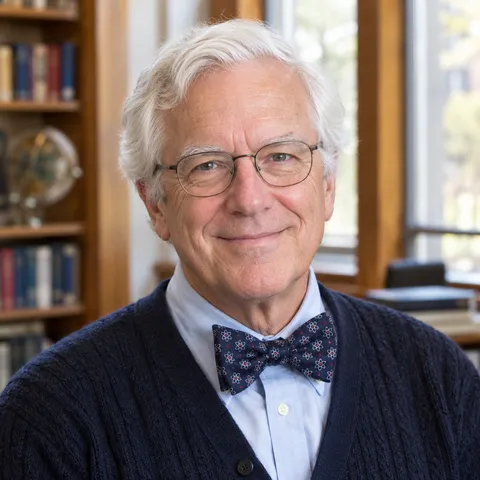
Dr. William Thorne
Professor of Physics
Instructor for PHYS 410, Fall 2026
- Office
- Meridian Science Center 410
- wthorne
@university.alkimi.ai
PHYS 410 · Physics
Wave functions and operators, the Schrödinger equation in one and three dimensions, the harmonic oscillator, the hydrogen atom, angular momentum and spin, identical particles, and perturbation theory.
Fall 2026 · At a glance
400-level courses: advanced capstone, senior research, and specialized seminars. Counts toward the 36 upper-division credits every bachelor's degree requires (Undergraduate Catalog §2.3). Details: Undergraduate Catalog §9.14.
Professor of Physics
Instructor for PHYS 410, Fall 2026
Questions about a major or your plan: Academic Advising Center, Lovell Hall 101, (555) 555-0158.
Class meetings
Mon, Tue, Wed, Fri, 1:00–1:50 p.m.
Meridian Science Center 170
Final exam
Wednesday, December 16, 2026
3:30–5:30 p.m., Meridian Science Center 170
Office hours
Mon & Thu, 10:00–11:30 a.m.
Meridian Science Center 410
Wed, 3:00–4:00 p.m.
Virtual (Zoom link in Canvas)
You may use AI tools to check matrix diagonalizations, verify commutators between operators, explore Dirac bra-ket notation manipulations, and generate practice problems for perturbation theory. You may not submit AI-generated derivations or proofs for weekly homework problem sets, copy AI solutions for take-home or in-class exams, or consult any generative AI during examinations.
From the syllabus
Grading
Letter grades follow the university scale (Student Handbook §4.1).
Key dates
First day of classes Past
Midterm Exam 1 Past
Midterm Exam 2 Next
Quantum Mechanics Term Paper
Required materials
Griffiths, David J., and Darrell F. Schroeter. Introduction to Quantum Mechanics. 3rd ed., Cambridge University Press, 2018.
Approx. $60 for digital; approx. $85 for print purchase.
Degree planning
What to take first, what this course opens up, and the requirements it can satisfy, from the Undergraduate Catalog.
No other catalog course lists PHYS 410 as a prerequisite.
Every course also counts toward the 120 credits needed for a bachelor's degree. Confirm your plan with your advisor or the Academic Advising Center.
No AP exam awards credit for PHYS 410 (Undergraduate Catalog §3.11).
Registration
PHYS 410 is offered in the fall semester. Register through AlkimiHub self-service registration, which opens by credit standing. Until the add deadline, you don't need instructor permission as long as seats remain and you've met the prerequisites. Details: Student Handbook §3.3.
When a seat opens, AlkimiHub offers it to the first student on the waitlist and emails you. You have 24 hours to claim it before it goes to the next student. Details: Student Handbook §3.10.
Fall 2026 withdrawal deadline
Last day to withdraw with a W or elect Pass/No Pass.
Fall 2027 registration opens
By credit standing, in AlkimiHub.
The Fall 2026 add deadline passed on Sep 2, 2026.
All dates: academic calendar. Registration help: Office of the Registrar.
Official course syllabus
The syllabus as filed with the department and posted in Canvas for Fall 2026.
Term: Fall 2026
Credits: 4.0
Seminar Times & Location: Monday, Tuesday, Wednesday, Friday 1:00–1:50 p.m., Meridian Science Center 170
Modality: In-Person Seminar
wthorne@university.alkimi.ai
Wave functions and operators, the Schrödinger equation in one and three dimensions, the harmonic oscillator, the hydrogen atom, angular momentum and spin, identical particles, and perturbation theory. PHYS 410 is an advanced, mathematically formal study of non-relativistic quantum mechanics for senior physics majors. Formulating the theory in Hilbert space using Dirac bra-ket notation, we investigate state vectors, Hermitian operators, observables, and generalized uncertainty relations. The course thoroughly develops the quantum harmonic oscillator via ladder operators, central force problems, orbital and spin angular momentum addition, systems of identical particles, and time-independent perturbation theory.
PHYS 221, MATH 250, and MATH 340.
Upon successful completion of PHYS 410, students will be able to:
In accordance with Alkimi University Academic Policies (Student Handbook §5.8), PHYS 410 operates under AI Level 2.
| Week | Dates | Topics & Readings | Assignments & Deadlines |
|---|---|---|---|
| Week 1 | Aug 26, 28 | Wave Function Formalism and Probability Current: Born interpretation, normalization condition, continuity equation for probability, expectation values, and momentum operator in position space. Reading: Griffiths Ch. 1 | First day of classes: Wed Aug 26. |
| Week 2 | Aug 31–Sep 4 | Stationary States and the Infinite Square Well: Time-independent Schrödinger equation, energy quantization, parity, boundary conditions, completeness, and orthonormality of stationary states. Reading: Griffiths Ch. 2.1–2.2 | Wed Sep 2: Add/section change deadline. |
| Week 3 | Sep 8–11 | Harmonic Oscillator: Power Series Solution: Asymptotic behavior, Hermite polynomials, generating functions, Rodrigues formula, and orthogonal wave functions. Reading: Griffiths Ch. 2.3.1 | Mon Sep 7: Labor Day (no classes). Wed Sep 9: Census date (last day to drop without a W). |
| Week 4 | Sep 14–18 | Harmonic Oscillator: Algebraic Operator Method: Commutation relations, raising and lowering ladder operators, ground state derivation, energy spectrum, and matrix elements. Reading: Griffiths Ch. 2.3.2 | — |
| Week 5 | Sep 21–25 | Free Particles and Wave Packets & Midterm Exam 1: Continuous spectrum, Fourier transforms, group versus phase velocity, delta-function potential well; Midterm Exam 1 in class. Reading: Griffiths Ch. 2.4–2.5 | Midterm Exam 1 (in class). |
| Week 6 | Sep 28–Oct 2 | Scattering States and Finite Wells: Transmission and reflection coefficients, scattering matrix formalism, resonance scattering, and bound states in finite potential wells. Reading: Griffiths Ch. 2.6 | — |
| Week 7 | Oct 5–9 | Hilbert Space and Dirac Bra-Ket Notation: Linear vector spaces, inner products, dual spaces, Dirac bras and kets, projection operators, Hermitian adjoints, and unitary operators. Reading: Griffiths Ch. 3.1–3.3 | — |
| Week 8 | Oct 14, 16 | Generalized Uncertainty Principle and Observables: Commuting observables, simultaneous eigenfunctions, generalized Robertson-Schrödinger uncertainty relation, and continuous spectra. Reading: Griffiths Ch. 3.4–3.6 | Oct 12–Oct 13: Fall break (no classes). |
| Week 9 | Oct 19–23 | Schrödinger Equation in Three Dimensions: Separation of variables in spherical coordinates, angular equation, Legendre polynomials, and radial differential equation. Reading: Griffiths Ch. 4.1 | — |
| Week 10 | Oct 26–30 | The Hydrogen Atom & Midterm Exam 2: Coulomb potential, associated Laguerre polynomials, Bohr radius, energy eigenvalue formula, and hydrogenic wave functions; Midterm Exam 2 in class. Reading: Griffiths Ch. 4.2 | Midterm Exam 2 (in class). |
| Week 11 | Nov 2–6 | Orbital Angular Momentum: Angular momentum ladder operators, spherical harmonics Y_lm, eigenvalues of L^2 and L_z, and spatial rotation generators. Reading: Griffiths Ch. 4.3 | Fri Nov 6: Last day to withdraw (W) or elect Pass/No Pass. |
| Week 12 | Nov 9–13 | Spin and Two-Level Systems: Spin 1/2 algebra, Pauli spin matrices, spinor wave functions, Stern-Gerlach apparatus, magnetic dipole moments, and Larmor precession. Reading: Griffiths Ch. 4.4.1 | — |
| Week 13 | Nov 16–20 | Addition of Angular Momenta: Coupled and uncoupled bases, total angular momentum J = L + S, Clebsch-Gordan coefficients, and selection rules. Reading: Griffiths Ch. 4.4.2–4.4.3 | Quantum Mechanics Term Paper due Fri Nov 20 at 11:59 p.m. |
| Week 14 | Nov 23, 24 | Identical Particles and Multi-Electron Systems: Two-particle systems, exchange operator, symmetric (bosons) and antisymmetric (fermions) wave functions, Pauli exclusion principle, and ortho/para-helium. Reading: Griffiths Ch. 5.1–5.2 | Nov 25–Nov 27: Thanksgiving break (no classes). |
| Week 15 | Nov 30–Dec 4 | Time-Independent Non-Degenerate Perturbation Theory: Perturbation expansion, first-order energy corrections, first-order wave function corrections, second-order energy shifts, and anharmonic oscillator. Reading: Griffiths Ch. 7.1 | — |
| Week 16 | Dec 7–9 | Degenerate Perturbation Theory and Fine Structure: Degenerate perturbation theory, relativistic kinetic energy correction, spin-orbit interaction, Darwin term, fine structure of hydrogen, and review. Reading: Griffiths Ch. 7.2–7.3 & Review | Wed Dec 9: Last day of classes. Thu Dec 10: Reading Day. |
| Finals | Dec 16 | Final Comprehensive Examination: Wednesday, December 16, 2026, 3:30–5:30 p.m., Meridian Science Center 170. | Comprehensive examination covering Hilbert space formalism, angular momentum, identical particles, and perturbation theory. |
Attendance at every seminar meeting is mandatory. Advanced quantum mechanics requires collaborative chalkboard derivations, rigorous conceptual dialogue, and active questioning. If you must miss a class due to illness or academic conference travel, notify Dr. Thorne via email in advance. More than three unexcused absences will result in a penalty to your final course grade. Students who miss the first two class meetings without notifying the instructor may be dropped. Students may miss class for religious observance without penalty if they notify the instructor in writing within the first two weeks of the semester (by Wednesday, September 9, 2026). Absences for university-sponsored activities (athletics, performances, conferences) are excused with a letter from the sponsoring office at least one week in advance.
Problem sets submitted within 24 hours of the Friday deadline receive a 20% penalty. Because solution packets are distributed immediately thereafter, no problem sets will be accepted after 24 hours. The single lowest weekly problem set score will be dropped.
The final examination (Wednesday, December 16, 2026, 3:30–5:30 p.m.) is scheduled by the University Registrar and can't be moved without the Dean's written approval (Faculty Handbook §5.5). A student with three or more final exams on the same calendar day may reschedule one of them. Requests go to the instructor of the middle exam by the last day of classes. For this term, send the request by Wednesday, December 9, 2026 (Student Handbook §6.4).
Alkimi University is an academic community devoted to rigorous scholarship, open intellectual inquiry, and uncompromising ethical conduct. All students are subject to the regulations of the Alkimi University Academic Integrity Policy. Academic dishonesty—including plagiarism, cheating on examinations, unauthorized collaboration, fabrication of empirical data, and unauthorized submission of academic work generated by artificial intelligence—undermines the integrity of the university and carries severe disciplinary sanctions. Sanctions range from a failing grade on an assignment or exam to an administrative course failure recorded as an 'XF' on the official transcript, academic suspension, or expulsion. Suspected violations are formally investigated and resolved through the Office of Academic Integrity in accordance with Faculty Handbook §6. For detailed information, consult the Office of Academic Integrity, Lovell Hall 315, (555) 555-0163, integrity@university.alkimi.ai.
Alkimi University is committed to providing equitable educational access and reasonable accommodations for all students with documented disabilities, including physical, sensory, psychological, learning, and chronic health conditions. Students requesting academic accommodations must formally register with the Office of Accessibility Services, Harlan Hall 204, (555) 555-0155, access@university.alkimi.ai. Once approved, students will receive an official Faculty Accommodation Letter detailing approved accommodations. Students should present this letter to the instructor as early in the semester as possible, and at least one week prior to any exam or assignment requiring accommodation. Accommodations cannot be applied retroactively.
Your physical health, psychological well-being, and mental health are essential to your academic success. If you experience heightened stress, anxiety, depressive symptoms, personal trauma, or academic burnout, free, confidential counseling and medical care are available through the Hollis Health & Counseling Center, located in the Hollis Center. Routine appointments are available Monday–Friday 8:00 a.m.–6:00 p.m. and Saturday 10:00 a.m.–2:00 p.m. during the semester by calling (555) 555-0190 or emailing health@university.alkimi.ai. Urgent, 24/7 crisis psychological counseling is accessible immediately at (555) 555-0199.
advising@university.alkimi.ai
askalibrarian@university.alkimi.ai
health@university.alkimi.ai
PHYS courses