
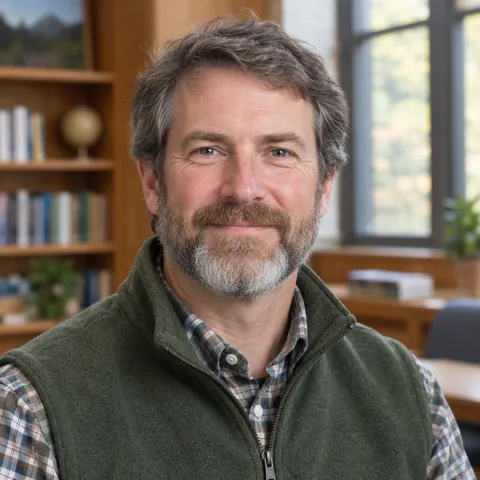
Dr. Everett Moss
Associate Professor of Environmental Science
Instructor for ENVS 201, Fall 2026
- Office
- Meridian Science Center 334
- emoss
@university.alkimi.ai
ENVS 201 · Environmental Science
Population, community, and ecosystem ecology studied through field sampling design, species surveys, and habitat assessment, with a weekly three-hour field laboratory.
Fall 2026 · At a glance
200-level courses: intermediate, lower-division courses suitable for sophomores and above. Details: Undergraduate Catalog §9.18.
Associate Professor of Environmental Science
Instructor for ENVS 201, Fall 2026
Questions about a major or your plan: Academic Advising Center, Lovell Hall 101, (555) 555-0158.
Class meetings
Lecture
Mon, Wed, Fri, 11:00–11:50 a.m.
Meridian Science Center 120
Lab
Mon, 8:00–10:50 a.m.
Meridian Science Center 132
Final exam
Tuesday, December 15, 2026
10:30 a.m.–12:30 p.m., Meridian Science Center 120
Office hours
Wed & Thu, 9:00–10:30 a.m.
Meridian Science Center 334
Mon, 3:00–4:00 p.m.
Virtual (Zoom link in Canvas)
You may use AI tools to generate R code snippets for ecological diversity calculations, brainstorm experimental sampling protocols, and proofread draft sections of your scientific field reports. You may not use AI to fabricate biodiversity data, synthesize field observations, generate complete written discussion sections, or access AI tools during exams.
From the syllabus
Grading
Letter grades follow the university scale (Student Handbook §4.1).
Key dates
First day of classes Past
Midterm Exam 1 Past
Midterm Exam 2 Next
Independent Field Research Project
Required materials
Begon, Michael, and Colin R. Townsend. Ecology: From Individuals to Ecosystems. 5th ed., Wiley-Blackwell, 2021.
Approx. $65 for digital rental; approx. $140 for print purchase.
Henderson, P. A. Practical Methods in Ecology. Wiley-Blackwell, 2003.
Approx. $40.
Waterproof field notebook (Rite in the Rain), hand lens (10x), and outdoor field boots.
Approx. $35.
Degree planning
What to take first, what this course opens up, and the requirements it can satisfy, from the Undergraduate Catalog.
Every course also counts toward the 120 credits needed for a bachelor's degree. Confirm your plan with your advisor or the Academic Advising Center.
No AP exam awards credit for ENVS 201 (Undergraduate Catalog §3.11).
Registration
ENVS 201 is offered in the fall semester. Register through AlkimiHub self-service registration, which opens by credit standing. Until the add deadline, you don't need instructor permission as long as seats remain and you've met the prerequisites. Details: Student Handbook §3.3.
When a seat opens, AlkimiHub offers it to the first student on the waitlist and emails you. You have 24 hours to claim it before it goes to the next student. Details: Student Handbook §3.10.
Fall 2026 withdrawal deadline
Last day to withdraw with a W or elect Pass/No Pass.
Fall 2027 registration opens
By credit standing, in AlkimiHub.
The Fall 2026 add deadline passed on Sep 2, 2026.
All dates: academic calendar. Registration help: Office of the Registrar.
Official course syllabus
The syllabus as filed with the department and posted in Canvas for Fall 2026.
Term: Fall 2026
Credits: 4.0
Lecture Times & Location: Monday, Wednesday, Friday 11:00–11:50 a.m., Meridian Science Center 120
Laboratory Time & Location: Monday 8:00–10:50 a.m., Meridian Science Center 132
Modality: In-Person Lecture and Laboratory
emoss@university.alkimi.ai
Population, community, and ecosystem ecology studied through field sampling design, species surveys, and habitat assessment, with a weekly three-hour field laboratory. ENVS 201 investigates fundamental principles of ecological systems from populations and communities to ecosystems and landscapes, emphasizing quantitative field methods and experimental design. Students examine life-history strategies, population demography, competitive and trophic interactions, biogeochemical cycling, and landscape fragmentation. Through weekly field laboratories across regional forest, wetland, and riparian habitats, you will master flora and fauna survey methods, vegetation sampling transects, mark-recapture techniques, and multivariate ecological data analysis.
ENVS 101 and BIO 101.
Upon successful completion of ENVS 201, students will be able to:
In accordance with Alkimi University Academic Policies (Student Handbook §5.8), ENVS 201 operates under AI Level 2.
| Week | Dates | Topics & Readings | Laboratory | Assignments & Deadlines |
|---|---|---|---|---|
| Week 1 | Aug 26, 28 | Introduction to Ecological Systems and Scales: Ecological hierarchies, organismal responses to environmental gradients, physiological ecology, and experimental design in field studies. Reading: Begon Ch. 1 | No lab meetings this week. | First day of classes: Wed Aug 26. |
| Week 2 | Aug 31–Sep 4 | The Physical Environment and Terrestrial Biomes: Global climate drivers, solar radiation, soil development, microclimatic variation, and biome characteristics. Reading: Begon Ch. 2 | Lab 1: Forest Habitat Assessment and Microclimate Profiling. | Wed Sep 2: Add/section change deadline. |
| Week 3 | Sep 9, 11 | Evolutionary Ecology and Life History Strategies: Trade-offs in reproduction and survival, r-selection versus K-selection, senescence, and evolutionary stable strategies. Reading: Begon Ch. 3 | No lab meetings this week (holiday). | Mon Sep 7: Labor Day (no classes). Wed Sep 9: Census date (last day to drop without a W). |
| Week 4 | Sep 14–18 | Population Demography and Life Tables: Age-structured populations, static and cohort life tables, net reproductive rate, generation time, and intrinsic rate of increase. Reading: Begon Ch. 4 | Lab 2: Mark-Recapture Population Size Estimation: Terrestrial Isopods. | — |
| Week 5 | Sep 21–25 | Interspecific Competition and Niches & Midterm Exam 1: Lotka-Volterra competition equations, competitive exclusion principle, resource partitioning, and character displacement; Midterm Exam 1 in class. Reading: Begon Ch. 5 | Lab 3: Plant Community Quadrat Sampling and Density Metrics. | Midterm Exam 1 (in class). |
| Week 6 | Sep 28–Oct 2 | Predation, Herbivory, and Prey Dynamics: Functional and numerical responses, predator-prey oscillations, optimal foraging theory, and plant defensive strategies. Reading: Begon Ch. 6 | Lab 4: Herbivory Damage Assessment and Plant Chemical Defenses. | — |
| Week 7 | Oct 5–9 | Mutualism, Parasitism, and Symbiosis: Endosymbiosis, mycorrhizal networks, pollinator mutualisms, host-parasite coevolution, and vector-borne transmission. Reading: Begon Ch. 7 & 8 | Lab 5: Riparian Forest Vegetation Transects and Basal Area Calculation. | — |
| Week 8 | Oct 14, 16 | Community Structure and Species Diversity: Species richness, Shannon-Wiener and Simpson diversity indices, rank-abundance curves, and latitudinal diversity gradients. Reading: Begon Ch. 9 | No lab meetings this week (holiday). | Oct 12–Oct 13: Fall break (no classes). Fri Oct 16: Midterm grades due. |
| Week 9 | Oct 19–23 | Food Webs, Trophic Cascades, and Keystones: Connectance, food web stability, top-down versus bottom-up regulation, keystone species, and trophic cascade impacts. Reading: Begon Ch. 10 | Lab 6: Aquatic Macroinvertebrate Sampling and Community Diversity Indices. | — |
| Week 10 | Oct 26–30 | Ecological Succession and Disturbance & Midterm Exam 2: Primary and secondary succession, facilitation, tolerance, inhibition models, intermediate disturbance hypothesis; Midterm Exam 2 in class. Reading: Begon Ch. 11 | Lab 7: Old-Field Secondary Succession Chronosequence Survey. | Midterm Exam 2 (in class). |
| Week 11 | Nov 2–6 | Ecosystem Metabolism and Primary Production: Gross and net primary productivity, light and dark bottle methods, Eddy covariance flux towers, and ecological efficiencies. Reading: Begon Ch. 12 | Lab 8: Leaf Litter Decomposition Rates and Macroinvertebrate Colonization. | Fri Nov 6: Last day to withdraw (W) or elect Pass/No Pass. |
| Week 12 | Nov 9–13 | Biogeochemical Cycles and Nutrient Spiraling: Nutrient pools and fluxes, carbon and nitrogen cycles, nutrient limitation, phosphorus immobilization, and stream nutrient spiraling. Reading: Begon Ch. 13 | Lab 9: Stream Nutrient Spiraling and Forest Soil Carbon Stocks. | — |
| Week 13 | Nov 16–20 | Landscape Ecology and Metapopulations: Patch-corridor-matrix models, edge effects, core area requirements, Levins metapopulation model, and source-sink dynamics. Reading: Begon Ch. 14 | Lab 10: Spatial Analysis of Forest Habitat Patches and Edge Effects. | Independent Field Research Project due Fri Nov 20 at 11:59 p.m. |
| Week 14 | Nov 23 | Island Biogeography and Reserve Design: MacArthur-Wilson equilibrium theory, species-area relationships, SLOSS debate (single large or several small reserves), and corridors. Reading: Begon Ch. 15 | Lab 11: Independent Project Field Data Collection and Sampling Validation. | Nov 25–Nov 27: Thanksgiving break (no classes). |
| Week 15 | Nov 30–Dec 4 | Global Change Ecology and Invasive Species: Anthropogenic nitrogen deposition, ocean warming, climate-driven phenological mismatch, and invasion ecology dynamics. Reading: Begon Ch. 16 | Lab 12: Invasive Plant Survey and Abundance Modeling. | — |
| Week 16 | Dec 7, 9 | Restoration Ecology and Research Symposium: Ecological restoration targets, novel ecosystems, rewilding initiatives, and semester student research symposium. Reading: Begon Ch. 17 & Review | Lab 13: Independent Research Project Symposium Presentations. | Wed Dec 9: Last day of classes. Thu Dec 10: Reading Day. |
| Finals | Dec 15 | Final Comprehensive Examination: Tuesday, December 15, 2026, 10:30 a.m.–12:30 p.m., Meridian Science Center 120. | — | Comprehensive examination covering population models, community ecology, ecosystem energetics, and landscape ecology. |
Field ecology requires prompt and reliable attendance. Laboratory sessions begin at 8:00 a.m. sharp with vans departing from Meridian Science Center for regional field sites; tardiness means missing transportation and earning a zero. Notify Dr. Moss in advance of medical or emergency absences. More than two unexcused lab absences results in an automatic grade of F. Students who miss the first two class meetings without notifying the instructor may be dropped. Students may miss class for religious observance without penalty if they notify the instructor in writing within the first two weeks of the semester (by Wednesday, September 9, 2026). Absences for university-sponsored activities (athletics, performances, conferences) are excused with a letter from the sponsoring office at least one week in advance.
Field reports submitted past the Friday deadline lose 10% per day and will not be accepted more than three days late. Problem sets and data exercises submitted late lose 20% and cannot be submitted after answer keys are published. The lowest problem set score is dropped.
Field laboratories take place rain or shine across muddy, wooded, and wetland terrains. Students must dress in durable outdoor clothing, long pants, waterproof hiking boots or rubber mud boots, and weather-appropriate rainwear. Field equipment, safety goggles, and high-visibility vests will be provided.
The final examination (Tuesday, December 15, 2026, 10:30 a.m.–12:30 p.m.) is scheduled by the University Registrar and can't be moved without the Dean's written approval (Faculty Handbook §5.5). A student with three or more final exams on the same calendar day may reschedule one of them. Requests go to the instructor of the middle exam by the last day of classes. For this term, send the request by Wednesday, December 9, 2026 (Student Handbook §6.4).
Alkimi University is an academic community devoted to rigorous scholarship, open intellectual inquiry, and uncompromising ethical conduct. All students are subject to the regulations of the Alkimi University Academic Integrity Policy. Academic dishonesty—including plagiarism, cheating on examinations, unauthorized collaboration, fabrication of empirical data, and unauthorized submission of academic work generated by artificial intelligence—undermines the integrity of the university and carries severe disciplinary sanctions. Sanctions range from a failing grade on an assignment or exam to an administrative course failure recorded as an 'XF' on the official transcript, academic suspension, or expulsion. Suspected violations are formally investigated and resolved through the Office of Academic Integrity in accordance with Faculty Handbook §6. For detailed information, consult the Office of Academic Integrity, Lovell Hall 315, (555) 555-0163, integrity@university.alkimi.ai.
Alkimi University is committed to providing equitable educational access and reasonable accommodations for all students with documented disabilities, including physical, sensory, psychological, learning, and chronic health conditions. Students requesting academic accommodations must formally register with the Office of Accessibility Services, Harlan Hall 204, (555) 555-0155, access@university.alkimi.ai. Once approved, students will receive an official Faculty Accommodation Letter detailing approved accommodations. Students should present this letter to the instructor as early in the semester as possible, and at least one week prior to any exam or assignment requiring accommodation. Accommodations cannot be applied retroactively.
Your physical health, psychological well-being, and mental health are essential to your academic success. If you experience heightened stress, anxiety, depressive symptoms, personal trauma, or academic burnout, free, confidential counseling and medical care are available through the Hollis Health & Counseling Center, located in the Hollis Center. Routine appointments are available Monday–Friday 8:00 a.m.–6:00 p.m. and Saturday 10:00 a.m.–2:00 p.m. during the semester by calling (555) 555-0190 or emailing health@university.alkimi.ai. Urgent, 24/7 crisis psychological counseling is accessible immediately at (555) 555-0199.
advising@university.alkimi.ai
askalibrarian@university.alkimi.ai
health@university.alkimi.ai
ENVS courses