
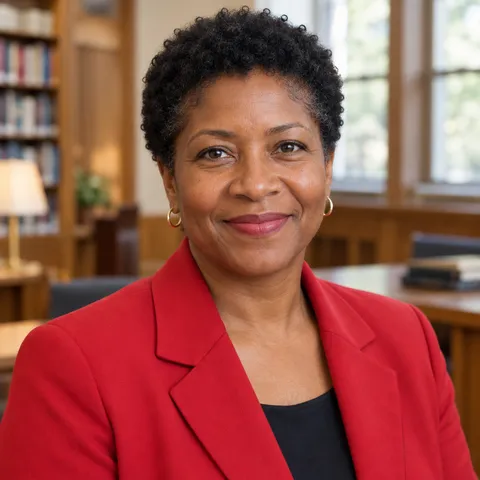
Dr. Deborah Evans
Associate Professor of Political Science
Course coordinator for all POSC 101 sections, 2026–27
- Office
- Lovell Hall 262
- devans
@university.alkimi.ai
POSC 101 · Political Science
The Constitution, federalism, civil liberties and civil rights, Congress, the presidency, the courts, parties, elections, interest groups, and public opinion in the United States.
Fall 2026 · At a glance
100-level courses: introductory, lower-division courses primarily for first-year students. Details: Undergraduate Catalog §9.16.
Associate Professor of Political Science
Course coordinator for all POSC 101 sections, 2026–27
Questions about a major or your plan: Academic Advising Center, Lovell Hall 101, (555) 555-0158.
Sections
POSC 101 is a multi-section course. Each section's days, time, room, and instructor are listed in AlkimiHub; every section follows this syllabus.
Final exam
No exam in the finals period. The final project deadline is listed under key dates.
Coordinator office hours
Mon & Wed, 10:00–11:30 a.m.
Lovell Hall 262
Tue, 2:00–3:00 p.m.
Virtual (Zoom link in Canvas)
Your section instructor posts their own office hours in Canvas.
You may use generative AI tools to explore background legislative histories, look up federal agency jurisdictions, brainstorm civic stakeholders for policy briefs, and proofread preliminary drafts for grammatical clarity. You may not use generative AI to write substantive policy arguments, generate draft text for submitted papers, complete reading quizzes, or take examinations.
From the syllabus
Grading
Letter grades follow the university scale (Student Handbook §4.1).
Key dates
First day of classes Past
Policy Brief 1: Federalism & Constitutional Governance Past
Midterm Examination Next
Policy Brief 2: Institutional Power & Civil Rights
Final Capstone Policy Brief & Strategic Memo
Required materials
Glen Krutz and Sylvie Waskiewicz. American Government 3e. OpenStax, 2021.
Free digital edition at openstax.org; optional print copy approx. $40.
Alkimi American Government Primary Source & Landmark Supreme Court Case Packet.
Free digital access provided via Canvas.
Degree planning
What to take first, what this course opens up, and the requirements it can satisfy, from the Undergraduate Catalog.
No catalog course is required first.
Catalog wording: None.
Every course also counts toward the 120 credits needed for a bachelor's degree. Confirm your plan with your advisor or the Academic Advising Center.
No AP exam awards credit for POSC 101 (Undergraduate Catalog §3.11).
Registration
None.
POSC 101 is offered in both the fall and spring semesters. Register through AlkimiHub self-service registration, which opens by credit standing. Until the add deadline, you don't need instructor permission as long as seats remain and you've met the prerequisites. Details: Student Handbook §3.3.
When a seat opens, AlkimiHub offers it to the first student on the waitlist and emails you. You have 24 hours to claim it before it goes to the next student. Details: Student Handbook §3.10.
Spring 2027 registration opens
By credit standing, in AlkimiHub.
Fall 2026 withdrawal deadline
Last day to withdraw with a W or elect Pass/No Pass.
Spring 2027 add deadline
Last day to add a course or change sections (11:59 p.m.).
Fall 2027 registration opens
By credit standing, in AlkimiHub.
The Fall 2026 add deadline passed on Sep 2, 2026.
All dates: academic calendar. Registration help: Office of the Registrar.
Official course syllabus
The syllabus as filed with the department and posted in Canvas for Fall 2026.
Term: Fall 2026
Credits: 3.0
Meeting Times & Location: Multiple sections. Your section's days, time, room, and instructor are listed in AlkimiHub and on your Canvas course page.
Modality: In-Person
devans@university.alkimi.ai
The Constitution, federalism, civil liberties and civil rights, Congress, the presidency, the courts, parties, elections, interest groups, and public opinion in the United States. POSC 101 provides an analytical, foundational examination of the institutions, political behavior, and constitutional structures that shape the American political system. Students investigate the constitutional framing, federalism, the expansion of civil liberties and civil rights, public opinion formation, electoral dynamics, and the legislative, executive, and judicial branches of the federal government. The course emphasizes empirical political analysis, civic literacy, and the critical evaluation of contemporary policy disputes and democratic stability.
None.
Upon successful completion of POSC 101, students will be able to:
In accordance with Alkimi University Academic Policies (Student Handbook §5.8), POSC 101 operates under AI Level 2.
All sections follow this common weekly schedule. Section meeting days vary, so dates are shown by week; your section instructor posts exact class dates in Canvas.
| Week | Dates | Topics & Readings | Assignments & Deadlines |
|---|---|---|---|
| Week 1 | Aug 26–Aug 28 | Constitutional Foundations and Democratic Principles: American political culture, democratic values, the colonial experience, the Articles of Confederation, and the constitutional founding. Reading: Krutz & Waskiewicz, Ch. 1–2 | First day of classes: Wed Aug 26. |
| Week 2 | Aug 31–Sep 4 | The Constitutional Framework and Separation of Powers: Drafting the Constitution, Virginia and New Jersey Plans, Connecticut Compromise, separation of powers, and the ratification debate (Federalist No. 10 and 51). Reading: Krutz & Waskiewicz, Ch. 2; Federalist Papers (selections) | Wed Sep 2: Add/section change deadline. |
| Week 3 | Sep 8–Sep 11 | American Federalism: Evolution and Conflict: Constitutional division of power; dual federalism, cooperative federalism, devolution, fiscal federalism (grants-in-aid), and Supreme Court federalism rulings. Reading: Krutz & Waskiewicz, Ch. 3 | Mon Sep 7: Labor Day (no classes). Wed Sep 9: Census date (last day to drop without a W). |
| Week 4 | Sep 14–Sep 18 | Civil Liberties: Protecting Individual Freedoms: Bill of Rights incorporation via the Fourteenth Amendment; free speech, freedom of religion (Establishment and Free Exercise), and privacy rights. Reading: Krutz & Waskiewicz, Ch. 4 | — |
| Week 5 | Sep 21–Sep 25 | Civil Rights: The Struggle for Equal Protection: The struggle for racial, gender, and LGBTQ+ equality; Reconstruction amendments; Civil Rights Act of 1964; Voting Rights Act of 1965; Policy Brief 1 due. Reading: Krutz & Waskiewicz, Ch. 5 | Policy Brief 1: Federalism & Constitutional Governance due Fri Sep 25 at 11:59 p.m. |
| Week 6 | Sep 28–Oct 2 | Public Opinion and Political Socialization: Formation of political attitudes, ideological spectrums, measuring public opinion, polling methodologies, margin of error, and partisan polarization. Reading: Krutz & Waskiewicz, Ch. 6 | — |
| Week 7 | Oct 5–Oct 9 | Voting, Elections, and Political Participation: Forms of political participation, voter registration laws, demographic determinants of turnout, electoral college mechanics, and voting reforms. Reading: Krutz & Waskiewicz, Ch. 7 | — |
| Week 8 | Oct 14–Oct 16 | The Media and American Politics (Fall Break Week): Evolution of mass media, agenda setting, framing, digital news consumption, disinformation, and media polarization; Midterm Examination in class (Fall Break week). Reading: Krutz & Waskiewicz, Ch. 8 and Review | Oct 12–Oct 13: Fall break (no classes). Fri Oct 16: Midterm grades due. Midterm Examination (in class this week). |
| Week 9 | Oct 19–Oct 23 | Political Parties: History and Modern Polarization: Why parties form; history of party systems in the US; party identification, realignments, party organizations, primaries, and national conventions. Reading: Krutz & Waskiewicz, Ch. 9 | — |
| Week 10 | Oct 26–Oct 30 | Interest Groups, Lobbying, and Money in Politics: Collective action problems, interest group strategies, lobbying techniques, campaign finance laws (Citizens United), PACs, and Super PACs. Reading: Krutz & Waskiewicz, Ch. 10 | — |
| Week 11 | Nov 2–Nov 6 | The United States Congress: Lawmaking and Oversight: Bicameralism, powers of Congress, committee systems, the legislative process, the filibuster, congressional polarization, and constituent representation. Reading: Krutz & Waskiewicz, Ch. 11 | Fri Nov 6: Last day to withdraw (W) or elect Pass/No Pass. |
| Week 12 | Nov 9–Nov 13 | The Presidency: Executive Power and Leadership: Formal constitutional powers, executive orders, executive agreements, the modern rhetorical presidency, war powers, and the Cabinet; Policy Brief 2 due. Reading: Krutz & Waskiewicz, Ch. 12 | Policy Brief 2: Institutional Power & Civil Rights due Fri Nov 13 at 11:59 p.m. |
| Week 13 | Nov 16–Nov 20 | The Federal Bureaucracy and Administrative Power: Bureaucratic structure, the civil service system, rulemaking under the Administrative Procedure Act, iron triangles, and legislative oversight. Reading: Krutz & Waskiewicz, Ch. 15 | — |
| Week 14 | Nov 23–Nov 24 | The Federal Courts and Judicial Power (Thanksgiving Week): Article III powers, judicial review (Marbury v. Madison), judicial selection, Supreme Court decision-making, and judicial restraint vs. activism (Thanksgiving week). Reading: Krutz & Waskiewicz, Ch. 13 | Nov 25–Nov 27: Thanksgiving break (no classes). |
| Week 15 | Nov 30–Dec 4 | Domestic and Economic Policymaking: The public policy process, economic policy (fiscal and monetary), social safety net programs, healthcare, and federal budgetary politics. Reading: Krutz & Waskiewicz, Ch. 16 | — |
| Week 16 | Dec 7–Dec 9 | Foreign Policy and the Future of American Democracy: Foreign policymaking actors, national security dilemmas, democratic resilience, institutional stress, and comprehensive course review. Reading: Krutz & Waskiewicz, Ch. 17 and Review | Wed Dec 9: Last day of classes. Thu Dec 10: Reading Day. |
| Finals | Dec 14 | Final Capstone Policy Brief & Strategic Memo due Monday, December 14, 2026 at 11:59 p.m. | No final examination. |
Classroom attendance and active engagement in all lecture and discussion sections are vital for cultivating informed civic discourse and participating in legislative simulations. Students are permitted two unexcused absences; each subsequent unexcused absence results in a penalty of one-third of a letter grade. Missing more than five class sessions will result in a failing grade. Students who miss the first two class meetings without notifying the instructor may be dropped. Students may miss class for religious observance without penalty if they notify the instructor in writing within the first two weeks of the semester (by Wednesday, September 9, 2026). Absences for university-sponsored activities (athletics, performances, conferences) are excused with a letter from the sponsoring office at least one week in advance.
Policy briefs submitted late lose 10% for each calendar day overdue and will not be accepted after three days past the deadline. Weekly civic issue posts must be submitted prior to Monday midnight to receive credit.
POSC 101 has no final examination. The final capstone policy brief & strategic memo takes its place. Nothing is due on Reading Day (Thursday, December 10, 2026).
Alkimi University is an academic community devoted to rigorous scholarship, open intellectual inquiry, and uncompromising ethical conduct. All students are subject to the regulations of the Alkimi University Academic Integrity Policy. Academic dishonesty—including plagiarism, cheating on examinations, unauthorized collaboration, fabrication of empirical data, and unauthorized submission of academic work generated by artificial intelligence—undermines the integrity of the university and carries severe disciplinary sanctions. Sanctions range from a failing grade on an assignment or exam to an administrative course failure recorded as an 'XF' on the official transcript, academic suspension, or expulsion. Suspected violations are formally investigated and resolved through the Office of Academic Integrity in accordance with Faculty Handbook §6. For detailed information, consult the Office of Academic Integrity, Lovell Hall 315, (555) 555-0163, integrity@university.alkimi.ai.
Alkimi University is committed to providing equitable educational access and reasonable accommodations for all students with documented disabilities, including physical, sensory, psychological, learning, and chronic health conditions. Students requesting academic accommodations must formally register with the Office of Accessibility Services, Harlan Hall 204, (555) 555-0155, access@university.alkimi.ai. Once approved, students will receive an official Faculty Accommodation Letter detailing approved accommodations. Students should present this letter to the instructor as early in the semester as possible, and at least one week prior to any exam or assignment requiring accommodation. Accommodations cannot be applied retroactively.
Your physical health, psychological well-being, and mental health are essential to your academic success. If you experience heightened stress, anxiety, depressive symptoms, personal trauma, or academic burnout, free, confidential counseling and medical care are available through the Hollis Health & Counseling Center, located in the Hollis Center. Routine appointments are available Monday–Friday 8:00 a.m.–6:00 p.m. and Saturday 10:00 a.m.–2:00 p.m. during the semester by calling (555) 555-0190 or emailing health@university.alkimi.ai. Urgent, 24/7 crisis psychological counseling is accessible immediately at (555) 555-0199.
advising@university.alkimi.ai
askalibrarian@university.alkimi.ai
health@university.alkimi.ai
POSC courses