
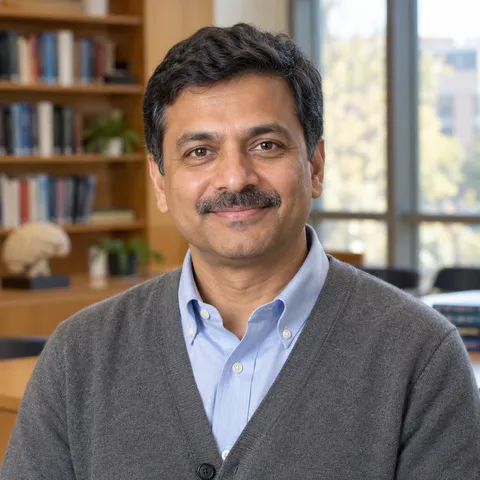
Dr. Arjun Iyer
Associate Professor of Neuroscience
Instructor for NEUR 201, Fall 2026
- Office
- Meridian Science Center 238
- aiyer
@university.alkimi.ai
NEUR 201 · Neuroscience
Neuroanatomy, neurons and glia, membrane potentials, synaptic transmission, sensory and motor systems, and the neural basis of learning and behavior, with a weekly three-hour laboratory in neuroanatomy and electrophysiology.
Fall 2026 · At a glance
200-level courses: intermediate, lower-division courses suitable for sophomores and above. Details: Undergraduate Catalog §9.19.
Associate Professor of Neuroscience
Instructor for NEUR 201, Fall 2026
Questions about a major or your plan: Academic Advising Center, Lovell Hall 101, (555) 555-0158.
Class meetings
Lecture
Mon, Wed, Fri, 3:00–3:50 p.m.
Meridian Science Center 140
Lab
Thu, 8:00–10:50 a.m.
Meridian Science Center 124
Final exam
Wednesday, December 16, 2026
11:30 a.m.–1:30 p.m., Meridian Science Center 140
Office hours
Wed & Fri, 1:00–2:30 p.m.
Meridian Science Center 238
Mon, 11:00 a.m.–12:00 p.m.
Virtual (Zoom link in Canvas)
You may use AI tools to generate 3D anatomical flashcards, clarify biophysical equations like the Nernst and Goldman-Hodgkin-Katz equations, and proofread draft laboratory write-ups. You may not use AI tools to interpret electrophysiological recordings or oscilloscope traces, complete assigned case studies, generate post-lab discussion text, or consult AI during exams.
From the syllabus
Grading
Letter grades follow the university scale (Student Handbook §4.1).
Key dates
First day of classes Past
Midterm Exam 1 Past
Midterm Exam 2 Next
Neurobiology Case Study Project
Required materials
Bear, Mark F., Barry W. Connors, and Michael A. Paradiso. Neuroscience: Exploring the Brain. 4th ed., Wolters Kluwer, 2016.
Approx. $65 for digital access; approx. $130 for print purchase.
NEUR 201 Neuroscience Laboratory Manual (Fall 2026). Alkimi University Copy Center.
Approx. $20.
Dissection kit with scalpel, fine forceps, blunt probe, and ANSI Z87.1 splash goggles.
Approx. $25 at campus bookstore.
Degree planning
What to take first, what this course opens up, and the requirements it can satisfy, from the Undergraduate Catalog.
Every course also counts toward the 120 credits needed for a bachelor's degree. Confirm your plan with your advisor or the Academic Advising Center.
No AP exam awards credit for NEUR 201 (Undergraduate Catalog §3.11).
Registration
NEUR 201 is offered in the fall semester. Register through AlkimiHub self-service registration, which opens by credit standing. Until the add deadline, you don't need instructor permission as long as seats remain and you've met the prerequisites. Details: Student Handbook §3.3.
When a seat opens, AlkimiHub offers it to the first student on the waitlist and emails you. You have 24 hours to claim it before it goes to the next student. Details: Student Handbook §3.10.
Fall 2026 withdrawal deadline
Last day to withdraw with a W or elect Pass/No Pass.
Fall 2027 registration opens
By credit standing, in AlkimiHub.
The Fall 2026 add deadline passed on Sep 2, 2026.
All dates: academic calendar. Registration help: Office of the Registrar.
Official course syllabus
The syllabus as filed with the department and posted in Canvas for Fall 2026.
Term: Fall 2026
Credits: 4.0
Lecture Times & Location: Monday, Wednesday, Friday 3:00–3:50 p.m., Meridian Science Center 140
Laboratory Time & Location: Thursday 8:00–10:50 a.m., Meridian Science Center 124
Modality: In-Person Lecture and Laboratory
aiyer@university.alkimi.ai
Neuroanatomy, neurons and glia, membrane potentials, synaptic transmission, sensory and motor systems, and the neural basis of learning and behavior, with a weekly three-hour laboratory in neuroanatomy and electrophysiology. NEUR 201 is the foundational gateway course for neuroscience majors and pre-health students, exploring the biological mechanisms underlying nervous system function from ion channels to complex cognitive behavior. We examine cellular neurobiology, resting membrane potentials, action potential generation and propagation, neurotransmitter synthesis and synaptic transmission, sensory transduction, motor circuitry, and synaptic plasticity. In the weekly laboratory in Meridian Science Center 124, you will perform sheep brain gross dissections, histological staining of neural tissue, computer simulation of Hodgkin-Huxley kinetics, and extracellular electrophysiology in invertebrate model organisms.
BIO 101 and CHEM 101.
Upon successful completion of NEUR 201, students will be able to:
In accordance with Alkimi University Academic Policies (Student Handbook §5.8), NEUR 201 operates under AI Level 2.
| Week | Dates | Topics & Readings | Laboratory | Assignments & Deadlines |
|---|---|---|---|---|
| Week 1 | Aug 26, 28 | Introduction to Neuroscience and Cellular Organization: History of neuroscience, the neuron doctrine, neuronal soma, dendrites, axons, synaptic terminals, and diverse glial subtypes (astrocytes, microglia, oligodendrocytes). Reading: Bear Ch. 1 & 2 | No lab meetings this week. | First day of classes: Wed Aug 26. |
| Week 2 | Aug 31–Sep 4 | The Neuronal Membrane at Rest and Ion Channels: Phospholipid bilayer, ion channels and pumps, electrical charge, Ohm's law, Nernst equation, and Goldman-Hodgkin-Katz resting membrane potential. Reading: Bear Ch. 3 | Lab 1: Mammalian Brain Gross Anatomy and Meninges Dissection. | Wed Sep 2: Add/section change deadline. |
| Week 3 | Sep 9, 11 | The Action Potential: Threshold and Propagation: Phases of the action potential, voltage-gated sodium and potassium channels, absolute and relative refractory periods, and saltatory conduction along myelinated axons. Reading: Bear Ch. 4 | Lab 2: Sheep Brain Cranial Nerves and Surface Neuroanatomy. | Mon Sep 7: Labor Day (no classes). Wed Sep 9: Census date (last day to drop without a W). |
| Week 4 | Sep 14–18 | Synaptic Transmission and Neurotransmitter Release: Electrical gap junctions, chemical synapse ultrastructure, SNARE proteins, calcium-dependent exocytosis, EPSPs, IPSPs, and spatial/temporal summation. Reading: Bear Ch. 5 | Lab 3: Sheep Brain Coronal and Sagittal Sectioning. | — |
| Week 5 | Sep 21–25 | Neurotransmitter Systems and Receptors & Midterm Exam 1: Acetylcholine, catecholamines, serotonin, amino acid transmitters (glutamate, GABA, glycine), and G-protein coupled receptors; Midterm Exam 1 in class. Reading: Bear Ch. 6 | Lab 4: Computer Simulation of Hodgkin-Huxley Action Potential Kinetics. | Midterm Exam 1 (in class). |
| Week 6 | Sep 28–Oct 2 | Gross Anatomy and Structural Organization of the Brain: Anatomical axes, forebrain, midbrain, hindbrain, ventricular system, cerebrospinal fluid circulation, meninges, and peripheral cranial and spinal nerves. Reading: Bear Ch. 7 | Lab 5: Neuronal Histology and Nissl/Golgi Staining Microscopy. | — |
| Week 7 | Oct 5–9 | The Chemical Senses: Olfaction and Gustation: Taste bud physiology, transduction mechanisms for five basic tastes, olfactory receptor neurons, glomeruli, and olfactory cortex projection maps. Reading: Bear Ch. 8 | Lab 6: Extracellular Electrophysiology: Earthworm Giant Axon Conduction Velocity. | — |
| Week 8 | Oct 14, 16 | The Eye: Photoreception and Retinal Circuitry: Optical apparatus, photoreceptor rods and cones, phototransduction cascade, rhodopsin, cyclic GMP, on/off center bipolar cells, and ganglion receptive fields. Reading: Bear Ch. 9 | Lab 7: Refractory Periods and Temperature Effects on Nerve Conduction. | Oct 12–Oct 13: Fall break (no classes). Fri Oct 16: Midterm grades due. |
| Week 9 | Oct 19–23 | Central Visual Pathways and Striate Cortex: Retinofugal projection, lateral geniculate nucleus (LGN) laminations, primary visual cortex (V1), ocular dominance columns, and dorsal/ventral visual streams. Reading: Bear Ch. 10 | Lab 8: Invertebrate Neuromuscular Junction Intracellular Recording. | — |
| Week 10 | Oct 26–30 | Auditory and Vestibular Sensation & Midterm Exam 2: Cochlear mechanics, hair cell stereocilia, tonotopic organization, auditory pathways, semicircular canals, and otolith organs; Midterm Exam 2 in class. Reading: Bear Ch. 11 | Lab 9: Sensory Psychophysics: Two-Point Discrimination and Audiometry. | Midterm Exam 2 (in class). |
| Week 11 | Nov 2–6 | The Somatosensory System and Pain Processing: Mechanoreceptors of the skin, receptive fields, dermatomes, dorsal column-medial lemniscal pathway, spinothalamic nociceptive pathway, and analgesia. Reading: Bear Ch. 12 | Lab 10: Human Electromyography (EMG) and Spinal Reflex Arc Testing. | Fri Nov 6: Last day to withdraw (W) or elect Pass/No Pass. |
| Week 12 | Nov 9–13 | Spinal Control of Movement and Motor Units: Lower motor neurons, motor unit recruitment (Henneman's size principle), muscle spindles, gamma motor neurons, Golgi tendon organs, and central pattern generators. Reading: Bear Ch. 13 | Lab 11: Electroencephalography (EEG) Rhythms and Evoked Potentials. | — |
| Week 13 | Nov 16–20 | Central Motor Control: Cortex and Basal Ganglia: Primary motor cortex (M1), supplementary motor area, basal ganglia direct and indirect pathways, Parkinson's and Huntington's pathology, and cerebellar coordination. Reading: Bear Ch. 14 | Lab 12: Behavioral Testing in Rodents: Open Field and Elevated Plus Maze. | Neurobiology Case Study Project due Fri Nov 20 at 11:59 p.m. |
| Week 14 | Nov 23 | Chemical Control of the Brain: Autonomic and Diffuse Systems: Sympathetic and parasympathetic divisions, diffuse modulatory systems (noradrenergic, serotonergic, dopaminergic, cholinergic), and psychostimulant actions. Reading: Bear Ch. 15 | No lab meetings this week (holiday). | Nov 25–Nov 27: Thanksgiving break (no classes). |
| Week 15 | Nov 30–Dec 4 | Motivation, Emotion, and Limbic Circuits: Hypothalamus homeostatic control, reward pathways (mesolimbic dopamine), amygdala fear conditioning circuits, and neurobiology of aggression. Reading: Bear Ch. 16 & 18 | Lab 13: Laboratory Practical Examination: Neuroanatomy and Electrophysiology. | — |
| Week 16 | Dec 7, 9 | Synaptic Plasticity, Memory Systems, and Course Review: Declarative versus procedural memory, hippocampal synaptic plasticity (LTP and LTD), NMDA receptor coincidence detection, AMPA insertion, and review. Reading: Bear Ch. 24 & 25 & Review | No lab meetings this week (holiday). | Wed Dec 9: Last day of classes. Thu Dec 10: Reading Day. |
| Finals | Dec 16 | Final Comprehensive Examination: Wednesday, December 16, 2026, 11:30 a.m.–1:30 p.m., Meridian Science Center 140. | — | Comprehensive examination covering cellular neurobiology, sensory-motor systems, neuroanatomy, and neural plasticity. |
Consistent attendance at all lectures and laboratory sessions is essential. Laboratory practicals, brain dissections, and live electrophysiological recordings cannot be made up outside designated section meetings. Notify Dr. Iyer in advance of excused absences. Accumulating more than two unexcused lab absences results in an administrative failure (F). Students who miss the first two class meetings without notifying the instructor may be dropped. Students may miss class for religious observance without penalty if they notify the instructor in writing within the first two weeks of the semester (by Wednesday, September 9, 2026). Absences for university-sponsored activities (athletics, performances, conferences) are excused with a letter from the sponsoring office at least one week in advance.
Laboratory reports submitted after the Thursday deadline lose 10% per day and will not be accepted after Sunday 11:59 p.m. Weekly pre-lecture quizzes close promptly at the deadline with no extensions, but the two lowest quiz grades are automatically dropped at semester end.
Meridian Science Center 124 involves biological tissue dissections and electronic recording equipment. Buttoned lab coats, ANSI Z87.1 splash goggles, nitrile gloves, and closed-toe footwear are mandatory during all dissection sessions. Dispose of all sharps in biohazard puncture-resistant containers.
The final examination (Wednesday, December 16, 2026, 11:30 a.m.–1:30 p.m.) is scheduled by the University Registrar and can't be moved without the Dean's written approval (Faculty Handbook §5.5). A student with three or more final exams on the same calendar day may reschedule one of them. Requests go to the instructor of the middle exam by the last day of classes. For this term, send the request by Wednesday, December 9, 2026 (Student Handbook §6.4).
Alkimi University is an academic community devoted to rigorous scholarship, open intellectual inquiry, and uncompromising ethical conduct. All students are subject to the regulations of the Alkimi University Academic Integrity Policy. Academic dishonesty—including plagiarism, cheating on examinations, unauthorized collaboration, fabrication of empirical data, and unauthorized submission of academic work generated by artificial intelligence—undermines the integrity of the university and carries severe disciplinary sanctions. Sanctions range from a failing grade on an assignment or exam to an administrative course failure recorded as an 'XF' on the official transcript, academic suspension, or expulsion. Suspected violations are formally investigated and resolved through the Office of Academic Integrity in accordance with Faculty Handbook §6. For detailed information, consult the Office of Academic Integrity, Lovell Hall 315, (555) 555-0163, integrity@university.alkimi.ai.
Alkimi University is committed to providing equitable educational access and reasonable accommodations for all students with documented disabilities, including physical, sensory, psychological, learning, and chronic health conditions. Students requesting academic accommodations must formally register with the Office of Accessibility Services, Harlan Hall 204, (555) 555-0155, access@university.alkimi.ai. Once approved, students will receive an official Faculty Accommodation Letter detailing approved accommodations. Students should present this letter to the instructor as early in the semester as possible, and at least one week prior to any exam or assignment requiring accommodation. Accommodations cannot be applied retroactively.
Your physical health, psychological well-being, and mental health are essential to your academic success. If you experience heightened stress, anxiety, depressive symptoms, personal trauma, or academic burnout, free, confidential counseling and medical care are available through the Hollis Health & Counseling Center, located in the Hollis Center. Routine appointments are available Monday–Friday 8:00 a.m.–6:00 p.m. and Saturday 10:00 a.m.–2:00 p.m. during the semester by calling (555) 555-0190 or emailing health@university.alkimi.ai. Urgent, 24/7 crisis psychological counseling is accessible immediately at (555) 555-0199.
advising@university.alkimi.ai
askalibrarian@university.alkimi.ai
health@university.alkimi.ai
NEUR courses