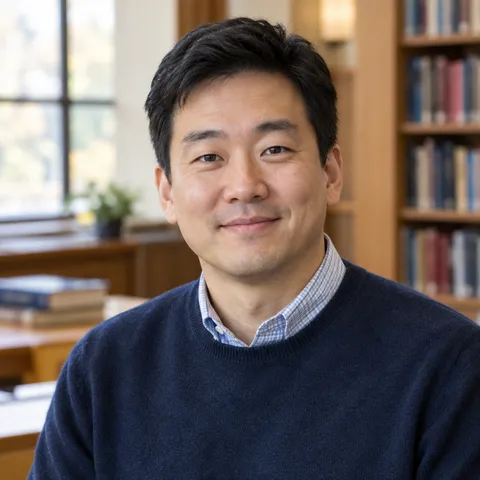
Dr. Daniel Kim
Associate Professor of Chemistry
Instructor for CHEM 101 (Fall 2026)
- Office
- Meridian Science Center 312
- dkim@university.alkimi.ai
CHEM 101 · Science
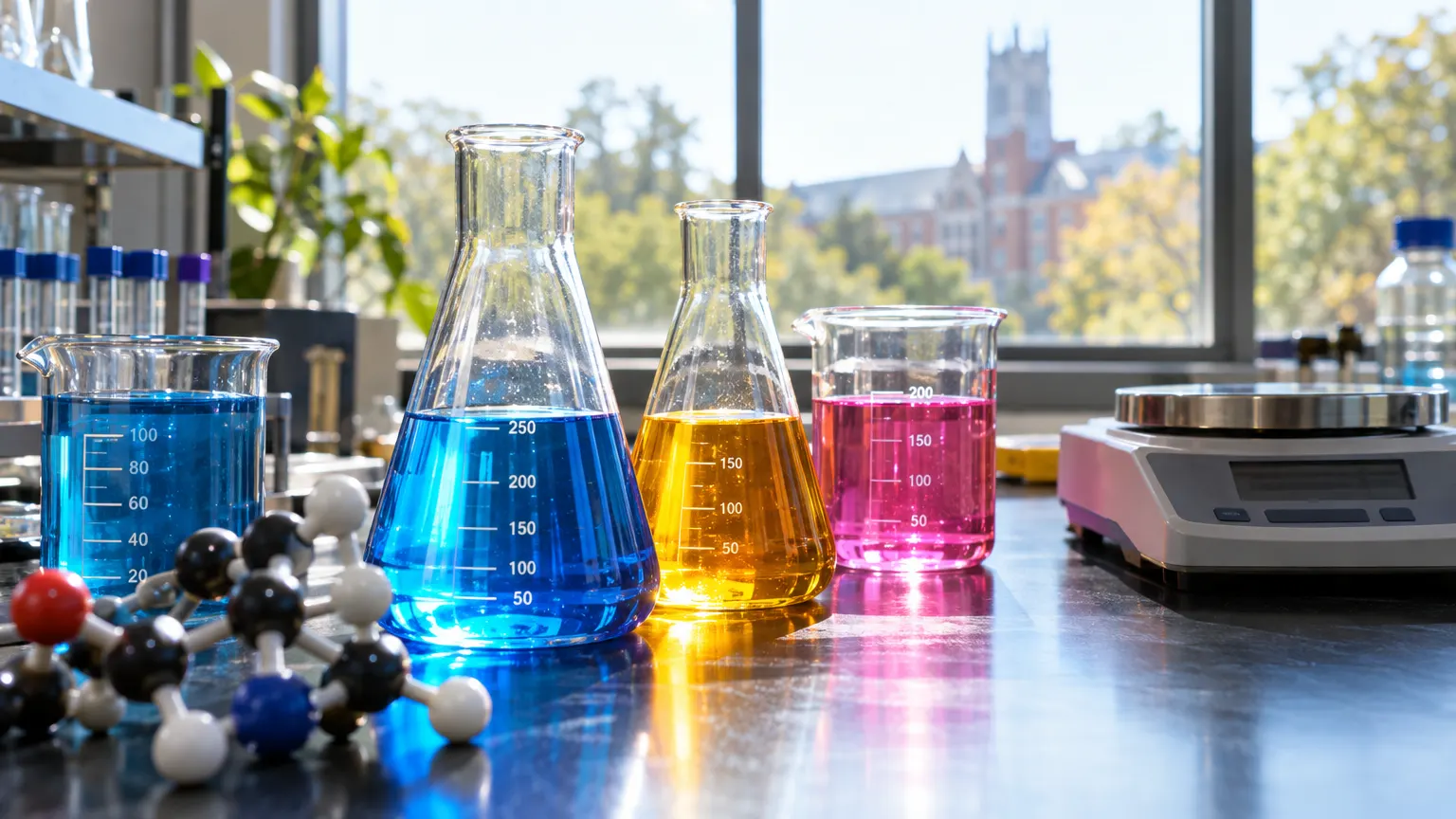
Atomic structure, bonding, stoichiometry, gases, thermochemistry, and solutions.
Fall 2026 Overview
Meeting Times & Location
Lecture MWF 9:00–9:50 a.m., Meridian 140; labs weekly
Generative AI Policy
AI Level 1AI Level 1: Not permitted for graded work. The CHEM 101 assistant acts strictly as a Socratic tutor, explaining conceptual principles and problem-solving steps. It will not solve homework problems, write lab reports, or balance equations for graded credit.
Associate Professor of Chemistry
Instructor for CHEM 101 (Fall 2026)
Enrolled students have 24/7 access to this course's dedicated AI assistant, grounded in the syllabus, weekly lecture notes, and assignment sheets.
Key Academic Benchmarks
Essential course requirements, grading structure, upcoming deadlines, and required learning materials.
Grading Weights
Deadlines
First Day of Classes
Wednesday, August 26, 2026
Assignment 1 Due
Friday, September 18, 2026
Midterm Exam 1 (In-Class)
Wednesday, October 7, 2026
Midterm Exam 2 (In-Class)
Friday, November 6, 2026
Final Comprehensive Exam
Wednesday, December 16, 2026 (9:00 a.m.)
Course Texts
Flowers et al., Chemistry 2e (OpenStax)
Free digital access / optional print approx. $55
CHEM 101 General Chemistry I Laboratory Manual
Approx. $20 at Copy Center
Duplicate-Page Lab Notebook & ANSI Splash Goggles
Approx. $23
Non-Programmable Scientific Calculator
Approx. $15
Curriculum
Week 1: Measurements & Essential Ideas
Scientific notation, significant figures, SI units, dimensional analysis, and classification of matter.
Week 2: Atoms, Molecules, & the Periodic Table
Atomic theory, subatomic particles, isotopes, average atomic mass, and the periodic table.
Week 3: Formulas & the Mole Concept
Chemical formulas, ionic and molecular compounds, nomenclature, and the mole concept.
Week 4: Chemical Equations & Stoichiometry
Balancing reactions, mole ratios, mass-to-mass calculations, limiting reactants, and percent yield.
Student Interactive Tool
Ask about the syllabus, deadlines, and this week's notes.
The CHEM 101 Learning Assistant is embedded directly into Canvas and accessible right here for registered students. Grounded exclusively in Dr. Daniel Kim's verified course documents, the assistant helps you:
Authentication Required
This assistant is private to enrolled students and course instructors. Sign in using your university AlkimiID credentials in the chat frame.
Official Course Contract
The official syllabus as filed with the department and published in Canvas for the Fall 2026 academic semester.
Term: Fall 2026
Credits: 4.0 (3 hours lecture + 3 hours laboratory weekly)
Lecture Times & Location: Monday, Wednesday, Friday 9:00–9:50 a.m., Meridian Science Center 140
Laboratory Location: Meridian Science Center 144 (Section 01: Tue 9:00–11:50 a.m. | Section 02: Tue 1:30–4:20 p.m. | Section 03: Thu 1:30–4:20 p.m.)
dkim@university.alkimi.aiAtomic structure, bonding, stoichiometry, gases, thermochemistry, and solutions. CHEM 101 is the initial course in the two-semester general chemistry sequence for science, engineering, and pre-professional health majors. The course explores the quantitative and conceptual principles of matter and chemical change: measurement and dimensional analysis, atomic theory and periodicity, chemical formula and reaction stoichiometry, aqueous precipitation, acid-base and redox reactions, thermochemical enthalpy and calorimetry, quantum mechanics and electronic configurations, molecular geometry and chemical bonding, and gas behaviors. Laboratory experiments emphasize quantitative analysis, precision measurement, spectrophotometry, thermochemistry, and formal scientific reporting.
High school chemistry or CHEM 090; MATH 115 (Precalculus) or placement into MATH 140 (Calculus I).
Upon completing this course, students will be able to:
In accordance with university policy (Student Handbook §5.8), CHEM 101 operates under AI Level 1.
| Week | Dates | Lecture Topics (MWF) | Laboratory Experiment | Assignments & Deadlines |
|---|---|---|---|---|
| Week 1 | Aug 26, 28 | Measurements & Essential Ideas: Scientific notation, significant figures, SI units, dimensional analysis, classification of matter. (First class: Wed Aug 26) | No lab meetings this week. | Welcome & diagnostic review. |
| Week 2 | Aug 31, Sep 2, 4 | Atoms, Molecules, & the Periodic Table: Atomic theory, subatomic particles, isotopes, average atomic mass, the periodic table. | Lab 1: Laboratory Safety, Balance Calibration, and Density Determination. | Wed Sep 2: Add/Drop deadline. Pre-lab 1 due. |
| Week 3 | Sep 9, 11 | Formulas & the Mole Concept: Chemical formulas, ionic/molecular compounds, chemical nomenclature, formula mass, the mole. (Mon Sep 7: Labor Day, No class) | Lab 2: Separation of a Mixture and Percent Recovery. | Wed Sep 9: Census date (Drop without W). |
| Week 4 | Sep 14, 16, 18 | Chemical Equations & Stoichiometry: Balancing reactions, mole ratios, mass-to-mass calculations, limiting reactants, percent yield. | Lab 3: Empirical Formula of a Copper Hydrate. | Assignment 1 Due: Friday Sep 18 at 11:59 p.m. |
| Week 5 | Sep 21, 23, 25 | Aqueous Reactions: Electrolytes, precipitation reactions, solubility rules, complete and net ionic equations, Arrhenius/Brønsted acids and bases. | Lab 4: Precipitation Reactions and Qualitative Solubility Rules. | Problem Set 4 due Sep 25. |
| Week 6 | Sep 28, 30, Oct 2 | Solution Stoichiometry & Redox: Solution concentration (Molarity), dilution equation ($M_1V_1 = M_2V_2$), titration stoichiometry, oxidation numbers; Exam 1 Review. | Lab 5: Volumetric Acid-Base Titration: Standardization of NaOH. | Pre-lab 5 due. |
| Week 7 | Oct 5, 7, 9 | Exam 1 & Thermochemistry: Energy, heat capacity, constant-pressure calorimetry ($q = mc\Delta T$). | Lab 6: Enthalpy of Neutralization and Hess’s Law Calorimetry. | Midterm Exam 1: Wednesday Oct 7 in class. |
| Week 8 | Oct 14, 16 | Enthalpy & Hess’s Law: State functions, Hess’s Law, standard enthalpies of formation ($\Delta H_f^\circ$). (Mon Oct 12: Fall Break, No class) | No lab meetings this week (Fall Break). | Fri Oct 16: Midterm grades due. |
| Week 9 | Oct 19, 21, 23 | Electronic Structure of Atoms: Waves, electromagnetic radiation, photon energy ($E=h\nu$), Bohr model, De Broglie wavelength, quantum numbers ($n, l, m_l, m_s$). | Lab 7: Emission Spectroscopy and Atomic Line Spectra. | Problem Set 7 due Oct 23. |
| Week 10 | Oct 26, 28, 30 | Orbitals & Periodic Trends: Orbital shapes, Aufbau principle, Hund’s rule, Pauli exclusion, electron configurations; periodic trends (atomic radii, $IE$, $EA$, electronegativity). | Lab 8: Periodic Properties of the Halogens and Alkaline Earth Metals. | Problem Set 8 due Oct 30. |
| Week 11 | Nov 2, 4, 6 | Chemical Bonding & Exam 2: Ionic vs. covalent bonds, electronegativity, Lewis electron dot structures, resonance, formal charges. | Lab 9: Molecular Modeling, Lewis Structures, and VSEPR Geometries. | Fri Nov 6: Withdrawal (W) deadline. Midterm Exam 2: Friday Nov 6 in class. |
| Week 12 | Nov 9, 11, 13 | Molecular Geometry & Hybridization: VSEPR theory, electron-pair vs. molecular geometry, bond dipoles, valence bond theory, hybrid orbitals ($sp, sp^2, sp^3$). | Lab 10: Spectrophotometric Analysis of Iron Concentration via Beer’s Law. | Problem Set 10 due Nov 13. |
| Week 13 | Nov 16, 18, 20 | Gas Laws & Gas Stoichiometry: Pressure, Boyle’s, Charles’s, Avogadro’s Laws, Ideal Gas Law ($PV=nRT$), gas densities, molar mass, Dalton’s Law of Partial Pressures. | Lab 11: Determination of the Molar Volume of Hydrogen Gas. | Problem Set 11 due Nov 20. |
| Week 14 | Nov 23 | Kinetic Molecular Theory: Real gases, effusion/diffusion, Van der Waals equation. (Nov 25–27: Thanksgiving Break, No class) | No lab meetings this week (Thanksgiving). | Thanksgiving Break Nov 25–27. |
| Week 15 | Nov 30, Dec 2, 4 | Intermolecular Forces & States of Matter: Dispersion forces, dipole-dipole, hydrogen bonding, ion-dipole; vapor pressure, boiling points, phase diagrams. | Lab 12: Laboratory Practical Examination & Check-out. | Lab Practical in lab section. |
| Week 16 | Dec 7, 9 | Solutions & Course Review: Solution formation thermodynamics, solubility factors; Comprehensive Review. | No labs. | Wed Dec 9: Last day of classes. Thu Dec 10: Reading Day. |
| Finals | Dec 16 | Final Comprehensive Examination: Wednesday, December 16, 2026, 9:00–11:00 a.m., Meridian Science Center 140. | Comprehensive exam covering all lectures. |
Online homework must be completed on time; no late homework is accepted after keys are released. Laboratory notebook entries and post-lab assignments submitted late incur a penalty of 10% per 24 hours, up to a maximum of 48 hours. Submissions beyond 48 hours receive a zero.
Under university policy (Student Handbook §6.4), students with three or more final exams scheduled on the same calendar day may request to reschedule the middle exam by contacting Dr. Kim in writing no later than Wednesday, December 9, 2026.
The university Academic Integrity Policy (Student Handbook §5.1) applies strictly. In chemistry, copying lab reports, manipulating numerical data, altering calculator programs, or using generative AI on graded assignments constitutes academic dishonesty. First violations may be handled via a Faculty Resolution Agreement (sanction up to an F in the course) and are permanently reported to the Office of Academic Integrity (Lovell Hall 315, integrity@university.alkimi.ai, (555) 555-0163).
Students with approved accommodations should contact the Office of Accessibility Services:
access@university.alkimi.aiDeliver your official accommodation letter to Dr. Kim within the first two weeks of the semester to coordinate testing or laboratory arrangements.
advising@university.alkimi.ai