
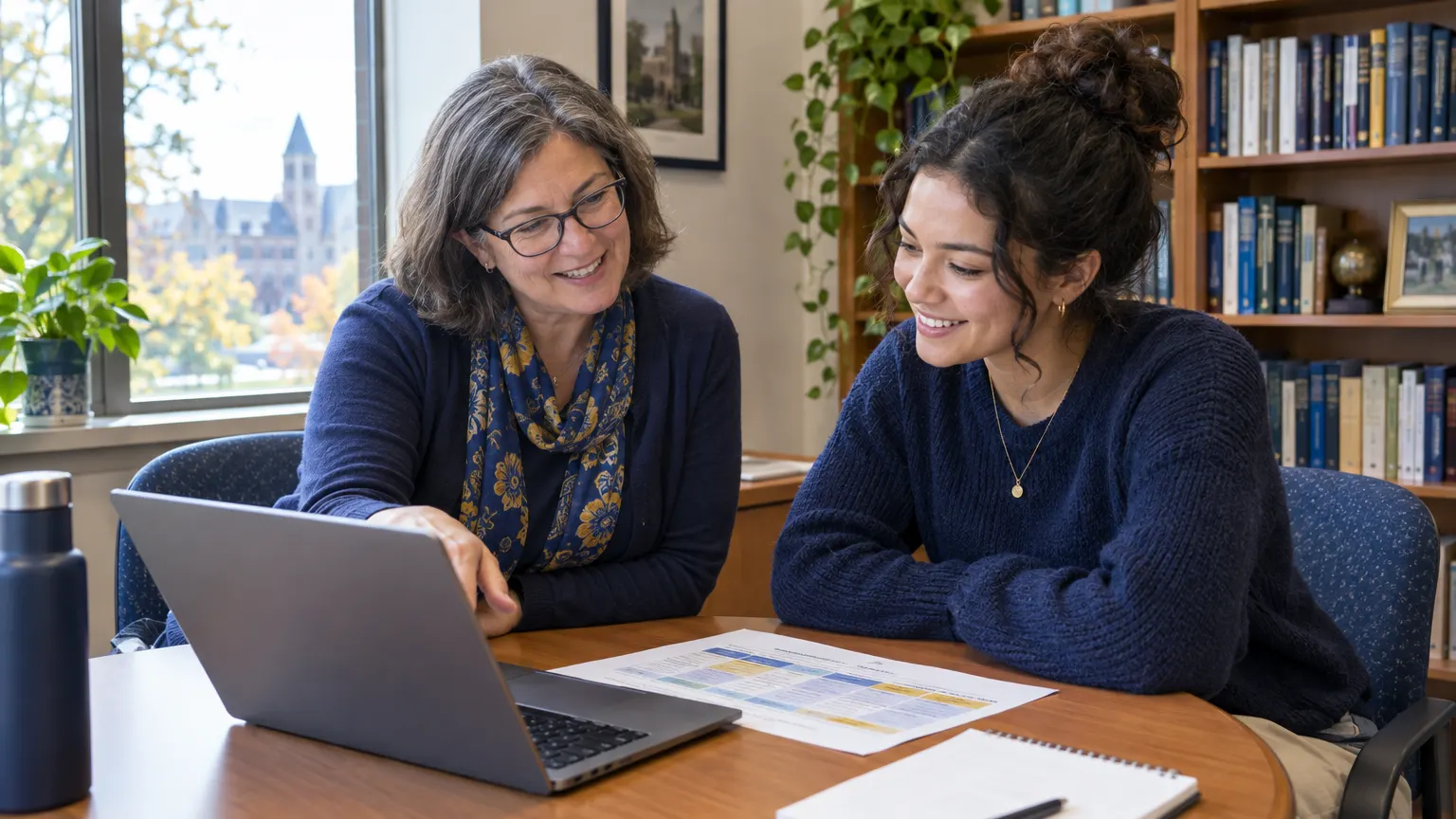

Dr. Leah Carver
Assistant Professor of Psychology
Instructor for PSYC 380, Fall 2026
- Office
- Lovell Hall 162
- lcarver
@university.alkimi.ai
PSYC 380 · Psychology
Factorial and repeated-measures designs, analysis of variance and covariance, multiple regression, mediation and moderation, power analysis, and reproducible analysis in R for behavioral research.
Fall 2026 · At a glance
300-level courses: advanced, upper-division courses requiring prior foundational preparation. Counts toward the 36 upper-division credits every bachelor's degree requires (Undergraduate Catalog §2.3). Details: Undergraduate Catalog §9.11.
Assistant Professor of Psychology
Instructor for PSYC 380, Fall 2026
Questions about a major or your plan: Academic Advising Center, Lovell Hall 101, (555) 555-0158.
Class meetings
Tue & Thu, 2:30–3:45 p.m.
Lovell Hall 325
Final exam
Thursday, December 17, 2026
1:00–3:00 p.m., Lovell Hall 325
Office hours
Tue & Fri, 1:00–2:30 p.m.
Lovell Hall 162
Mon, 9:00–10:00 a.m.
Virtual (Zoom link in Canvas)
You may use AI tools to troubleshoot R syntax errors, explain statistical package error messages (e.g., from car, lme4, or mediation), generate practice datasets, and refine R Markdown documentation formatting. You may not submit AI-generated statistical interpretation text, automated data analysis write-ups, or unverified R code.
From the syllabus
Grading
Letter grades follow the university scale (Student Handbook §4.1).
Key dates
First day of classes Past
Midterm Exam 1 Past
Midterm Exam 2 Next
Reproducible Empirical Research Project
Required materials
Field, Andy, Jeremy Miles, and Zoë Field. Discovering Statistics Using R. SAGE Publications, 2012.
Approx. $50 for digital rental; approx. $85 for print purchase.
Navarro, Danielle. Learning Statistics with R: A Tutorial for Psychology Students and Other Beginners. Free open-access digital edition.
Free.
R (v4.3+) and RStudio Desktop development environment.
Free open-source software.
Degree planning
What to take first, what this course opens up, and the requirements it can satisfy, from the Undergraduate Catalog.
No other catalog course lists PSYC 380 as a prerequisite.
Every course also counts toward the 120 credits needed for a bachelor's degree. Confirm your plan with your advisor or the Academic Advising Center.
No AP exam awards credit for PSYC 380 (Undergraduate Catalog §3.11).
Registration
PSYC 380 is offered in the fall semester. Register through AlkimiHub self-service registration, which opens by credit standing. Until the add deadline, you don't need instructor permission as long as seats remain and you've met the prerequisites. Details: Student Handbook §3.3.
When a seat opens, AlkimiHub offers it to the first student on the waitlist and emails you. You have 24 hours to claim it before it goes to the next student. Details: Student Handbook §3.10.
Fall 2026 withdrawal deadline
Last day to withdraw with a W or elect Pass/No Pass.
Fall 2027 registration opens
By credit standing, in AlkimiHub.
The Fall 2026 add deadline passed on Sep 2, 2026.
All dates: academic calendar. Registration help: Office of the Registrar.
Official course syllabus
The syllabus as filed with the department and posted in Canvas for Fall 2026.
Term: Fall 2026
Credits: 3.0
Lecture Times & Location: Tuesday & Thursday 2:30–3:45 p.m., Lovell Hall 325
Modality: In-Person
lcarver@university.alkimi.ai
Factorial and repeated-measures designs, analysis of variance and covariance, multiple regression, mediation and moderation, power analysis, and reproducible analysis in R for behavioral research. PSYC 380 provides advanced methodological and statistical training for behavioral science majors preparing for graduate study or empirical research careers. Emphasizing open science and reproducible workflow practices, students formulate complex experimental and quasi-experimental designs and conduct sophisticated hypothesis testing using R and R Markdown. Core analytical topics include factorial analysis of variance (ANOVA), repeated-measures and mixed ANOVA, analysis of covariance (ANCOVA), multiple linear regression, mediation and moderation models, statistical power estimation, effect size reporting, and nonparametric alternatives.
PSYC 205 and STAT 205.
Upon successful completion of PSYC 380, students will be able to:
In accordance with Alkimi University Academic Policies (Student Handbook §5.8), PSYC 380 operates under AI Level 2.
| Week | Dates | Topics & Readings | Assignments & Deadlines |
|---|---|---|---|
| Week 1 | Aug 27 | Open Science, Reproducibility, and the R Environment: Replication crisis in psychology, preregistration, RStudio project setup, tidyverse packages, and dynamic reproducible authoring with R Markdown. Reading: Field Ch. 1 & 3 | First day of classes: Wed Aug 26. |
| Week 2 | Sep 1, 3 | Exploratory Data Analysis and Data Visualization: Data wrangling with dplyr, descriptive statistics, distribution normality checks, outlier detection, and publication-ready figures in ggplot2. Reading: Field Ch. 4 & 5 | Wed Sep 2: Add/section change deadline. |
| Week 3 | Sep 8, 10 | The General Linear Model and Parametric Assumptions: Linear model formulation, ordinary least squares, homoscedasticity, normality of residuals, multicollinearity, and data transformation strategies. Reading: Field Ch. 6 | Mon Sep 7: Labor Day (no classes). Wed Sep 9: Census date (last day to drop without a W). |
| Week 4 | Sep 15, 17 | One-Way Independent ANOVA and Contrast Testing: Partitioning variance (SS_between, SS_within), F-distribution, orthogonal planned comparisons, trend analysis, and post-hoc adjustments (Tukey, Bonferroni). Reading: Field Ch. 10.1–10.3 | — |
| Week 5 | Sep 22, 24 | Factorial Independent ANOVA & Midterm Exam 1: Two-way and three-way factorial designs, main effects, disordinal and ordinal interactions, simple main effects; Midterm Exam 1 in class. Reading: Field Ch. 12 | Midterm Exam 1 (in class). |
| Week 6 | Sep 29, Oct 1 | Repeated-Measures ANOVA and Sphericity: Within-subjects variance partitioning, Mauchly's test of sphericity, Greenhouse-Geisser and Huynh-Feldt corrections, and repeated-measures contrasts. Reading: Field Ch. 13 | — |
| Week 7 | Oct 6, 8 | Mixed-Design (Split-Plot) ANOVA: Between- and within-subjects factors, interaction partitioning, simple simple effects, and error term selection in mixed ANOVA models. Reading: Field Ch. 14 | — |
| Week 8 | Oct 15 | Analysis of Covariance (ANCOVA): Controlling extraneous variance, covariate selection criteria, adjusted means, and testing the assumption of homogeneity of regression slopes. Reading: Field Ch. 11 | Oct 12–Oct 13: Fall break (no classes). |
| Week 9 | Oct 20, 22 | Multiple Linear Regression and Diagnostics: Simultaneous regression, standardized coefficients (beta), semi-partial correlations, R-squared change, leverage, Cook's distance, and VIF. Reading: Field Ch. 7.1–7.6 | — |
| Week 10 | Oct 27, 29 | Hierarchical Regression & Midterm Exam 2: Theoretical block entry, incremental variance accounted for, model comparison tests; Midterm Exam 2 in class. Reading: Field Ch. 7.7–7.12 | Midterm Exam 2 (in class). |
| Week 11 | Nov 3, 5 | Moderation Analysis and Probing Interactions: Continuous by continuous interactions, mean centering, simple slopes analysis, Johnson-Neyman technique (floodlight analysis), and PROCESS macro in R. Reading: Field Ch. 10 & Hayes | Fri Nov 6: Last day to withdraw (W) or elect Pass/No Pass. |
| Week 12 | Nov 10, 12 | Mediation Analysis and Bootstrapping: Baron and Kenny causal steps approach, contemporary indirect effect estimation, non-normal sampling distributions, and percentile bootstrapping. Reading: Field Ch. 10 & Hayes | — |
| Week 13 | Nov 17, 19 | Statistical Power Analysis and Effect Sizes: Type I and Type II errors, alpha and beta, Cohen's d, partial eta-squared, omega-squared, and power calculation with G*Power and pwr package. Reading: Navarro Ch. 11 | Reproducible Empirical Research Project due Fri Nov 20 at 11:59 p.m. |
| Week 14 | Nov 24 | Nonparametric Alternatives to ANOVA: Rank-based hypothesis testing, Mann-Whitney U, Wilcoxon signed-rank, Kruskal-Wallis test, Friedman test, and robust statistical alternatives. Reading: Field Ch. 15 | Nov 25–Nov 27: Thanksgiving break (no classes). |
| Week 15 | Dec 1, 3 | Introduction to Linear Mixed-Effects Models: Random intercepts and slopes, clustered data, handling missing repeated measurements, and estimating models using the lme4 and lmerTest packages. Reading: Field Ch. 19 | — |
| Week 16 | Dec 8 | Reproducible Science, Preregistration, and Project Showcase: Preregistration workflows, data sharing repositories (OSF), code transparency, and final student empirical project research presentations. Reading: Navarro Ch. 17 & Review | Wed Dec 9: Last day of classes. Thu Dec 10: Reading Day. |
| Finals | Dec 17 | Final Comprehensive Examination: Thursday, December 17, 2026, 1:00–3:00 p.m., Lovell Hall 325. | Comprehensive examination covering experimental design, ANOVA, multiple regression, mediation, and statistical power. |
Mastering advanced statistical analysis in R requires active, hands-on computer lab participation during class sessions. If an illness or university-approved absence arises, email Dr. Carver in advance. More than three unexcused absences will negatively affect your final course grade. Students who miss the first two class meetings without notifying the instructor may be dropped. Students may miss class for religious observance without penalty if they notify the instructor in writing within the first two weeks of the semester (by Wednesday, September 9, 2026). Absences for university-sponsored activities (athletics, performances, conferences) are excused with a letter from the sponsoring office at least one week in advance.
R problem sets submitted after the Friday deadline lose 10% per day and will not be accepted more than three days late. Complete solution scripts are posted after that window. The single lowest weekly problem set score is automatically dropped at the end of the semester.
The final examination (Thursday, December 17, 2026, 1:00–3:00 p.m.) is scheduled by the University Registrar and can't be moved without the Dean's written approval (Faculty Handbook §5.5). A student with three or more final exams on the same calendar day may reschedule one of them. Requests go to the instructor of the middle exam by the last day of classes. For this term, send the request by Wednesday, December 9, 2026 (Student Handbook §6.4).
Alkimi University is an academic community devoted to rigorous scholarship, open intellectual inquiry, and uncompromising ethical conduct. All students are subject to the regulations of the Alkimi University Academic Integrity Policy. Academic dishonesty—including plagiarism, cheating on examinations, unauthorized collaboration, fabrication of empirical data, and unauthorized submission of academic work generated by artificial intelligence—undermines the integrity of the university and carries severe disciplinary sanctions. Sanctions range from a failing grade on an assignment or exam to an administrative course failure recorded as an 'XF' on the official transcript, academic suspension, or expulsion. Suspected violations are formally investigated and resolved through the Office of Academic Integrity in accordance with Faculty Handbook §6. For detailed information, consult the Office of Academic Integrity, Lovell Hall 315, (555) 555-0163, integrity@university.alkimi.ai.
Alkimi University is committed to providing equitable educational access and reasonable accommodations for all students with documented disabilities, including physical, sensory, psychological, learning, and chronic health conditions. Students requesting academic accommodations must formally register with the Office of Accessibility Services, Harlan Hall 204, (555) 555-0155, access@university.alkimi.ai. Once approved, students will receive an official Faculty Accommodation Letter detailing approved accommodations. Students should present this letter to the instructor as early in the semester as possible, and at least one week prior to any exam or assignment requiring accommodation. Accommodations cannot be applied retroactively.
Your physical health, psychological well-being, and mental health are essential to your academic success. If you experience heightened stress, anxiety, depressive symptoms, personal trauma, or academic burnout, free, confidential counseling and medical care are available through the Hollis Health & Counseling Center, located in the Hollis Center. Routine appointments are available Monday–Friday 8:00 a.m.–6:00 p.m. and Saturday 10:00 a.m.–2:00 p.m. during the semester by calling (555) 555-0190 or emailing health@university.alkimi.ai. Urgent, 24/7 crisis psychological counseling is accessible immediately at (555) 555-0199.
advising@university.alkimi.ai
askalibrarian@university.alkimi.ai
health@university.alkimi.ai
PSYC courses