
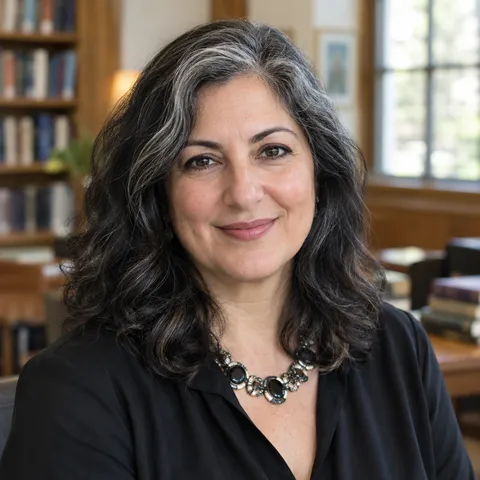
Dr. Leila Haddad
Professor of English; Chair of the University Curriculum Committee
Instructor for ENGL 210 (Fall 2026)
- Office
- Lovell Hall 332
- lhaddad@university.alkimi.ai
ENGL 210 · Writing & Humanities
American fiction, poetry, and essays from the early republic to the present.
Fall 2026 Overview
Meeting Times & Location
TTh 1:00–2:15 p.m., Lovell Hall 305
Generative AI Policy
AI Level 1AI Level 1: Not permitted for graded work. All analytical essays, reading journal responses, and seminar contributions must represent your original literary voice and interpretation. The course assistant assists only with biographical context and vocabulary definitions.
Professor of English; Chair of the University Curriculum Committee
Instructor for ENGL 210 (Fall 2026)
Enrolled students have 24/7 access to this course's dedicated AI assistant, grounded in the syllabus, weekly lecture notes, and assignment sheets.
Key Academic Benchmarks
Essential course requirements, grading structure, upcoming deadlines, and required learning materials.
Grading Weights
Deadlines
First Day of Classes
Thursday, August 27, 2026
Close Reading Essay 1 Due
Friday, September 18, 2026
Midterm Examination (In-Class)
Thursday, October 8, 2026
Major Comparative Research Essay Due
Friday, November 20, 2026
Final Comprehensive Exam
Monday, December 14, 2026 (1:00 p.m.)
Course Texts
Curated Public Domain Primary Readings (Canvas / Alkimi)
Free digital downloads
Levine, ed., The Norton Anthology of American Literature (Shorter 10th ed.)
Optional; approx. $55 used / $30 rental (reserve in Whitcombe Library)
Curriculum
Week 1: Early National Myth & Folklore
Washington Irving, Rip Van Winkle, and the invention of American literary identity after independence.
Week 2: Transcendentalism & the Sovereign Self
Ralph Waldo Emerson, Nature and Self-Reliance, intuition, nonconformity, and institutional critique.
Week 3: Dark Romanticism & Inherited Guilt
Nathaniel Hawthorne, Young Goodman Brown, The Minister’s Black Veil, and Puritan conscience.
Week 4: Abolitionism & the Slave Narrative
Frederick Douglass, Narrative of the Life, literacy, bodily subjugation, and masculine selfhood.
Student Interactive Tool
Ask about the syllabus, deadlines, and this week's notes.
The ENGL 210 Learning Assistant is embedded directly into Canvas and accessible right here for registered students. Grounded exclusively in Dr. Leila Haddad's verified course documents, the assistant helps you:
Authentication Required
This assistant is private to enrolled students and course instructors. Sign in using your university AlkimiID credentials in the chat frame.
Official Course Contract
The official syllabus as filed with the department and published in Canvas for the Fall 2026 academic semester.
Term: Fall 2026
Credits: 3.0
Meeting Schedule & Location: Tuesday & Thursday 1:00–2:15 p.m., Lovell Hall 305
Modality: In-Person Seminar & Discussion
lhaddad@university.alkimi.aiAmerican fiction, poetry, and essays from the early republic to the present. This course interrogates how writers have defined, contested, and reimagined the concept of "America." Tracing literary movements from early national mythmaking and Romantic transcendentalism through dark romanticism, the abolitionist slave narrative, realism, naturalism, and modernism, we examine how aesthetic forms grapple with democracy, individualism, race, gender, empire, and industrialization. Central authors include Washington Irving, Ralph Waldo Emerson, Henry David Thoreau, Nathaniel Hawthorne, Frederick Douglass, Herman Melville, Walt Whitman, Emily Dickinson, Mark Twain, and Kate Chopin.
Completion of the Alkimi Core Writing I requirement (WRIT 101 or equivalent) with a grade of C- or higher. Satisfies 3 credits of the Alkimi Core Humanities requirement and serves as a foundational requirement for English majors and minors.
Upon successful completion of ENGL 210, students will be able to:
In accordance with university academic policies (Student Handbook §5.8), ENGL 210 operates under AI Level 1.
| Week | Dates | Topics & Primary Authors | Major Readings & Deadlines |
|---|---|---|---|
| Week 1 | Aug 27 | Early National Myth & Folklore: The invention of American literary identity after independence. (First class: Thu Aug 27) | Washington Irving, "Rip Van Winkle" (1819). Syllabus review. |
| Week 2 | Sep 1, 3 | Transcendentalism & the Sovereign Self: Nature, intuition, nonconformity, and institutional critique. | Ralph Waldo Emerson, Nature (Introduction, Ch. 1) & "Self-Reliance" (1841). Wed Sep 2: Add/Drop deadline. |
| Week 3 | Sep 8, 10 | Dark Romanticism & Inherited Guilt: The Puritan conscience, psychological ambiguity, and symbolic alienation. | Nathaniel Hawthorne, "Young Goodman Brown" (1835) & "The Minister’s Black Veil" (1836). Wed Sep 9: Census date. |
| Week 4 | Sep 15, 17 | Abolitionism & the Slave Narrative: Literacy, bodily subjugation, masculine selfhood, and Christian hypocrisy. | Frederick Douglass, Narrative of the Life of Frederick Douglass, an American Slave (1845). Assignment 1 Due: Friday Sep 18. |
| Week 5 | Sep 22, 24 | The American Renaissance & Alienation: Wall Street capitalism, passive resistance, and cosmic obsession. | Herman Melville, "Bartleby, the Scrivener: A Story of Wall-Street" (1853) & selections from Moby-Dick (1851). |
| Week 6 | Sep 29, Oct 1 | Democratic Poetics I: Free verse, catalogues, the body electric, and cosmic democratic inclusion. | Walt Whitman, Leaves of Grass (1855 Preface & selections from "Song of Myself"). |
| Week 7 | Oct 6, 8 | Democratic Poetics II & Midterm Exam: Slant truth, compressed lyricism, mortality, and domestic rebellion. | Emily Dickinson, selected poems (e.g., 269, 340, 479, 591, 1263). Midterm Exam: Thursday Oct 8 in class. |
| Week 8 | Oct 15 | Realism, Vernacular, and Satire: The river journey, racial moral awakening, and the critique of southern chivalry. (Tue Oct 13: Fall Break, No class) | Mark Twain, Adventures of Huckleberry Finn (1884, Ch. 1–16). Fri Oct 16: Midterm grades due. |
| Week 9 | Oct 20, 22 | Twain Continued & Regional Local Color: The crisis of conscience; gender constraints and female autonomy in the South. | Mark Twain, Adventures of Huckleberry Finn (Ch. 31 to end); Kate Chopin, "The Story of an Hour" (1894). |
| Week 10 | Oct 27, 29 | Feminist Realism & Awakening: Sensual awakening, Creole social taboos, and the limits of maternal sacrifice. | Kate Chopin, The Awakening (1899, complete). |
| Week 11 | Nov 3, 5 | Naturalism & Determinism: Environmental indifference, animal instinct, and the breakdown of human agency. | Stephen Crane, "The Open Boat" (1897); Jack London, "To Build a Fire" (1908). Fri Nov 6: Withdrawal (W) deadline. |
| Week 12 | Nov 10, 12 | The Psychological Realism of Henry James: Narrative unreliability, ambiguity, and the haunted Victorian psyche. | Henry James, The Turn of the Screw (1898, Part 1). Essay 2 Proposal Due. |
| Week 13 | Nov 17, 19 | Modernist Fracture & The Harlem Renaissance: High modernism; African American aesthetic renewal. | T. S. Eliot, "The Love Song of J. Alfred Prufrock"; Langston Hughes, selected poems. Essay 2 Due: Friday Nov 20. |
| Week 14 | Nov 24 | Modern American Drama: Domestic claustrophobia, silent solidarity, and patriarchal blind spots. (Nov 26: Thanksgiving) | Susan Glaspell, Trifles (1916). Thanksgiving Break Nov 25–27. |
| Week 15 | Dec 1, 3 | Southern Gothic & Mid-Century Reckonings: Grace, violent revelation, and the racial burden of history. | Flannery O’Connor, "A Good Man Is Hard to Find" (1953); James Baldwin, "Sonny's Blues" (1957). |
| Week 16 | Dec 8 | Synthesis & Course Conclusion: Retrospective on the American literary canon; review for final examination. | Retrospective seminar discussion. Wed Dec 9: Last day of classes. Thu Dec 10: Reading Day. |
| Finals | Dec 14 | Final Comprehensive Examination: Monday, December 14, 2026, 1:00–3:00 p.m., Lovell Hall 305. | Covers comprehensive course themes, text identifications, and comparative essay. |
Literature seminars depend upon the dynamic exchange of ideas. Students who miss the first two class meetings without prior notification will be dropped (Student Handbook §6.1). You are permitted up to two unexcused absences without penalty; subsequent unexcused absences deduct 3% each from your overall course grade.
Reading journals must be posted prior to class discussion and cannot be submitted late for credit. Formal essays incur a deduction of one-third of a letter grade per calendar day late (e.g., an A becomes an A- if submitted 24 hours late; a B+ becomes a B). Essays more than four days late receive a failing grade.
Under university policy (Student Handbook §6.4), any student with three or more final exams scheduled on the same calendar day may petition to reschedule the middle exam by contacting Dr. Haddad in writing no later than Wednesday, December 9, 2026.
The university Academic Integrity Policy (Student Handbook §5.1) applies rigorously to all written work. Plagiarism—including incorporating uncited secondary scholarship, purchasing essays, submitting papers written for other courses, or generating text with AI models—is strictly forbidden. Violations are reported to the Office of Academic Integrity (Lovell Hall 315, integrity@university.alkimi.ai, (555) 555-0163).
Students with documented disabilities requiring academic accommodations must register with the Office of Accessibility Services:
access@university.alkimi.aiDeliver your accommodation letter within the first two weeks of class so appropriate accommodations can be established.
advising@university.alkimi.ai