
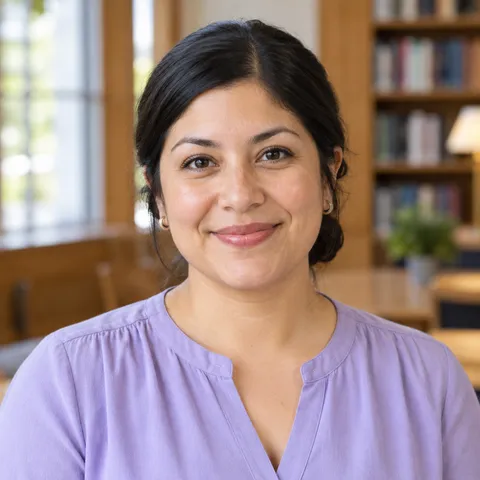
Dr. Carmen Montoya
Assistant Professor of Teacher Education
Instructor for EDUC 325, Fall 2026
- Office
- Lovell Hall 128
- cmontoya
@university.alkimi.ai
EDUC 325 · Education
Inquiry-based science instruction, the Next Generation Science Standards, health education, and integrating science with literacy for grades K–6.
Fall 2026 · At a glance
300-level courses: advanced, upper-division courses requiring prior foundational preparation. Counts toward the 36 upper-division credits every bachelor's degree requires (Undergraduate Catalog §2.3). Details: Undergraduate Catalog §9.25.
Assistant Professor of Teacher Education
Instructor for EDUC 325, Fall 2026
Questions about a major or your plan: Academic Advising Center, Lovell Hall 101, (555) 555-0158.
Class meetings
Tue & Thu, 8:00–9:15 a.m.
Lovell Hall 110
Final exam
No exam in the finals period. The final project deadline is listed under key dates.
Office hours
Wed & Fri, 1:30–3:00 p.m.
Lovell Hall 128
Tue, 11:00 a.m.–12:00 p.m.
Virtual (Zoom link in Canvas)
You may use generative AI tools to brainstorm real-world natural phenomena to anchor science investigations, generate hands-on material alternatives for elementary science experiments, and edit your lesson plan prose for clarity. You may not use generative AI to write your 5E inquiry lesson plan, draft the complete integrated science and health unit, fabricate safety protocols, or complete weekly methodology quizzes.
From the syllabus
Grading
Letter grades follow the university scale (Student Handbook §4.1).
Key dates
First day of classes Past
Midterm Examination 1 Next
5E Inquiry Science Investigation Design
Midterm Examination 2
Elementary Health Education Microteaching Simulation
Integrated Elementary Science & Health Unit Plan & Portfolio
Required materials
Contant, Terry L., et al. Teaching Science Through Inquiry-Based Instruction. 13th ed., Pearson, 2018.
Approx. $85 print, $50 digital rental.
National Research Council. A Framework for K-12 Science Education: Practices, Crosscutting Concepts, and Core Ideas. National Academies Press, 2012.
Approx. $40 print, free open-access PDF via publisher.
Telljohann, Susan K., et al. Health Education in Elementary and Middle School. 9th ed., McGraw Hill, 2021.
Approx. $65 print or digital.
Degree planning
What to take first, what this course opens up, and the requirements it can satisfy, from the Undergraduate Catalog.
No catalog course is required first.
Catalog wording: Admission to Teacher Education.
No other catalog course lists EDUC 325 as a prerequisite.
Every course also counts toward the 120 credits needed for a bachelor's degree. Confirm your plan with your advisor or the Academic Advising Center.
No AP exam awards credit for EDUC 325 (Undergraduate Catalog §3.11).
Registration
Admission to Teacher Education.
EDUC 325 is offered in the fall semester. Register through AlkimiHub self-service registration, which opens by credit standing. Until the add deadline, you don't need instructor permission as long as seats remain and you've met the prerequisites. Details: Student Handbook §3.3.
When a seat opens, AlkimiHub offers it to the first student on the waitlist and emails you. You have 24 hours to claim it before it goes to the next student. Details: Student Handbook §3.10.
Fall 2026 withdrawal deadline
Last day to withdraw with a W or elect Pass/No Pass.
Fall 2027 registration opens
By credit standing, in AlkimiHub.
The Fall 2026 add deadline passed on Sep 2, 2026.
All dates: academic calendar. Registration help: Office of the Registrar.
Official course syllabus
The syllabus as filed with the department and posted in Canvas for Fall 2026.
Term: Fall 2026
Credits: 3.0
Lecture Times & Location: Tuesday & Thursday 8:00–9:15 a.m., Lovell Hall 110
Modality: In-Person
cmontoya@university.alkimi.ai
Inquiry-based science instruction, the Next Generation Science Standards, health education, and integrating science with literacy for grades K–6. EDUC 325 prepares elementary teacher candidates to design and implement inquiry-based science and health curricula across kindergarten through grade 6. Grounded in the Next Generation Science Standards (NGSS) and National Health Education Standards (NHES), candidates learn to integrate three-dimensional science learning—Science and Engineering Practices, Crosscutting Concepts, and Disciplinary Core Ideas—using the 5E instructional model (Engage, Explore, Explain, Elaborate, Evaluate). The course emphasizes anchoring lessons in observable natural phenomena, integrating science notebooks with informational literacy, managing elementary classroom science safety, and promoting lifelong wellness through elementary health education.
Admission to Teacher Education.
Upon successful completion of EDUC 325, students will be able to:
In accordance with Alkimi University Academic Policies (Student Handbook §5.8), EDUC 325 operates under AI Level 2.
| Week | Dates | Topics & Readings | Assignments & Deadlines |
|---|---|---|---|
| Week 1 | Aug 27 | The Nature of Science and Elementary Inquiry: How children learn science, scientific versus everyday reasoning, inquiry continuum (structured, guided, open), and debunking the rigid 'scientific method'. Reading: Contant et al., Ch. 1–2; NRC Framework, Ch. 1–2 | First day of classes: Wed Aug 26. |
| Week 2 | Sep 1, 3 | The NGSS Framework: Three-Dimensional Learning: Deconstructing the Next Generation Science Standards: Science & Engineering Practices (SEPs), Crosscutting Concepts (CCCs), and Disciplinary Core Ideas (DCIs). Reading: NRC Framework, Ch. 3–4; Contant et al., Ch. 3 | Wed Sep 2: Add/section change deadline. |
| Week 3 | Sep 8, 10 | Phenomenon-Based Instruction and Anchoring Events: Selecting compelling, locally relevant natural phenomena; eliciting student prior knowledge, driving question boards, and student initial models. Reading: Contant et al., Ch. 4 | Mon Sep 7: Labor Day (no classes). Wed Sep 9: Census date (last day to drop without a W). |
| Week 4 | Sep 15, 17 | The 5E Instructional Model: Engage and Explore: Structuring engaging hooks, planning hands-on exploratory investigations, cooperative roles, and managing materials in elementary classrooms. Reading: Contant et al., Ch. 5 | — |
| Week 5 | Sep 22, 24 | The 5E Instructional Model: Explain, Elaborate, and Evaluate: Claim-Evidence-Reasoning (CER) frameworks, facilitating sense-making discussions, applying concepts to new contexts, and formative assessment probes. Reading: Contant et al., Ch. 5–6 | — |
| Week 6 | Sep 29, Oct 1 | Elementary Science Safety and Legal Liability: NSTA safety guidelines, eyewash/first aid procedures, chemical handling, plant and animal safety, and liability prevention; Midterm Examination 1 in class. Reading: Contant et al., Ch. 7 | Midterm Examination 1 (in class). |
| Week 7 | Oct 6, 8 | Physical Science in Grades K–6: Matter and its interactions, forces and motion, energy transformations, waves and light; designing developmentally appropriate physical science investigations. Reading: Contant et al., Ch. 9; NRC Framework, Ch. 5 | — |
| Week 8 | Oct 15 | Life Science in Grades K–6: Plant and animal structures, life cycles, ecosystems and food webs, adaptation, and using classroom terrariums and gardens responsibly. Reading: Contant et al., Ch. 10; NRC Framework, Ch. 6 | Oct 12–Oct 13: Fall break (no classes). |
| Week 9 | Oct 20, 22 | Earth and Space Science in Grades K–6: Weather patterns, rock cycle and soil, Earth's water, solar system models, seasons, and day/night cycles; addressing common astronomy misconceptions. Reading: Contant et al., Ch. 11; NRC Framework, Ch. 7 | 5E Inquiry Science Investigation Design due Fri Oct 23 at 11:59 p.m. |
| Week 10 | Oct 27, 29 | Engineering Design and Technology in Elementary Science: The engineering design cycle (ask, imagine, plan, create, improve), constraints, prototyping, and integrating STEM challenges into curriculum. Reading: Contant et al., Ch. 12; NRC Framework, Ch. 8 | — |
| Week 11 | Nov 3, 5 | Science Notebooks and Integrating Informational Literacy: Using science notebooks for diagramming and data tracking; integrating informational trade books, read-alouds, and disciplinary vocabulary strategies. Reading: Contant et al., Ch. 8 | Fri Nov 6: Last day to withdraw (W) or elect Pass/No Pass. |
| Week 12 | Nov 10, 12 | Foundations of Elementary Health Education: National Health Education Standards (NHES), Whole School, Whole Community, Whole Child (WSCC) model, and health literacy; Midterm Examination 2 in class. Reading: Telljohann et al., Ch. 1–3 | Midterm Examination 2 (in class). |
| Week 13 | Nov 17, 19 | Nutrition, Physical Activity, and Chronic Disease Prevention: MyPlate guidelines for youth, beverage choices, promoting daily physical activity, dental hygiene, and establishing lifelong healthy habits in elementary school. Reading: Telljohann et al., Ch. 6–7 | Elementary Health Education Microteaching Simulation due Fri Nov 20 at 11:59 p.m. |
| Week 14 | Nov 24 | Social-Emotional Wellness and Personal Safety: Teaching emotional literacy, conflict resolution, anti-bullying curricula, sun and fire safety, personal boundaries, and abuse prevention education. Reading: Telljohann et al., Ch. 8–10 | Nov 25–Nov 27: Thanksgiving break (no classes). |
| Week 15 | Dec 1, 3 | Integrated Unit Planning Workshop: Synthesizing science inquiry and health concepts into a coherent multi-day unit plan; peer feedback on 5E lesson sequences and assessment rubrics. Reading: Selected unit planning samples | — |
| Week 16 | Dec 8 | Course Synthesis and Science Educator Identity: Reflecting on inquiry-based pedagogy, fostering wonder in young learners, professional teacher organizations (NSTA), and unit portfolio submission. Reading: Course review packet | Wed Dec 9: Last day of classes. Thu Dec 10: Reading Day. |
| Finals | Dec 17 | Integrated Elementary Science & Health Unit Plan & Portfolio due by the end of the scheduled final exam period, Thursday, December 17, 2026, 10:30 a.m.–12:30 p.m. | No final examination. |
Regular attendance and active engagement in hands-on science inquiry activities and health microteaching presentations are required. Science methods relies upon experiential laboratory stations and peer-facilitated investigations that cannot be made up independently. If illness or emergency causes an absence, please contact Dr. Montoya. More than two unexcused absences will result in a lowered course grade. Students who miss the first two class meetings without notifying the instructor may be dropped. Students may miss class for religious observance without penalty if they notify the instructor in writing within the first two weeks of the semester (by Wednesday, September 9, 2026). Absences for university-sponsored activities (athletics, performances, conferences) are excused with a letter from the sponsoring office at least one week in advance.
Assignments submitted after the deadline will be penalized 10% per calendar day up to three days. Submissions after 72 hours will receive no credit. Weekly Canvas quizzes must be completed by the Monday deadline.
Enrollment in EDUC 325 requires formal Admission to Teacher Education (at least 45 earned credits, 2.750 GPA, basic skills test, and background check). Candidates must achieve a minimum grade of C+ in EDUC 325 to fulfill degree and licensing requirements.
EDUC 325 has no final examination. The integrated elementary science & health unit plan & portfolio takes its place. Nothing is due on Reading Day (Thursday, December 10, 2026).
Alkimi University is an academic community devoted to rigorous scholarship, open intellectual inquiry, and uncompromising ethical conduct. All students are subject to the regulations of the Alkimi University Academic Integrity Policy. Academic dishonesty—including plagiarism, cheating on examinations, unauthorized collaboration, fabrication of empirical data, and unauthorized submission of academic work generated by artificial intelligence—undermines the integrity of the university and carries severe disciplinary sanctions. Sanctions range from a failing grade on an assignment or exam to an administrative course failure recorded as an 'XF' on the official transcript, academic suspension, or expulsion. Suspected violations are formally investigated and resolved through the Office of Academic Integrity in accordance with Faculty Handbook §6. For detailed information, consult the Office of Academic Integrity, Lovell Hall 315, (555) 555-0163, integrity@university.alkimi.ai.
Alkimi University is committed to providing equitable educational access and reasonable accommodations for all students with documented disabilities, including physical, sensory, psychological, learning, and chronic health conditions. Students requesting academic accommodations must formally register with the Office of Accessibility Services, Harlan Hall 204, (555) 555-0155, access@university.alkimi.ai. Once approved, students will receive an official Faculty Accommodation Letter detailing approved accommodations. Students should present this letter to the instructor as early in the semester as possible, and at least one week prior to any exam or assignment requiring accommodation. Accommodations cannot be applied retroactively.
Your physical health, psychological well-being, and mental health are essential to your academic success. If you experience heightened stress, anxiety, depressive symptoms, personal trauma, or academic burnout, free, confidential counseling and medical care are available through the Hollis Health & Counseling Center, located in the Hollis Center. Routine appointments are available Monday–Friday 8:00 a.m.–6:00 p.m. and Saturday 10:00 a.m.–2:00 p.m. during the semester by calling (555) 555-0190 or emailing health@university.alkimi.ai. Urgent, 24/7 crisis psychological counseling is accessible immediately at (555) 555-0199.
advising@university.alkimi.ai
askalibrarian@university.alkimi.ai
health@university.alkimi.ai
EDUC courses