
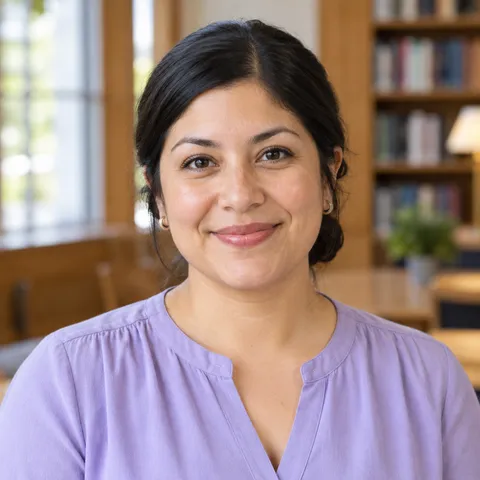
Dr. Carmen Montoya
Assistant Professor of Teacher Education
Instructor for EDUC 315, Fall 2026
- Office
- Lovell Hall 128
- cmontoya
@university.alkimi.ai
EDUC 315 · Education
Number sense, operations, fractions, geometry, and measurement for grades K–6, with standards-based planning, manipulatives, and student-thinking-centered instruction.
Fall 2026 · At a glance
300-level courses: advanced, upper-division courses requiring prior foundational preparation. Counts toward the 36 upper-division credits every bachelor's degree requires (Undergraduate Catalog §2.3). Details: Undergraduate Catalog §9.25.
Assistant Professor of Teacher Education
Instructor for EDUC 315, Fall 2026
Questions about a major or your plan: Academic Advising Center, Lovell Hall 101, (555) 555-0158.
Class meetings
Tue & Thu, 4:00–5:15 p.m.
Lovell Hall 130
Final exam
No exam in the finals period. The final project deadline is listed under key dates.
Office hours
Wed & Fri, 1:30–3:00 p.m.
Lovell Hall 128
Tue, 11:00 a.m.–12:00 p.m.
Virtual (Zoom link in Canvas)
You may use generative AI tools to brainstorm real-world contexts for elementary word problems, generate variations of mathematical tasks, and proofread draft lesson plan descriptions for grammatical correctness. You may not use generative AI to diagnose student mathematical misconceptions in clinical interview assignments, write your comprehensive elementary math unit plan, or complete weekly methodology quizzes.
From the syllabus
Grading
Letter grades follow the university scale (Student Handbook §4.1).
Key dates
First day of classes Past
Midterm Examination 1 Next
Student Mathematical Thinking & Clinical Interview Analysis
Midterm Examination 2
Number Talk Design & Microteaching Simulation
Comprehensive Elementary Mathematics Unit Plan & Portfolio
Required materials
Van de Walle, John A., Karen S. Karp, and Jennifer M. Bay-Williams. Elementary and Middle School Mathematics: Teaching Developmentally. 10th ed., Pearson, 2019.
Approx. $95 print, $50 digital rental.
National Council of Teachers of Mathematics. Principles to Actions: Ensuring Mathematical Success for All. NCTM, 2014.
Approx. $35 print or digital.
Degree planning
What to take first, what this course opens up, and the requirements it can satisfy, from the Undergraduate Catalog.
Catalog wording: Admission to Teacher Education and MATH 105.
No other catalog course lists EDUC 315 as a prerequisite.
Every course also counts toward the 120 credits needed for a bachelor's degree. Confirm your plan with your advisor or the Academic Advising Center.
No AP exam awards credit for EDUC 315 (Undergraduate Catalog §3.11).
Registration
Admission to Teacher Education and MATH 105.
EDUC 315 is offered in the fall semester. Register through AlkimiHub self-service registration, which opens by credit standing. Until the add deadline, you don't need instructor permission as long as seats remain and you've met the prerequisites. Details: Student Handbook §3.3.
When a seat opens, AlkimiHub offers it to the first student on the waitlist and emails you. You have 24 hours to claim it before it goes to the next student. Details: Student Handbook §3.10.
Fall 2026 withdrawal deadline
Last day to withdraw with a W or elect Pass/No Pass.
Fall 2027 registration opens
By credit standing, in AlkimiHub.
The Fall 2026 add deadline passed on Sep 2, 2026.
All dates: academic calendar. Registration help: Office of the Registrar.
Official course syllabus
The syllabus as filed with the department and posted in Canvas for Fall 2026.
Term: Fall 2026
Credits: 3.0
Lecture Times & Location: Tuesday & Thursday 4:00–5:15 p.m., Lovell Hall 130
Modality: In-Person
cmontoya@university.alkimi.ai
Number sense, operations, fractions, geometry, and measurement for grades K–6, with standards-based planning, manipulatives, and student-thinking-centered instruction. EDUC 315 prepares elementary teacher candidates to design and implement standards-based, student-centered mathematics instruction across kindergarten through grade 6. Grounded in the National Council of Teachers of Mathematics (NCTM) Process Standards and state mathematical content domains, candidates investigate early number sense, place value, operations, rational numbers, algebraic thinking, geometry, and measurement. Candidates learn to employ the Concrete-Representational-Abstract (CRA) instructional sequence, utilize physical and digital manipulatives, lead number talks, analyze student misconceptions, and support multilingual learners in developing mathematical discourse.
Admission to Teacher Education and MATH 105.
Upon successful completion of EDUC 315, students will be able to:
In accordance with Alkimi University Academic Policies (Student Handbook §5.8), EDUC 315 operates under AI Level 2.
| Week | Dates | Topics & Readings | Assignments & Deadlines |
|---|---|---|---|
| Week 1 | Aug 27 | Teaching Mathematics for Understanding: Relational versus instrumental understanding, NCTM Process Standards, standards for mathematical practice, and creating an equitable math community. Reading: Van de Walle et al., Ch. 1–2; NCTM, pp. 1–12 | First day of classes: Wed Aug 26. |
| Week 2 | Sep 1, 3 | Early Number Concepts and Number Sense: Subitizing, one-to-one correspondence, cardinality, conservation of number, ten-frames, and dot card routines in kindergarten and grade 1. Reading: Van de Walle et al., Ch. 8 | Wed Sep 2: Add/section change deadline. |
| Week 3 | Sep 8, 10 | Meanings of Operations: Addition and Subtraction: Cognitively Guided Instruction (CGI) problem types: join, separate, part-part-whole, and compare word problem structures; modeling with counters. Reading: Van de Walle et al., Ch. 9 | Mon Sep 7: Labor Day (no classes). Wed Sep 9: Census date (last day to drop without a W). |
| Week 4 | Sep 15, 17 | Developing Place Value Concepts: Groupable versus pre-grouped manipulatives (bundles of sticks, base-ten blocks), unitizing, multi-digit decomposing, and mental math strings. Reading: Van de Walle et al., Ch. 11 | — |
| Week 5 | Sep 22, 24 | Multi-Digit Addition and Subtraction Strategies: Student-invented strategies, open number lines, partial sums, compensation, and transition to standard algorithms with conceptual transparency. Reading: Van de Walle et al., Ch. 12 | — |
| Week 6 | Sep 29, Oct 1 | Multiplication and Division Concepts: Equal groups, arrays, area models, measurement versus fair-share division, and multi-digit multiplication strategies; Midterm Examination 1 in class. Reading: Van de Walle et al., Ch. 10, 13 | Midterm Examination 1 (in class). |
| Week 7 | Oct 6, 8 | Early Algebraic Thinking in Elementary Grades: Repeating and growing patterns, generalized arithmetic, meaning of the equal sign, balance scales, and relational thinking across K–6. Reading: Van de Walle et al., Ch. 14 | — |
| Week 8 | Oct 15 | Fraction Concepts: Meanings and Representations: Area, length, and set models of fractions; partitioning, iterating, unit fractions, equivalent fractions with fraction strips, and number lines. Reading: Van de Walle et al., Ch. 15 | Oct 12–Oct 13: Fall break (no classes). |
| Week 9 | Oct 20, 22 | Fraction Computation and Conceptual Models: Adding and subtracting fractions with like and unlike denominators, multiplying fractions as taking parts of parts, and division by fractions. Reading: Van de Walle et al., Ch. 16 | Student Mathematical Thinking & Clinical Interview Analysis due Fri Oct 23 at 11:59 p.m. |
| Week 10 | Oct 27, 29 | Decimals, Percentages, and Proportional Reasoning: Base-ten decimal models, decimal place value, connecting fractions to decimals, percent as hundredths, and qualitative proportional reasoning. Reading: Van de Walle et al., Ch. 17–18 | — |
| Week 11 | Nov 3, 5 | Measurement Concepts and Geometric Thinking: Direct and indirect comparison, standard and non-standard units, length, area, perimeter, volume, and Van Hiele levels of geometric thought. Reading: Van de Walle et al., Ch. 19–20 | Fri Nov 6: Last day to withdraw (W) or elect Pass/No Pass. |
| Week 12 | Nov 10, 12 | Data Analysis, Probability, and Graphing in Grades K–6: Categorical and numerical data displays, picture graphs, bar graphs, dot plots, line plots, and early informal probability; Midterm Examination 2 in class. Reading: Van de Walle et al., Ch. 21 | Midterm Examination 2 (in class). |
| Week 13 | Nov 17, 19 | Supporting Multilingual Learners in Elementary Math: Mathematical language routines (MLRs), visual representations, bilingual scaffolding, Spanish cognates in math, and fostering student voice. Reading: Van de Walle et al., Ch. 6; selected readings by Dr. Montoya | Number Talk Design & Microteaching Simulation due Fri Nov 20 at 11:59 p.m. |
| Week 14 | Nov 24 | Differentiation, Intervention, and Math Anxiety: Tiered math tasks, low-floor/high-ceiling problems, addressing math trauma and anxiety, and strengths-based feedback for struggling mathematicians. Reading: Van de Walle et al., Ch. 7 | Nov 25–Nov 27: Thanksgiving break (no classes). |
| Week 15 | Dec 1, 3 | Unit Planning Workshop and Assessment Design: Aligning learning targets with formative check-ins, performance tasks, and designing rubrics for the comprehensive elementary unit plan. Reading: Van de Walle et al., Ch. 5 | — |
| Week 16 | Dec 8 | Course Synthesis and Mathematical Identity: Reflecting on growth as an elementary mathematics educator, professional NCTM resources, and finalizing the unit portfolio. Reading: Course review packet | Wed Dec 9: Last day of classes. Thu Dec 10: Reading Day. |
| Finals | Dec 17 | Comprehensive Elementary Mathematics Unit Plan & Portfolio due by the end of the scheduled final exam period, Thursday, December 17, 2026, 3:30–5:30 p.m. | No final examination. |
Class attendance and hands-on participation in manipulative workshops and microteaching simulations are essential. Elementary math methods relies upon cooperative peer problem solving and experiential modeling of mathematical concepts. If illness or an emergency prevents attendance, notify Dr. Montoya prior to class. More than two unexcused absences will result in a deduction from your course grade. Students who miss the first two class meetings without notifying the instructor may be dropped. Students may miss class for religious observance without penalty if they notify the instructor in writing within the first two weeks of the semester (by Wednesday, September 9, 2026). Absences for university-sponsored activities (athletics, performances, conferences) are excused with a letter from the sponsoring office at least one week in advance.
Assignments submitted after the deadline will lose 10% per calendar day for up to 72 hours. Submissions beyond three days late will not be accepted. Weekly Canvas quizzes must be completed before the posted Monday deadline.
Enrollment in EDUC 315 requires formal Admission to Teacher Education (including at least 45 earned credits, 2.750 GPA, basic skills exam, and background check) and completion of MATH 105. Teacher candidates must achieve a grade of C+ or higher to progress toward clinical student teaching.
EDUC 315 has no final examination. The comprehensive elementary mathematics unit plan & portfolio takes its place. Nothing is due on Reading Day (Thursday, December 10, 2026).
Alkimi University is an academic community devoted to rigorous scholarship, open intellectual inquiry, and uncompromising ethical conduct. All students are subject to the regulations of the Alkimi University Academic Integrity Policy. Academic dishonesty—including plagiarism, cheating on examinations, unauthorized collaboration, fabrication of empirical data, and unauthorized submission of academic work generated by artificial intelligence—undermines the integrity of the university and carries severe disciplinary sanctions. Sanctions range from a failing grade on an assignment or exam to an administrative course failure recorded as an 'XF' on the official transcript, academic suspension, or expulsion. Suspected violations are formally investigated and resolved through the Office of Academic Integrity in accordance with Faculty Handbook §6. For detailed information, consult the Office of Academic Integrity, Lovell Hall 315, (555) 555-0163, integrity@university.alkimi.ai.
Alkimi University is committed to providing equitable educational access and reasonable accommodations for all students with documented disabilities, including physical, sensory, psychological, learning, and chronic health conditions. Students requesting academic accommodations must formally register with the Office of Accessibility Services, Harlan Hall 204, (555) 555-0155, access@university.alkimi.ai. Once approved, students will receive an official Faculty Accommodation Letter detailing approved accommodations. Students should present this letter to the instructor as early in the semester as possible, and at least one week prior to any exam or assignment requiring accommodation. Accommodations cannot be applied retroactively.
Your physical health, psychological well-being, and mental health are essential to your academic success. If you experience heightened stress, anxiety, depressive symptoms, personal trauma, or academic burnout, free, confidential counseling and medical care are available through the Hollis Health & Counseling Center, located in the Hollis Center. Routine appointments are available Monday–Friday 8:00 a.m.–6:00 p.m. and Saturday 10:00 a.m.–2:00 p.m. during the semester by calling (555) 555-0190 or emailing health@university.alkimi.ai. Urgent, 24/7 crisis psychological counseling is accessible immediately at (555) 555-0199.
advising@university.alkimi.ai
askalibrarian@university.alkimi.ai
health@university.alkimi.ai
EDUC courses