

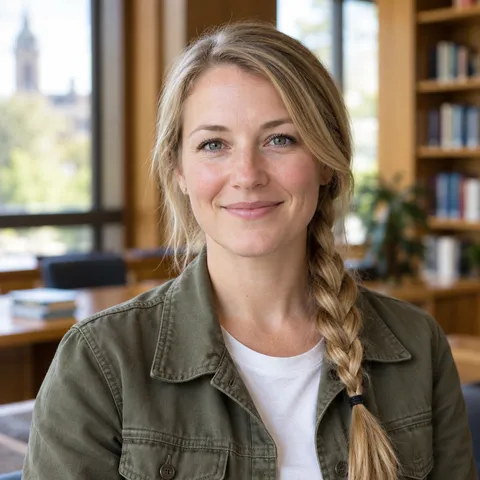
Dr. Olivia Hart
Assistant Professor of Civil & Environmental Engineering
Instructor for CE 310, Fall 2026
- Office
- Rowan Engineering Center 310
- ohart
@university.alkimi.ai
CE 310 · Civil Engineering
Soil classification, compaction, permeability and seepage, effective stress, consolidation, shear strength, and bearing capacity, with a weekly three-hour soils laboratory.
Fall 2026 · At a glance
300-level courses: advanced, upper-division courses requiring prior foundational preparation. Counts toward the 36 upper-division credits every bachelor's degree requires (Undergraduate Catalog §2.3). Details: Undergraduate Catalog §9.22.
Assistant Professor of Civil & Environmental Engineering
Instructor for CE 310, Fall 2026
Questions about a major or your plan: Academic Advising Center, Lovell Hall 101, (555) 555-0158.
Class meetings
Lecture
Mon, Wed, Fri, 11:00–11:50 a.m.
Rowan Engineering Center 110
Lab
Thu, 1:00–3:50 p.m.
Rowan Engineering Center 150
Final exam
Tuesday, December 15, 2026
10:30 a.m.–12:30 p.m., Rowan Engineering Center 110
Office hours
Mon & Wed, 3:30–5:00 p.m.
Rowan Engineering Center 310
Fri, 10:00–11:00 a.m.
Virtual (Zoom link in Canvas)
Students may consult approved AI tools to assist in writing Python, MATLAB, or spreadsheet scripts for laboratory data reduction (such as fitting consolidation curves or plotting Mohr circles) and exploring ASTM standard testing terminology. Generative AI must not be used to author geotechnical laboratory discussion sections, generate soil classification solutions, or calculate foundation settlement and bearing capacity on graded problem sets.
From the syllabus
Grading
Letter grades follow the university scale (Student Handbook §4.1).
Key dates
First day of classes Past
Midterm Exam 1 (Classification, Permeability & Seepage) Next
Midterm Exam 2 (Effective Stress, Consolidation & Shear Strength)
Geotechnical Site Investigation & Foundation Design Project
Required materials
Das, Braja M., and Khaled Sobhan. Principles of Geotechnical Engineering. 9th ed., Cengage Learning, 2018.
Approx. $85 digital rental ($195 purchase; reserve copies available in Alkimi Library).
Laboratory manual and ASTM Geotechnical Standards (provided electronically on Canvas); personal PPE (ANSI Z87 safety glasses and lab coat).
Approx. $20 for personal protective equipment.
Degree planning
What to take first, what this course opens up, and the requirements it can satisfy, from the Undergraduate Catalog.
Every course also counts toward the 120 credits needed for a bachelor's degree. Confirm your plan with your advisor or the Academic Advising Center.
No AP exam awards credit for CE 310 (Undergraduate Catalog §3.11).
Registration
CE 310 is offered in the fall semester. Register through AlkimiHub self-service registration, which opens by credit standing. Until the add deadline, you don't need instructor permission as long as seats remain and you've met the prerequisites. Details: Student Handbook §3.3.
When a seat opens, AlkimiHub offers it to the first student on the waitlist and emails you. You have 24 hours to claim it before it goes to the next student. Details: Student Handbook §3.10.
Fall 2026 withdrawal deadline
Last day to withdraw with a W or elect Pass/No Pass.
Fall 2027 registration opens
By credit standing, in AlkimiHub.
The Fall 2026 add deadline passed on Sep 2, 2026.
All dates: academic calendar. Registration help: Office of the Registrar.
Official course syllabus
The syllabus as filed with the department and posted in Canvas for Fall 2026.
Term: Fall 2026
Credits: 4.0
Lecture Times & Location: Monday, Wednesday, Friday 11:00–11:50 a.m., Rowan Engineering Center 110
Laboratory Time & Location: Thursday 1:00–3:50 p.m., Rowan Engineering Center 150
Modality: In-Person Lecture and Laboratory
ohart@university.alkimi.ai
Soil classification, compaction, permeability and seepage, effective stress, consolidation, shear strength, and bearing capacity, with a weekly three-hour soils laboratory. CE 310 investigates the engineering mechanics and index properties of soil as an engineering construction material and foundation medium. Students examine soil phase relationships, particle size distribution, plasticity, Darcy's law for seepage, the principle of effective stress, one-dimensional consolidation settlement, and Mohr-Coulomb shear strength. Through extensive hands-on laboratory testing adhering to ASTM standards, students characterize native soils, evaluate field compaction, and perform geotechnical analyses for shallow foundations and retaining structures.
CE 202 and CE 210.
Upon successful completion of CE 310, students will be able to:
In accordance with Alkimi University Academic Policies (Student Handbook §5.8), CE 310 operates under AI Level 2.
| Week | Dates | Topics & Readings | Laboratory | Assignments & Deadlines |
|---|---|---|---|---|
| Week 1 | Aug 26, 28 | Origin of Soils and Grain-Size Characteristics: Geological origins of soil, weathering, mineral composition, grain size distribution curves, uniformity coefficient, and coefficient of gradation. Reading: Das & Sobhan Ch. 1–2 | No lab meetings this week. | First day of classes: Wed Aug 26. |
| Week 2 | Aug 31–Sep 4 | Weight-Volume Relationships and Soil Classification: Three-phase soil diagram, void ratio, porosity, moisture content, degree of saturation, unit weight relations, and USCS and AASHTO classification criteria. Reading: Das & Sobhan Ch. 3, 5 | Lab 1: Sieve Analysis and Hydrometer Test (ASTM D422/D7928) | Wed Sep 2: Add/section change deadline. |
| Week 3 | Sep 9, 11 | Plasticity and Atterberg Limits: Soil consistency states, liquid limit, plastic limit, plasticity index, liquidity index, activity of clays, and engineering implications for expansive soils. Reading: Das & Sobhan Ch. 4 | Lab 2: Atterberg Limits: Liquid Limit and Plastic Limit (ASTM D4318) | Mon Sep 7: Labor Day (no classes). Wed Sep 9: Census date (last day to drop without a W). |
| Week 4 | Sep 14–18 | Soil Compaction and Field Specifications: Compaction theory, moisture-density relationship, optimum moisture content, standard and modified Proctor efforts, zero-air-voids curve, and field roller equipment. Reading: Das & Sobhan Ch. 6 | Lab 3: Standard and Modified Proctor Compaction Tests (ASTM D698/D1557) | — |
| Week 5 | Sep 21–25 | Permeability and Groundwater Flow: Darcy's law, hydraulic gradient, discharge vs. seepage velocity, constant-head and falling-head permeability tests, and equivalent permeability in stratified soils. Reading: Das & Sobhan Ch. 7 | Lab 4: Constant-Head and Falling-Head Permeability Tests (ASTM D2434) | — |
| Week 6 | Sep 28–Oct 2 | Seepage and Two-Dimensional Flow Nets: Laplace equation for 2D flow, flow lines and equipotential lines, flow nets under dams and sheet piles, uplift pressure, exit gradient, and Midterm Exam 1 in Friday lecture. Reading: Das & Sobhan Ch. 8 | Lab 5: 2D Seepage Modeling in Sand Tank Flume | Midterm Exam 1 (Classification, Permeability & Seepage) (in class). |
| Week 7 | Oct 5–9 | The Principle of Effective Stress: Total vertical stress, pore water pressure, Terzaghi's effective stress principle, stress changes due to water table fluctuations, and capillary rise effects. Reading: Das & Sobhan Ch. 9 | Lab 6: In-Situ Unit Weight Determination: Sand Cone Method (ASTM D1556) | — |
| Week 8 | Oct 14, 16 | Stress Distribution in a Soil Mass: Boussinesq point load equations, line loads, uniformly loaded circular and rectangular foundation areas, 2:1 stress approximation, and Newmark charts. Reading: Das & Sobhan Ch. 10 | Lab 7: Direct Shear Testing on Cohesionless Soils (ASTM D3080) | Oct 12–Oct 13: Fall break (no classes). |
| Week 9 | Oct 19–23 | Soil Compressibility and Consolidation Mechanics: Spring analogy for consolidation, e-log(p) curves, pre-consolidation pressure, overconsolidation ratio (OCR), compression and recompression indices. Reading: Das & Sobhan Ch. 11.1–11.6 | Lab 8: One-Dimensional Consolidation Test Setup (ASTM D2435) | — |
| Week 10 | Oct 26–30 | Time Rate of Primary Consolidation: Terzaghi's 1D consolidation differential equation, excess pore water pressure dissipation, degree of consolidation, time factor (Tv), and settlement timing. Reading: Das & Sobhan Ch. 11.7–11.12 | Lab 9: Consolidation Data Reduction and Time-Rate Settlement Curves | — |
| Week 11 | Nov 2–6 | Shear Strength of Soil: Mohr-Coulomb Criterion: Mohr's circle of stress, Mohr-Coulomb failure envelope, friction angle, cohesion, drained vs. undrained shear parameters, and Midterm Exam 2 in Friday lecture. Reading: Das & Sobhan Ch. 12.1–12.5 | Lab 10: Unconfined Compressive Strength of Cohesive Soil (ASTM D2166) | Fri Nov 6: Last day to withdraw (W) or elect Pass/No Pass. Midterm Exam 2 (Effective Stress, Consolidation & Shear Strength) (in class). |
| Week 12 | Nov 9–13 | Triaxial Shear Testing and Pore Pressure Parameters: Consolidated-drained (CD), consolidated-undrained (CU) with pore pressure measurement, and unconsolidated-undrained (UU) triaxial tests; Skempton's parameters. Reading: Das & Sobhan Ch. 12.6–12.11 | Lab 11: Consolidated-Undrained (CU) Triaxial Compression Test (ASTM D4767) | — |
| Week 13 | Nov 16–20 | Lateral Earth Pressure: Rankine and Coulomb: At-rest, active, and passive earth pressures, Rankine's earth pressure theory, Coulomb's wedge analysis, wall friction effects, and surcharge loadings; Project due Friday. Reading: Das & Sobhan Ch. 13 | Lab 12: Retaining Wall Lateral Earth Pressure Demonstration | Geotechnical Site Investigation & Foundation Design Project due Fri Nov 20 at 11:59 p.m. |
| Week 14 | Nov 23 | Retaining Wall Stability Analysis: Gravity and cantilever retaining wall stability, factors of safety against overturning, sliding, and bearing capacity failure; drainage provisions. Reading: Das & Sobhan Ch. 14 | No lab meetings this week (holiday). | Nov 25–Nov 27: Thanksgiving break (no classes). |
| Week 15 | Nov 30–Dec 4 | Bearing Capacity of Shallow Foundations: General shear, local shear, and punching shear failure modes; Terzaghi's bearing capacity equation; Meyerhof's general bearing capacity equation with shape/depth factors. Reading: Das & Sobhan Ch. 15 | Lab 13: Plate Load Testing and Bearing Capacity Verification | — |
| Week 16 | Dec 7, 9 | Deep Foundations, Slope Stability, and Review: Overview of driven piles and drilled shafts, infinite slope stability, Swedish circle method, comprehensive course synthesis, and final exam preparation. Reading: Review Das & Sobhan Ch. 3–13, 15 | No lab meetings this week (holiday). | Wed Dec 9: Last day of classes. Thu Dec 10: Reading Day. |
| Finals | Dec 15 | Comprehensive Final Examination: Tuesday, December 15, 2026, 10:30 a.m.–12:30 p.m., Rowan Engineering Center 110. | — | Comprehensive. |
Class attendance at lectures and the weekly geotechnical laboratory session is mandatory. Soil mechanics experiments require strict adherence to ASTM protocols, soil specimen preparation, and bench equipment safety in Rowan Engineering Center 150. If an unavoidable absence arises due to illness or approved university events, notify Dr. Hart prior to the session. Students who miss the first two class meetings without notifying the instructor may be dropped. Students may miss class for religious observance without penalty if they notify the instructor in writing within the first two weeks of the semester (by Wednesday, September 9, 2026). Absences for university-sponsored activities (athletics, performances, conferences) are excused with a letter from the sponsoring office at least one week in advance.
Homework problem sets submitted past the deadline will receive a 15% penalty per 24 hours, accepted up to 48 hours late. Laboratory reports submitted after Sunday 11:59 p.m. will incur a 10% deduction per day. The lowest homework score and lowest lab report score are dropped to account for unanticipated emergencies.
The final examination (Tuesday, December 15, 2026, 10:30 a.m.–12:30 p.m.) is scheduled by the University Registrar and can't be moved without the Dean's written approval (Faculty Handbook §5.5). A student with three or more final exams on the same calendar day may reschedule one of them. Requests go to the instructor of the middle exam by the last day of classes. For this term, send the request by Wednesday, December 9, 2026 (Student Handbook §6.4).
Alkimi University is an academic community devoted to rigorous scholarship, open intellectual inquiry, and uncompromising ethical conduct. All students are subject to the regulations of the Alkimi University Academic Integrity Policy. Academic dishonesty—including plagiarism, cheating on examinations, unauthorized collaboration, fabrication of empirical data, and unauthorized submission of academic work generated by artificial intelligence—undermines the integrity of the university and carries severe disciplinary sanctions. Sanctions range from a failing grade on an assignment or exam to an administrative course failure recorded as an 'XF' on the official transcript, academic suspension, or expulsion. Suspected violations are formally investigated and resolved through the Office of Academic Integrity in accordance with Faculty Handbook §6. For detailed information, consult the Office of Academic Integrity, Lovell Hall 315, (555) 555-0163, integrity@university.alkimi.ai.
Alkimi University is committed to providing equitable educational access and reasonable accommodations for all students with documented disabilities, including physical, sensory, psychological, learning, and chronic health conditions. Students requesting academic accommodations must formally register with the Office of Accessibility Services, Harlan Hall 204, (555) 555-0155, access@university.alkimi.ai. Once approved, students will receive an official Faculty Accommodation Letter detailing approved accommodations. Students should present this letter to the instructor as early in the semester as possible, and at least one week prior to any exam or assignment requiring accommodation. Accommodations cannot be applied retroactively.
Your physical health, psychological well-being, and mental health are essential to your academic success. If you experience heightened stress, anxiety, depressive symptoms, personal trauma, or academic burnout, free, confidential counseling and medical care are available through the Hollis Health & Counseling Center, located in the Hollis Center. Routine appointments are available Monday–Friday 8:00 a.m.–6:00 p.m. and Saturday 10:00 a.m.–2:00 p.m. during the semester by calling (555) 555-0190 or emailing health@university.alkimi.ai. Urgent, 24/7 crisis psychological counseling is accessible immediately at (555) 555-0199.
advising@university.alkimi.ai
askalibrarian@university.alkimi.ai
health@university.alkimi.ai
CE courses