
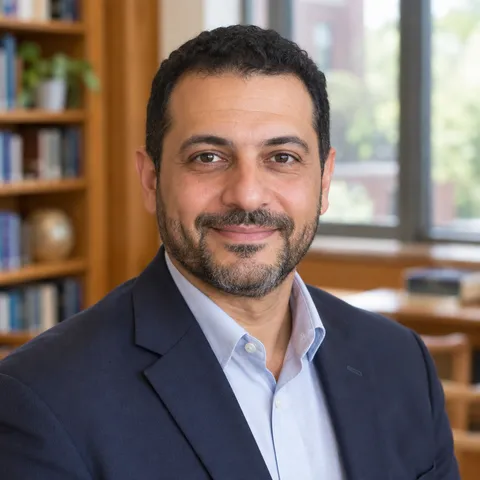
Dr. Samir Rashid
Associate Professor of Civil & Environmental Engineering
Instructor for CE 301, Fall 2026
- Office
- Rowan Engineering Center 308
- srashid
@university.alkimi.ai
CE 301 · Civil Engineering
Loads on structures, analysis of statically determinate and indeterminate beams, trusses, and frames, influence lines, and matrix and computer methods.
Fall 2026 · At a glance
300-level courses: advanced, upper-division courses requiring prior foundational preparation. Counts toward the 36 upper-division credits every bachelor's degree requires (Undergraduate Catalog §2.3). Details: Undergraduate Catalog §9.22.
Associate Professor of Civil & Environmental Engineering
Instructor for CE 301, Fall 2026
Questions about a major or your plan: Academic Advising Center, Lovell Hall 101, (555) 555-0158.
Class meetings
Tue & Thu, 9:30–10:45 a.m.
Rowan Engineering Center 110
Final exam
Tuesday, December 15, 2026
8:00–10:00 a.m., Rowan Engineering Center 110
Office hours
Tue & Fri, 11:30 a.m.–1:00 p.m.
Rowan Engineering Center 308
Wed, 2:00–3:00 p.m.
Virtual (Zoom link in Canvas)
Students may use AI tools to generate MATLAB or Python code for assembling structural stiffness matrices, cross-check ASCE 7 load combination formulas, and visualize deflected structural shapes. AI models must not be used to complete assigned hand calculations for indeterminate structures, solve slope-deflection or moment distribution problems on problem sets, or formulate influence lines without independent derivation.
From the syllabus
Grading
Letter grades follow the university scale (Student Handbook §4.1).
Key dates
First day of classes Past
Midterm Exam 1 (Loads, Influence Lines & Virtual Work) Next
Midterm Exam 2 (Force Method & Slope-Deflection)
Building Frame Matrix Analysis & RISA-2D Project
Required materials
Hibbeler, Russell C. Structural Analysis. 10th ed., Pearson, 2018.
Approx. $85 digital rental ($195 purchase; reserve copies available in Alkimi Library).
RISA-2D Educational Software and MATLAB (available on campus computer lab workstations).
Free educational access provided through department licensing.
Degree planning
What to take first, what this course opens up, and the requirements it can satisfy, from the Undergraduate Catalog.
Every course also counts toward the 120 credits needed for a bachelor's degree. Confirm your plan with your advisor or the Academic Advising Center.
No AP exam awards credit for CE 301 (Undergraduate Catalog §3.11).
Registration
CE 301 is offered in the fall semester. Register through AlkimiHub self-service registration, which opens by credit standing. Until the add deadline, you don't need instructor permission as long as seats remain and you've met the prerequisites. Details: Student Handbook §3.3.
When a seat opens, AlkimiHub offers it to the first student on the waitlist and emails you. You have 24 hours to claim it before it goes to the next student. Details: Student Handbook §3.10.
Fall 2026 withdrawal deadline
Last day to withdraw with a W or elect Pass/No Pass.
Fall 2027 registration opens
By credit standing, in AlkimiHub.
The Fall 2026 add deadline passed on Sep 2, 2026.
All dates: academic calendar. Registration help: Office of the Registrar.
Official course syllabus
The syllabus as filed with the department and posted in Canvas for Fall 2026.
Term: Fall 2026
Credits: 3.0
Lecture Times & Location: Tuesday & Thursday 9:30–10:45 a.m., Rowan Engineering Center 110
Modality: In-Person
srashid@university.alkimi.ai
Loads on structures, analysis of statically determinate and indeterminate beams, trusses, and frames, influence lines, and matrix and computer methods. CE 301 provides a thorough treatment of structural behavior, load paths, and analytical methods for determinate and indeterminate civil engineering systems. Building on mechanics of deformable bodies, students analyze beams, trusses, and rigid building frames under dead, live, and environmental loads per ASCE 7. The course investigates influence lines for moving bridge loads, classical energy methods (virtual work and Castigliano's theorem), and classical indeterminate frameworks (consistent deformations, slope-deflection, moment distribution), concluding with the matrix stiffness method implemented computationally.
CE 202 and MATH 240.
Upon successful completion of CE 301, students will be able to:
In accordance with Alkimi University Academic Policies (Student Handbook §5.8), CE 301 operates under AI Level 2.
| Week | Dates | Topics & Readings | Assignments & Deadlines |
|---|---|---|---|
| Week 1 | Aug 27 | Structural Systems, Loads, and ASCE 7 Standards: Classification of structures (trusses, cables, arches, frames, surface structures), dead and live loads, environmental loads (wind, snow), and ASCE 7 load combinations. Reading: Hibbeler Ch. 1 | First day of classes: Wed Aug 26. |
| Week 2 | Sep 1, 3 | Analysis of Statically Determinate Trusses: Determinacy and stability criteria, planar trusses, method of joints, method of sections, space trusses, and structural efficiency of truss configurations. Reading: Hibbeler Ch. 3 | Wed Sep 2: Add/section change deadline. |
| Week 3 | Sep 8, 10 | Internal Loads in Beams and Portal Frames: Internal axial force, shear force, and bending moment diagrams for determinate non-prismatic beams and rigid portal frames; differential relationships. Reading: Hibbeler Ch. 4 | Mon Sep 7: Labor Day (no classes). Wed Sep 9: Census date (last day to drop without a W). |
| Week 4 | Sep 15, 17 | Influence Lines for Determinate Beams: Concept of moving loads, qualitative influence lines via Müller-Breslau principle, analytical influence lines for beam reactions, shear, and bending moment. Reading: Hibbeler Ch. 6.1–6.4 | — |
| Week 5 | Sep 22, 24 | Influence Lines for Girders, Trusses, and Moving Trucks: Floor-girder systems, panel points, influence lines for truss member forces, and absolute maximum shear and moment envelopes for AASHTO HL-93 truck loading. Reading: Hibbeler Ch. 6.5–6.9 | — |
| Week 6 | Sep 29, Oct 1 | Deflections: Geometric and Moment-Area Methods: Elastic beam theory, double integration, moment-area theorems, conjugate-beam method, and administration of Midterm Exam 1 during Thursday class. Reading: Hibbeler Ch. 8.1–8.5 | Midterm Exam 1 (Loads, Influence Lines & Virtual Work) (in class). |
| Week 7 | Oct 6, 8 | Energy Methods: Virtual Work and Castigliano's Theorem: Principle of virtual work (unit load method) for trusses, beams, and frames; temperature changes and fabrication errors; Castigliano's second theorem. Reading: Hibbeler Ch. 9.1–9.9 | — |
| Week 8 | Oct 15 | Indeterminate Structures and Approximate Analysis: Degree of kinematic and static indeterminacy; approximate analysis of building frames subjected to vertical and lateral wind loads (portal and cantilever methods). Reading: Hibbeler Ch. 2.4–2.5, 7.1–7.4 | Oct 12–Oct 13: Fall break (no classes). |
| Week 9 | Oct 20, 22 | Force Method of Analysis (Consistent Deformations): Compatibility equations, flexibility coefficients, redundant choice, force method applied to single- and multiple-degree indeterminate beams and trusses. Reading: Hibbeler Ch. 10.1–10.4 | — |
| Week 10 | Oct 27, 29 | Force Method Applied to Frames and Support Settlements: Force method applied to indeterminate portal frames, support settlement effects, temperature changes, and internal moment diagrams for continuous frames. Reading: Hibbeler Ch. 10.5–10.7 | — |
| Week 11 | Nov 3, 5 | Displacement Method: Slope-Deflection Equations: Kinematic degrees of freedom, slope-deflection equations for continuous beams, fixed-end moments, and administration of Midterm Exam 2 in Thursday class. Reading: Hibbeler Ch. 11.1–11.3 | Fri Nov 6: Last day to withdraw (W) or elect Pass/No Pass. Midterm Exam 2 (Force Method & Slope-Deflection) (in class). |
| Week 12 | Nov 10, 12 | Slope-Deflection for Frames With and Without Sidesway: Slope-deflection analysis of non-sway frames, side-sway shear equations for multistory portal frames, and joint equilibrium formulation. Reading: Hibbeler Ch. 11.4–11.6 | — |
| Week 13 | Nov 17, 19 | Moment Distribution Method (Hardy Cross): Stiffness factors, distribution factors, carry-over factors, iterative convergence for continuous beams and non-sway frames; Matrix Project due Friday. Reading: Hibbeler Ch. 12.1–12.4 | Building Frame Matrix Analysis & RISA-2D Project due Fri Nov 20 at 11:59 p.m. |
| Week 14 | Nov 24 | Moment Distribution for Frames with Sidesway: Sidesway correction in rigid frames, superposition of non-sway and pure-sway solutions, and comparison of classical methods. Reading: Hibbeler Ch. 12.5–12.7 | Nov 25–Nov 27: Thanksgiving break (no classes). |
| Week 15 | Dec 1, 3 | Introduction to Matrix Structural Analysis: Direct stiffness method, local vs. global coordinate systems, member transformation matrices, assembly of structure stiffness matrix, and boundary restraints. Reading: Hibbeler Ch. 14, 15 | — |
| Week 16 | Dec 8 | Computational Structural Synthesis and FE Review: Validation of matrix computer solutions against commercial software (RISA-2D), synthesis of indeterminate behavior, and comprehensive final examination review. Reading: Review Hibbeler Ch. 4, 6, 9–12, 14 | Wed Dec 9: Last day of classes. Thu Dec 10: Reading Day. |
| Finals | Dec 15 | Comprehensive Final Examination: Tuesday, December 15, 2026, 8:00–10:00 a.m., Rowan Engineering Center 110. | Comprehensive. |
Class attendance at every lecture is expected. Structural analysis methods involve intricate iterative procedures (slope-deflection, moment distribution, virtual work) that require guided problem-solving and immediate instructor feedback. If an unavoidable illness or university-approved absence arises, notify Dr. Rashid prior to class. Students who miss the first two class meetings without notifying the instructor may be dropped. Students may miss class for religious observance without penalty if they notify the instructor in writing within the first two weeks of the semester (by Wednesday, September 9, 2026). Absences for university-sponsored activities (athletics, performances, conferences) are excused with a letter from the sponsoring office at least one week in advance.
Homework problem sets submitted after the deadline will be assessed a penalty of 15% per day up to 48 hours late, after which solutions will be made available and zero credit awarded. The lowest homework score and lowest quiz score are automatically dropped to accommodate emergencies.
The final examination (Tuesday, December 15, 2026, 8:00–10:00 a.m.) is scheduled by the University Registrar and can't be moved without the Dean's written approval (Faculty Handbook §5.5). A student with three or more final exams on the same calendar day may reschedule one of them. Requests go to the instructor of the middle exam by the last day of classes. For this term, send the request by Wednesday, December 9, 2026 (Student Handbook §6.4).
Alkimi University is an academic community devoted to rigorous scholarship, open intellectual inquiry, and uncompromising ethical conduct. All students are subject to the regulations of the Alkimi University Academic Integrity Policy. Academic dishonesty—including plagiarism, cheating on examinations, unauthorized collaboration, fabrication of empirical data, and unauthorized submission of academic work generated by artificial intelligence—undermines the integrity of the university and carries severe disciplinary sanctions. Sanctions range from a failing grade on an assignment or exam to an administrative course failure recorded as an 'XF' on the official transcript, academic suspension, or expulsion. Suspected violations are formally investigated and resolved through the Office of Academic Integrity in accordance with Faculty Handbook §6. For detailed information, consult the Office of Academic Integrity, Lovell Hall 315, (555) 555-0163, integrity@university.alkimi.ai.
Alkimi University is committed to providing equitable educational access and reasonable accommodations for all students with documented disabilities, including physical, sensory, psychological, learning, and chronic health conditions. Students requesting academic accommodations must formally register with the Office of Accessibility Services, Harlan Hall 204, (555) 555-0155, access@university.alkimi.ai. Once approved, students will receive an official Faculty Accommodation Letter detailing approved accommodations. Students should present this letter to the instructor as early in the semester as possible, and at least one week prior to any exam or assignment requiring accommodation. Accommodations cannot be applied retroactively.
Your physical health, psychological well-being, and mental health are essential to your academic success. If you experience heightened stress, anxiety, depressive symptoms, personal trauma, or academic burnout, free, confidential counseling and medical care are available through the Hollis Health & Counseling Center, located in the Hollis Center. Routine appointments are available Monday–Friday 8:00 a.m.–6:00 p.m. and Saturday 10:00 a.m.–2:00 p.m. during the semester by calling (555) 555-0190 or emailing health@university.alkimi.ai. Urgent, 24/7 crisis psychological counseling is accessible immediately at (555) 555-0199.
advising@university.alkimi.ai
askalibrarian@university.alkimi.ai
health@university.alkimi.ai
CE courses