
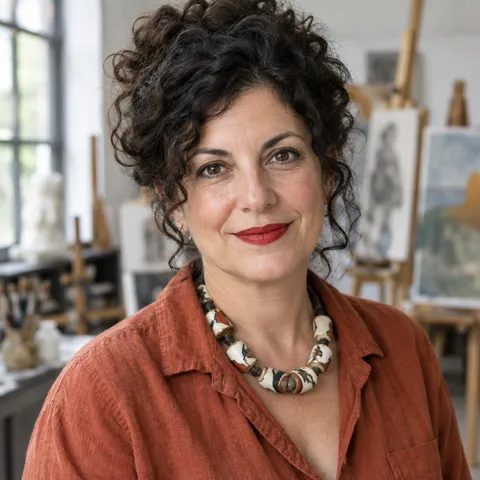
Dr. Lucia Marchetti
Associate Professor of Art and Art History
Instructor for ART 110, Fall 2026 and Spring 2027
- Office
- Lovell Hall 170
- lmarchetti
@university.alkimi.ai
ART 110 · Art
Fundamental principles of observational drawing and two-dimensional visual composition, with studio practice in line, value, perspective, texture, and mixed drawing media.
Fall 2026 · At a glance
100-level courses: introductory, lower-division courses primarily for first-year students. Details: Undergraduate Catalog §9.27.
Associate Professor of Art and Art History
Instructor for ART 110, Fall 2026 and Spring 2027
Questions about a major or your plan: Academic Advising Center, Lovell Hall 101, (555) 555-0158.
Class meetings
Tue & Thu, 4:00–5:15 p.m.
Lovell Hall 310
Final exam
Thursday, December 17, 2026
3:30–5:30 p.m., Lovell Hall 310
Office hours
Wed & Fri, 2:00–3:30 p.m.
Lovell Hall 170
Tue, 11:00 a.m.–12:00 p.m.
Virtual (Zoom link in Canvas)
You may use generative AI tools to research historical drawing techniques, look up biographical information on master draftsmen, or explore color and value theory concepts. You may not use generative AI to generate reference images for observational drawing assignments, produce digital drawings presented as manual work, or automate compositional sketches.
From the syllabus
Grading
Letter grades follow the university scale (Student Handbook §4.1).
Key dates
First day of classes Past
Studio Project 1: Line, Proportion, and Sighting Past
Studio Project 2: Tonal Value and Chiaroscuro Still Life Next
Midterm Studio Portfolio Critique
Studio Project 3: Perspective and Spatial Composition
Required materials
Alkimi University Custom Studio Drawing Kit (drawing board, 18x24 Strathmore 400 drawing pad, newsprint pad, graphite set 2H–6B, vine and compressed charcoal sticks, kneaded eraser, blending stumps, conté crayons, black ink, and portfolio case).
Approx. $65 to $80 at the campus bookstore.
M. Kathleen Martin. Drawing from Observation: An Introduction to Perceptual Drawing. 2nd ed., McGraw-Hill, 2009.
Approx. $45 used or rental, $80 print purchase.
Degree planning
What to take first, what this course opens up, and the requirements it can satisfy, from the Undergraduate Catalog.
No catalog course is required first.
Catalog wording: None.
No other catalog course lists ART 110 as a prerequisite.
Every course also counts toward the 120 credits needed for a bachelor's degree. Confirm your plan with your advisor or the Academic Advising Center.
No AP exam awards credit for ART 110 (Undergraduate Catalog §3.11).
Registration
None.
ART 110 is offered in both the fall and spring semesters. Register through AlkimiHub self-service registration, which opens by credit standing. Until the add deadline, you don't need instructor permission as long as seats remain and you've met the prerequisites. Details: Student Handbook §3.3.
When a seat opens, AlkimiHub offers it to the first student on the waitlist and emails you. You have 24 hours to claim it before it goes to the next student. Details: Student Handbook §3.10.
Spring 2027 registration opens
By credit standing, in AlkimiHub.
Fall 2026 withdrawal deadline
Last day to withdraw with a W or elect Pass/No Pass.
Spring 2027 add deadline
Last day to add a course or change sections (11:59 p.m.).
Fall 2027 registration opens
By credit standing, in AlkimiHub.
The Fall 2026 add deadline passed on Sep 2, 2026.
All dates: academic calendar. Registration help: Office of the Registrar.
Official course syllabus
The syllabus as filed with the department and posted in Canvas for Fall 2026.
Term: Fall 2026
Credits: 3.0
Lecture Times & Location: Tuesday & Thursday 4:00–5:15 p.m., Lovell Hall 310
Modality: In-Person
lmarchetti@university.alkimi.ai
Fundamental principles of observational drawing and two-dimensional visual composition, with studio practice in line, value, perspective, texture, and mixed drawing media. ART 110 is an intensive, hands-on studio foundation course exploring the core principles of observational drawing and two-dimensional visual design. Working directly from still life arrangements, architectural interiors, natural forms, and the draped human figure, students develop technical proficiency in contour line, cross-hatching, tonal modeling, linear perspective, and textural rendering. The studio curriculum emphasizes disciplined mark-making using graphite, charcoal, conté crayon, and ink washes. Through iterative sketchbook practice, weekly studio critique, and portfolio development, students learn to translate three-dimensional spatial relationships into compelling, unified two-dimensional visual compositions.
None.
Upon successful completion of ART 110, students will be able to:
In accordance with Alkimi University Academic Policies (Student Handbook §5.8), ART 110 operates under AI Level 1.
| Week | Dates | Topics & Readings | Assignments & Deadlines |
|---|---|---|---|
| Week 1 | Aug 27 | Studio Orientation, Materials, and Mark-Making: Introduction to studio procedures, drawing materials, paper types, ergonomic drawing posture, grip, and expressive mark-making exercises. Reading: Martin Ch. 1, 2 | First day of classes: Wed Aug 26. |
| Week 2 | Sep 1, 3 | Gesture Drawing, Sighting, and Proportion: Perceptual sighting techniques: using the drawing tool as a measuring gauge, finding angle alignments, and intuitive gesture drawing. Reading: Martin Ch. 3 | Wed Sep 2: Add/section change deadline. |
| Week 3 | Sep 8, 10 | Contour Line Systems and Cross-Contour Modeling: Pure blind contour, modified contour, cross-contour line modeling, and line weight variation to depict volume and edge. Reading: Martin Ch. 4 | Mon Sep 7: Labor Day (no classes). Wed Sep 9: Census date (last day to drop without a W). |
| Week 4 | Sep 15, 17 | Negative Space and Compositional Structure: Isolating positive and negative shapes, framing the visual field with viewfinders, and compositional balance; Studio Project 1 due Thursday. Reading: Martin Ch. 5 | Studio Project 1: Line, Proportion, and Sighting due Thu Sep 17 at 11:59 p.m. |
| Week 5 | Sep 22, 24 | Value Theory and Light Logic: The five-step and nine-step value scale, light logic, core shadow, cast shadow, reflected light, and continuous graphite gradation. Reading: Martin Ch. 6 | — |
| Week 6 | Sep 29, Oct 1 | Volumetric Form and Geometric Solids: Rendering simple geometric solids (sphere, cylinder, cone, cube) in vine charcoal; establishing directional light sources and volumetric form. Reading: Martin Ch. 7 | — |
| Week 7 | Oct 6, 8 | Complex Still Life and Surface Textures: Complex multi-object still life drawing; rendering metallic reflection, glass transparency, matte ceramic, and drapery; Studio Project 2 due Thursday. Reading: Martin Ch. 8 | Studio Project 2: Tonal Value and Chiaroscuro Still Life due Thu Oct 8 at 11:59 p.m. |
| Week 8 | Oct 15 | Subtractive Drawing Techniques (Fall Break Week): In-studio open drawing session focusing on charcoal reductive drawing techniques (subtractive drawing with kneaded erasers). Reading: Martin Ch. 9; in-studio exercises | Oct 12–Oct 13: Fall break (no classes). Fri Oct 16: Midterm grades due. |
| Week 9 | Oct 20, 22 | Midterm Portfolio Review and Studio Critique: Formal midterm studio critique: displaying selected drawings from weeks 1–8; group evaluation of draftsmanship, composition, and craftsmanship. Reading: Martin Ch. 10; Midterm Portfolio Review | Midterm Studio Portfolio Critique due Thu Oct 22 at 11:59 p.m. |
| Week 10 | Oct 27, 29 | One-Point Linear Perspective and Interior Space: Introduction to one-point linear perspective: horizon line, eye level, vanishing points, converging orthogonal lines, and interior room space. Reading: Martin Ch. 11 | — |
| Week 11 | Nov 3, 5 | Two-Point Perspective and Architectural Structures: Two-point linear perspective: measuring inclined planes, architectural blocks, rotating geometric forms, and foreshortened ellipses. Reading: Martin Ch. 12 | Fri Nov 6: Last day to withdraw (W) or elect Pass/No Pass. |
| Week 12 | Nov 10, 12 | Atmospheric Perspective and Deep Spatial Composition: Depicting atmospheric depth through contrast reduction, edge softness, and scale attenuation; Studio Project 3 due Thursday. Reading: Martin Ch. 13 | Studio Project 3: Perspective and Spatial Composition due Thu Nov 12 at 11:59 p.m. |
| Week 13 | Nov 17, 19 | Introduction to Figure Drawing and Human Proportion: Proportions of the human skeleton, landmark anatomical points, sighting the head and torso, and short gesture poses from the costumed model. Reading: Martin Ch. 14 | — |
| Week 14 | Nov 24 | Drapery and the Clothed Figure (Thanksgiving Week): Understanding structural folds in clothing (pipe, diaper, zigzag, spiral folds) and drawing the clothed human figure (Thanksgiving Week). Reading: Martin Ch. 15 | Nov 25–Nov 27: Thanksgiving break (no classes). |
| Week 15 | Dec 1, 3 | Mixed Media Drawing and Ink Wash Techniques: Translating observational forms into mixed drawing media: combining waterproof black drawing ink washes, dip pen lines, conté crayon, and gouache highlights. Reading: Martin Ch. 16 | — |
| Week 16 | Dec 8 | Final Portfolio Preparation and Curatorial Studio Practice: Curating final drawings, matting and framing techniques, portfolio presentation standards, and self-assessment documentation. Reading: Martin Ch. 17; Final portfolio curation | Wed Dec 9: Last day of classes. Thu Dec 10: Reading Day. |
| Finals | Dec 17 | Final Capstone Portfolio and Critique: Thursday, December 17, 2026, 3:30–5:30 p.m., Lovell Hall 310. | Comprehensive. |
Studio drawing is an experiential discipline requiring hands-on studio practice, direct observation under controlled lighting, and peer critique. Attendance at every studio session is mandatory. You are permitted two unexcused absences without penalty; subsequent absences will reduce your final course grade by one third of a letter grade. Missing more than five studio sessions will result in a failing grade. Students who miss the first two class meetings without notifying the instructor may be dropped. Students may miss class for religious observance without penalty if they notify the instructor in writing within the first two weeks of the semester (by Wednesday, September 9, 2026). Absences for university-sponsored activities (athletics, performances, conferences) are excused with a letter from the sponsoring office at least one week in advance.
Studio projects and portfolios submitted late lose one letter grade (10%) per day overdue, up to a maximum of three days, after which work is not accepted. Sketchbook assignments must be present in the studio on critique days to receive credit. Missed in-class studio setups cannot be replicated outside of studio hours.
The final examination (Thursday, December 17, 2026, 3:30–5:30 p.m.) is scheduled by the University Registrar and can't be moved without the Dean's written approval (Faculty Handbook §5.5). A student with three or more final exams on the same calendar day may reschedule one of them. Requests go to the instructor of the middle exam by the last day of classes. For this term, send the request by Wednesday, December 9, 2026 (Student Handbook §6.4).
Alkimi University is an academic community devoted to rigorous scholarship, open intellectual inquiry, and uncompromising ethical conduct. All students are subject to the regulations of the Alkimi University Academic Integrity Policy. Academic dishonesty—including plagiarism, cheating on examinations, unauthorized collaboration, fabrication of empirical data, and unauthorized submission of academic work generated by artificial intelligence—undermines the integrity of the university and carries severe disciplinary sanctions. Sanctions range from a failing grade on an assignment or exam to an administrative course failure recorded as an 'XF' on the official transcript, academic suspension, or expulsion. Suspected violations are formally investigated and resolved through the Office of Academic Integrity in accordance with Faculty Handbook §6. For detailed information, consult the Office of Academic Integrity, Lovell Hall 315, (555) 555-0163, integrity@university.alkimi.ai.
Alkimi University is committed to providing equitable educational access and reasonable accommodations for all students with documented disabilities, including physical, sensory, psychological, learning, and chronic health conditions. Students requesting academic accommodations must formally register with the Office of Accessibility Services, Harlan Hall 204, (555) 555-0155, access@university.alkimi.ai. Once approved, students will receive an official Faculty Accommodation Letter detailing approved accommodations. Students should present this letter to the instructor as early in the semester as possible, and at least one week prior to any exam or assignment requiring accommodation. Accommodations cannot be applied retroactively.
Your physical health, psychological well-being, and mental health are essential to your academic success. If you experience heightened stress, anxiety, depressive symptoms, personal trauma, or academic burnout, free, confidential counseling and medical care are available through the Hollis Health & Counseling Center, located in the Hollis Center. Routine appointments are available Monday–Friday 8:00 a.m.–6:00 p.m. and Saturday 10:00 a.m.–2:00 p.m. during the semester by calling (555) 555-0190 or emailing health@university.alkimi.ai. Urgent, 24/7 crisis psychological counseling is accessible immediately at (555) 555-0199.
advising@university.alkimi.ai
askalibrarian@university.alkimi.ai
health@university.alkimi.ai
ART courses