
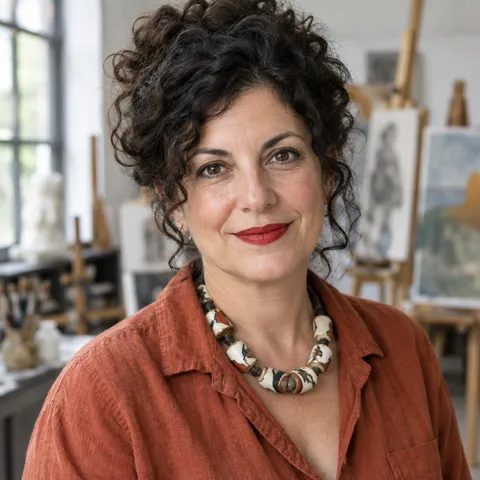
Dr. Lucia Marchetti
Associate Professor of Art and Art History
Instructor for ART 101, Fall 2026 and Spring 2027
- Office
- Lovell Hall 170
- lmarchetti
@university.alkimi.ai
ART 101 · Art
Global survey of visual art and architecture from antiquity to the contemporary era, emphasizing cultural contexts, stylistic movements, visual analysis, and critical interpretation.
Fall 2026 · At a glance
100-level courses: introductory, lower-division courses primarily for first-year students. Details: Undergraduate Catalog §9.27.
Associate Professor of Art and Art History
Instructor for ART 101, Fall 2026 and Spring 2027
Questions about a major or your plan: Academic Advising Center, Lovell Hall 101, (555) 555-0158.
Class meetings
Tue & Thu, 2:30–3:45 p.m.
Lovell Hall 130
Final exam
Thursday, December 17, 2026
1:00–3:00 p.m., Lovell Hall 130
Office hours
Wed & Fri, 2:00–3:30 p.m.
Lovell Hall 170
Tue, 11:00 a.m.–12:00 p.m.
Virtual (Zoom link in Canvas)
You may use generative AI tools to review chronological timelines, look up definitions of architectural and artistic terms, or check spelling and grammar on preliminary drafts. You may not use generative AI to write formal visual analyses, generate artwork comparisons, interpret iconographic symbolism, or answer examination essay prompts.
From the syllabus
Grading
Letter grades follow the university scale (Student Handbook §4.1).
Key dates
First day of classes Past
Formal Visual Analysis Paper: Sculpture or Monument Past
Midterm Slide Identification & Essay Examination Next
Comparative Artwork Analysis Essay
Required materials
Fred S. Kleiner. Gardner's Art through the Ages: A Global History. 16th ed., Cengage Learning, 2020.
Approx. $55 digital rental via MindTap/Canvas, $95 print purchase.
Alkimi Art History Digital Image Archive and Primary Source Anthology.
Free digital access provided via Canvas.
Degree planning
What to take first, what this course opens up, and the requirements it can satisfy, from the Undergraduate Catalog.
No catalog course is required first.
Catalog wording: None.
No other catalog course lists ART 101 as a prerequisite.
Every course also counts toward the 120 credits needed for a bachelor's degree. Confirm your plan with your advisor or the Academic Advising Center.
No AP exam awards credit for ART 101 (Undergraduate Catalog §3.11).
Registration
None.
ART 101 is offered in both the fall and spring semesters. Register through AlkimiHub self-service registration, which opens by credit standing. Until the add deadline, you don't need instructor permission as long as seats remain and you've met the prerequisites. Details: Student Handbook §3.3.
When a seat opens, AlkimiHub offers it to the first student on the waitlist and emails you. You have 24 hours to claim it before it goes to the next student. Details: Student Handbook §3.10.
Spring 2027 registration opens
By credit standing, in AlkimiHub.
Fall 2026 withdrawal deadline
Last day to withdraw with a W or elect Pass/No Pass.
Spring 2027 add deadline
Last day to add a course or change sections (11:59 p.m.).
Fall 2027 registration opens
By credit standing, in AlkimiHub.
The Fall 2026 add deadline passed on Sep 2, 2026.
All dates: academic calendar. Registration help: Office of the Registrar.
Official course syllabus
The syllabus as filed with the department and posted in Canvas for Fall 2026.
Term: Fall 2026
Credits: 3.0
Lecture Times & Location: Tuesday & Thursday 2:30–3:45 p.m., Lovell Hall 130
Modality: In-Person
lmarchetti@university.alkimi.ai
Global survey of visual art and architecture from antiquity to the contemporary era, emphasizing cultural contexts, stylistic movements, visual analysis, and critical interpretation. ART 101 introduces students to the global history of visual art, sculpture, and monumental architecture from antiquity through the Renaissance to the contemporary era. We investigate how visual objects embody sacred beliefs, political power, cultural identity, and aesthetic values across historical civilizations in the Mediterranean, Asia, Africa, and the Americas. Students develop disciplined formal visual analysis skills, learning to interrogate composition, scale, medium, line, color, light, and iconography. Through comparative case studies and primary source readings, students explore the cross-cultural exchange of artistic materials, styles, and ideas across centuries.
None.
Upon successful completion of ART 101, students will be able to:
In accordance with Alkimi University Academic Policies (Student Handbook §5.8), ART 101 operates under AI Level 1.
| Week | Dates | Topics & Readings | Assignments & Deadlines |
|---|---|---|---|
| Week 1 | Aug 27 | The Language of Art History and Prehistoric Expression: What is art history? Formal visual analysis, elements of art, medium, technique, style, and iconography; prehistoric cave painting and Neolithic architecture. Reading: Kleiner Ch. 1 | First day of classes: Wed Aug 26. |
| Week 2 | Sep 1, 3 | Ancient Near East and the Nile Valley: Ziggurats, stele, and palace reliefs of Sumer, Akkad, and Assyria; monumental Egyptian funerary complexes, Old and New Kingdom sculpture, and divine kingship. Reading: Kleiner Ch. 2, 3 | Wed Sep 2: Add/section change deadline. |
| Week 3 | Sep 8, 10 | The Aegean World and Classical Greek Art: Cycladic figurines, Minoan palatial frescoes, Mycenaean citadels, Archaic kouroi, Classical temples, and the Parthenon sculptures. Reading: Kleiner Ch. 4, 5 | Mon Sep 7: Labor Day (no classes). Wed Sep 9: Census date (last day to drop without a W). |
| Week 4 | Sep 15, 17 | Etruscan and Roman Art and Imperial Architecture: Etruscan tombs and terracotta statuary; Roman architectural innovation (concrete, arch, dome), imperial portraiture, the Colosseum, and the Pantheon. Reading: Kleiner Ch. 6, 7 | — |
| Week 5 | Sep 22, 24 | Late Antiquity and Byzantine Splendor: Catacomb frescoes, early Christian basilicas, Justinianic mosaics at Ravenna, Hagia Sophia, and the iconoclastic controversy; Formal Visual Analysis due Thursday. Reading: Kleiner Ch. 8, 9 | Formal Visual Analysis Paper: Sculpture or Monument due Thu Sep 24 at 11:59 p.m. |
| Week 6 | Sep 29, Oct 1 | Islamic Visual Culture and Architectural Innovation: The Great Mosque of Córdoba, the Dome of the Rock, calligraphy, arabesques, geometric tilework, and Islamic courtly arts. Reading: Kleiner Ch. 10 | — |
| Week 7 | Oct 6, 8 | Arts of South and East Asia: India, China, and Japan: The Great Stupa at Sanchi, Hindu rock-cut temples at Ellora, Angkor Wat, Chinese bronze casting, terracotta warriors, and scroll painting. Reading: Kleiner Ch. 15, 16, 17 | — |
| Week 8 | Oct 15 | Midterm Examination and Visual Synthesis (Fall Break Week): Synthesizing visual analysis and cultural contexts across ancient and medieval traditions; Midterm Examination administered in class on Thursday. Reading: Kleiner review chapters 1–10; Midterm Examination in class | Oct 12–Oct 13: Fall break (no classes). Fri Oct 16: Midterm grades due. Midterm Slide Identification & Essay Examination (in class). |
| Week 9 | Oct 20, 22 | Early Medieval and Romanesque Art in Western Europe: Insular manuscript illumination (Book of Kells), pilgrimage churches, Romanesque portal sculpture, and reliquaries. Reading: Kleiner Ch. 11, 12 | — |
| Week 10 | Oct 27, 29 | The Gothic Cathedral: Engineering Light and Faith: Pointed arches, ribbed vaults, flying buttresses, stained glass, and sculptural programs at Saint-Denis, Chartres, and Notre-Dame de Paris. Reading: Kleiner Ch. 13 | — |
| Week 11 | Nov 3, 5 | The Italian Renaissance: Florence, Rome, and Venice: Giotto and the pre-Renaissance; Florentine humanism, linear perspective (Brunelleschi, Alberti), Donatello, Botticelli, and high Renaissance masters. Reading: Kleiner Ch. 14, 21, 22 | Fri Nov 6: Last day to withdraw (W) or elect Pass/No Pass. |
| Week 12 | Nov 10, 12 | Northern Renaissance Art and Global Trade Networks: Oil glazing techniques, van Eyck, Dürer's printmaking, Holbein, and maritime trade connections to West Africa; Comparative Essay due Thursday. Reading: Kleiner Ch. 20, 23 | Comparative Artwork Analysis Essay due Thu Nov 12 at 11:59 p.m. |
| Week 13 | Nov 17, 19 | Indigenous Americas and Traditional African Arts: Mesoamerican pyramids (Teotihuacan, Maya, Aztec), Andean textiles and Inka stonework; Benin bronzes, Yoruba beadwork, and West African royal regalia. Reading: Kleiner Ch. 18, 19 | — |
| Week 14 | Nov 24 | Baroque Theatricality and Absolutist Splendor (Thanksgiving Week): The Counter-Reformation, dynamic theatricality, chiaroscuro in Caravaggio and Gentileschi, Bernini's sculpture, and Dutch Golden Age portraiture (Thanksgiving Week). Reading: Kleiner Ch. 24, 25 | Nov 25–Nov 27: Thanksgiving break (no classes). |
| Week 15 | Dec 1, 3 | Enlightenment, Neoclassicism, and Romanticism: Rococo opulence, Enlightenment rationalism, Neoclassical virtue (David), Romantic passion and sublime landscapes (Goya, Turner, Friedrich). Reading: Kleiner Ch. 26, 27 | — |
| Week 16 | Dec 8 | The Advent of Modernity and Global Contemporary Practice: Realism, Impressionism, Post-Impressionism, Modernist abstraction, and global contemporary artistic dialogues; comprehensive course review. Reading: Kleiner Ch. 28, 29; Final exam preparation | Wed Dec 9: Last day of classes. Thu Dec 10: Reading Day. |
| Finals | Dec 17 | Final Comprehensive Examination: Thursday, December 17, 2026, 1:00–3:00 p.m., Lovell Hall 130. | Comprehensive. |
Visual literacy is cultivated through real-time looking, collaborative visual analysis, and active dialogue in the lecture hall. Regular and punctual attendance is required for every scheduled class session. You are allowed two unexcused absences without grade penalty; each additional unexcused absence will reduce your final course grade by one third of a letter grade. Missing more than five class sessions will result in a failing grade. Students who miss the first two class meetings without notifying the instructor may be dropped. Students may miss class for religious observance without penalty if they notify the instructor in writing within the first two weeks of the semester (by Wednesday, September 9, 2026). Absences for university-sponsored activities (athletics, performances, conferences) are excused with a letter from the sponsoring office at least one week in advance.
Written visual analysis papers and comparative essays lose 10% per calendar day late and will not be accepted after three days past the stated deadline. Weekly image responses and in-class examinations cannot be made up without a documented university medical or dean's excuse.
The final examination (Thursday, December 17, 2026, 1:00–3:00 p.m.) is scheduled by the University Registrar and can't be moved without the Dean's written approval (Faculty Handbook §5.5). A student with three or more final exams on the same calendar day may reschedule one of them. Requests go to the instructor of the middle exam by the last day of classes. For this term, send the request by Wednesday, December 9, 2026 (Student Handbook §6.4).
Alkimi University is an academic community devoted to rigorous scholarship, open intellectual inquiry, and uncompromising ethical conduct. All students are subject to the regulations of the Alkimi University Academic Integrity Policy. Academic dishonesty—including plagiarism, cheating on examinations, unauthorized collaboration, fabrication of empirical data, and unauthorized submission of academic work generated by artificial intelligence—undermines the integrity of the university and carries severe disciplinary sanctions. Sanctions range from a failing grade on an assignment or exam to an administrative course failure recorded as an 'XF' on the official transcript, academic suspension, or expulsion. Suspected violations are formally investigated and resolved through the Office of Academic Integrity in accordance with Faculty Handbook §6. For detailed information, consult the Office of Academic Integrity, Lovell Hall 315, (555) 555-0163, integrity@university.alkimi.ai.
Alkimi University is committed to providing equitable educational access and reasonable accommodations for all students with documented disabilities, including physical, sensory, psychological, learning, and chronic health conditions. Students requesting academic accommodations must formally register with the Office of Accessibility Services, Harlan Hall 204, (555) 555-0155, access@university.alkimi.ai. Once approved, students will receive an official Faculty Accommodation Letter detailing approved accommodations. Students should present this letter to the instructor as early in the semester as possible, and at least one week prior to any exam or assignment requiring accommodation. Accommodations cannot be applied retroactively.
Your physical health, psychological well-being, and mental health are essential to your academic success. If you experience heightened stress, anxiety, depressive symptoms, personal trauma, or academic burnout, free, confidential counseling and medical care are available through the Hollis Health & Counseling Center, located in the Hollis Center. Routine appointments are available Monday–Friday 8:00 a.m.–6:00 p.m. and Saturday 10:00 a.m.–2:00 p.m. during the semester by calling (555) 555-0190 or emailing health@university.alkimi.ai. Urgent, 24/7 crisis psychological counseling is accessible immediately at (555) 555-0199.
advising@university.alkimi.ai
askalibrarian@university.alkimi.ai
health@university.alkimi.ai
ART courses