ECON 201 — Principles of Microeconomics
3 Credits Fall, Spring
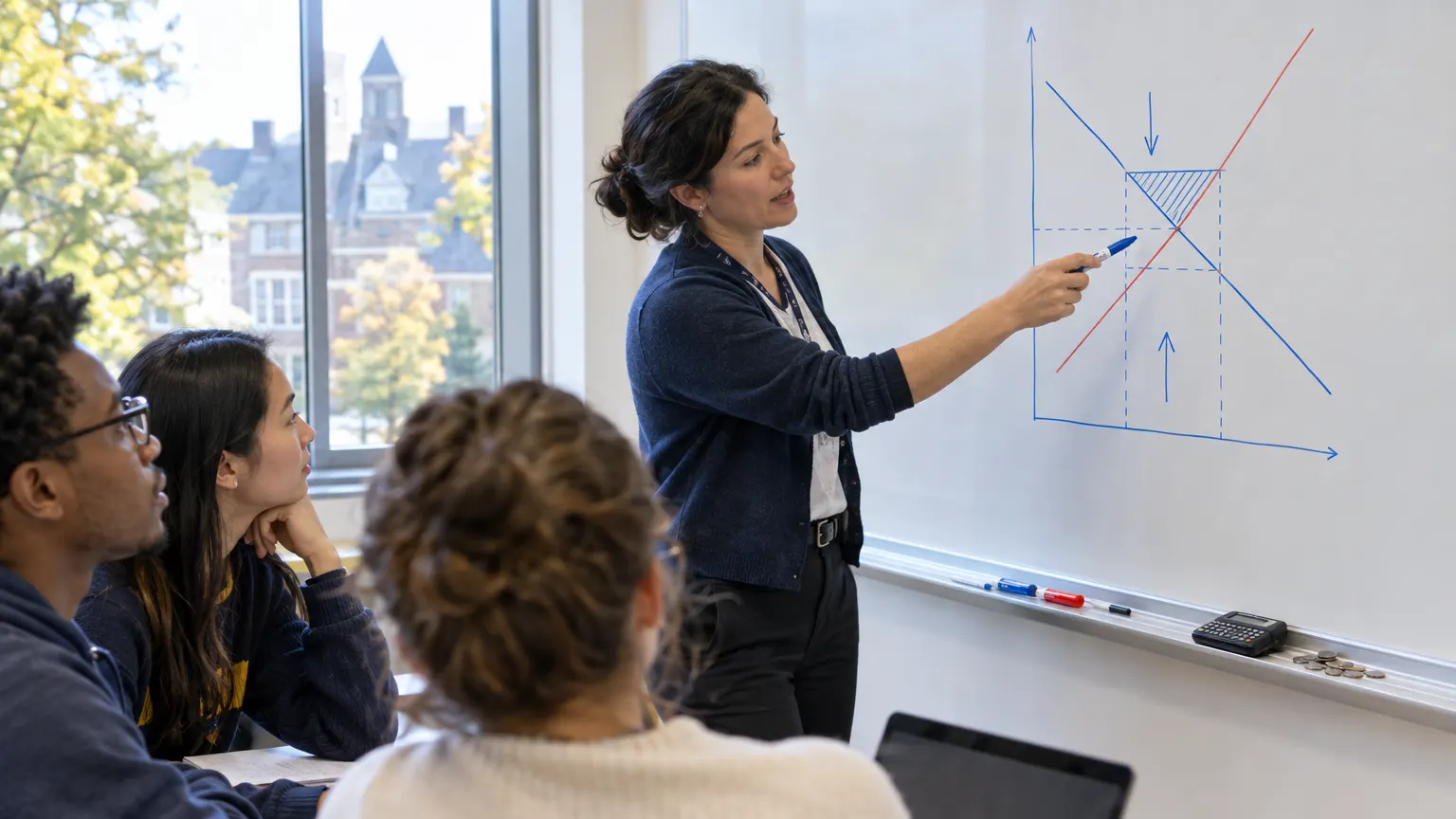
Supply and demand, consumer and firm behavior, market structures, and public policy.
- Prerequisites:
- None.
- Typically Offered:
- Fall, Spring
Subject Code: ECON • Section 9.6
Undergraduate courses offered by the faculty in Economics, supporting major curricula, academic minors, and the Alkimi Core.
Catalog Documentation
Courses in Economics are designed around rigorous empirical, theoretical, and applied principles. Coursework builds systematically from 100-level introductory surveys through 400-level advanced capstones and research seminars.
Prerequisites must be completed with a grade of C- or higher (unless specified otherwise by the academic department). Students who have not satisfied course prerequisites may only enroll with explicit written permission of the instructor and department chair.
Catalog Citation
Official descriptions, credit distributions, and prerequisites authorized by the Faculty Senate.
Subject Summary
Complete Listings
Supply and demand, consumer and firm behavior, market structures, and public policy.
National income accounting, inflation, unemployment, fiscal and monetary policies, banking systems, long-run economic growth, and international exchange rates.
Mathematical analysis of consumer choice, utility maximization, production functions, cost minimization, perfect competition, monopoly, oligopoly, and game theory.
Formal models of economic growth (Solow model), aggregate demand and supply (IS-LM, AD-AS), monetary transmission, inflationary expectations, and macroeconomic stabilization.
Linear regression modeling, ordinary least squares (OLS) estimation, hypothesis testing, heteroskedasticity, autocorrelation, instrumental variables, and panel data using Stata/R.
Structure and functions of financial intermediaries, central banking operations, interest rate determination, monetary policy implementation, and financial crises.
Independent capstone research analyzing pressing microeconomic or macroeconomic policy issues, culminating in an empirical senior thesis and defense.