
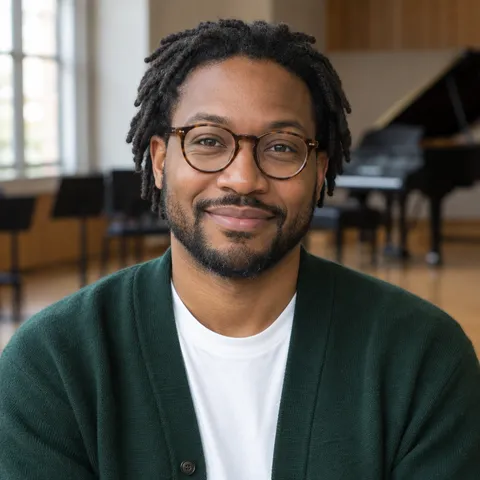
Dr. Julian Whitlock
Assistant Teaching Professor of Music and Theatre
Instructor for THTR 105, Fall 2026 and Spring 2027
- Office
- Lovell Hall 172
- jwhitlock
@university.alkimi.ai
THTR 105 · Theatre
Introduction to the fundamentals of acting, dramatic analysis, and stagecraft, featuring studio performance exercises in vocal projection, physical expression, scene study, and improvisation.
Fall 2026 · At a glance
100-level courses: introductory, lower-division courses primarily for first-year students. Details: Undergraduate Catalog §9.29.
Assistant Teaching Professor of Music and Theatre
Instructor for THTR 105, Fall 2026 and Spring 2027
Questions about a major or your plan: Academic Advising Center, Lovell Hall 101, (555) 555-0158.
Class meetings
Tue & Thu, 4:00–5:15 p.m.
Lovell Hall 320
Final exam
Thursday, December 17, 2026
3:30–5:30 p.m., Lovell Hall 320
Office hours
Tue & Fri, 11:30 a.m.–1:00 p.m.
Lovell Hall 172
Wed, 11:00 a.m.–12:00 p.m.
Virtual (Zoom link in Canvas)
You may use generative AI tools to research theatrical production histories, brainstorm hypothetical character backstories, or explore historical dramaturgical context for your assigned scenes. You may not use generative AI to write your rehearsal journals, compose your play attendance response paper, analyze scene objectives, or replace memorization and live performance work.
From the syllabus
Grading
Letter grades follow the university scale (Student Handbook §4.1).
Key dates
First day of classes Past
Contemporary Monologue Performance Next
Play Attendance Dramatic Response Paper
Scene Study Performance
Culminating Dramatic Performance & Analysis
Required materials
Uta Hagen with Haskel Frankel. Respect for Acting. 2nd ed., John Wiley & Sons, 2008.
Approx. $18 print or digital purchase.
Alkimi University Theatre Production Tickets (admission to two campus productions during the semester).
Approx. $15 for two student-rate tickets.
Acting editions of selected contemporary plays for monologue and scene study (Dramatists Play Service / Concord Theatricals).
Approx. $15 for printed acting scripts.
Degree planning
What to take first, what this course opens up, and the requirements it can satisfy, from the Undergraduate Catalog.
No catalog course is required first.
Catalog wording: None.
No other catalog course lists THTR 105 as a prerequisite.
Every course also counts toward the 120 credits needed for a bachelor's degree. Confirm your plan with your advisor or the Academic Advising Center.
No AP exam awards credit for THTR 105 (Undergraduate Catalog §3.11).
Registration
None.
THTR 105 is offered in both the fall and spring semesters. Register through AlkimiHub self-service registration, which opens by credit standing. Until the add deadline, you don't need instructor permission as long as seats remain and you've met the prerequisites. Details: Student Handbook §3.3.
When a seat opens, AlkimiHub offers it to the first student on the waitlist and emails you. You have 24 hours to claim it before it goes to the next student. Details: Student Handbook §3.10.
Spring 2027 registration opens
By credit standing, in AlkimiHub.
Fall 2026 withdrawal deadline
Last day to withdraw with a W or elect Pass/No Pass.
Spring 2027 add deadline
Last day to add a course or change sections (11:59 p.m.).
Fall 2027 registration opens
By credit standing, in AlkimiHub.
The Fall 2026 add deadline passed on Sep 2, 2026.
All dates: academic calendar. Registration help: Office of the Registrar.
Official course syllabus
The syllabus as filed with the department and posted in Canvas for Fall 2026.
Term: Fall 2026
Credits: 3.0
Lecture Times & Location: Tuesday & Thursday 4:00–5:15 p.m., Lovell Hall 320
Modality: In-Person
jwhitlock@university.alkimi.ai
Introduction to the fundamentals of acting, dramatic analysis, and stagecraft, featuring studio performance exercises in vocal projection, physical expression, scene study, and improvisation. THTR 105 introduces students to the fundamentals of acting, dramatic analysis, and stagecraft through immersive studio performance. Rooted in Stanislavskian principles and contemporary physical theatre practices, this course guides actors through vocal projection, expressive movement, psychological objectives, and active listening. Students learn how to analyze dramatic scripts from an actor's perspective, score scenes for dynamic beats and subtext, and collaborate effectively with ensemble partners. Through monologue presentations, intensive scene study, and critical evaluation of live theatre, participants cultivate creative confidence, empathetic interpretation, and disciplined artistic expression.
None.
Upon successful completion of THTR 105, students will be able to:
In accordance with Alkimi University Academic Policies (Student Handbook §5.8), THTR 105 operates under AI Level 2.
| Week | Dates | Topics & Readings | Assignments & Deadlines |
|---|---|---|---|
| Week 1 | Aug 27 | Foundations of Dramatic Action and Ensemble Building: Introduction to the actor's craft, studio etiquette, release of tension, ensemble building, and active presence. Reading: Hagen, Part I: 'The Actor' | First day of classes: Wed Aug 26. |
| Week 2 | Sep 1, 3 | Physical Expression and Stage Movement: Physical alignment, body awareness, spatial relationships, gesture, and tempo-rhythm on stage. Reading: Hagen, Ch. 1–3 | Wed Sep 2: Add/section change deadline. |
| Week 3 | Sep 8, 10 | Vocal Projection, Breath Support, and Articulation: Diaphragmatic breath support, vocal resonance, projection without strain, phonetic articulation, and diction. Reading: Hagen, Ch. 4–5 | Mon Sep 7: Labor Day (no classes). Wed Sep 9: Census date (last day to drop without a W). |
| Week 4 | Sep 15, 17 | Stanislavskian Technique: Objectives and Actions: Stanislavski's system; defining objective, super-objective, action verbs, and overcoming stage obstacles. Reading: Hagen, Ch. 6–7 | — |
| Week 5 | Sep 22, 24 | Given Circumstances and Sensory Endowment: The 'Magic If', sensory memory, exploring given circumstances, and personalizing dramatic stakes. Reading: Hagen, Ch. 8–10 | — |
| Week 6 | Sep 29, Oct 1 | Monologue Performance and Textual Scoring: Textual scoring, finding the inner monologue, and live performance of assigned monologues in class. Reading: Assigned monologue texts | Contemporary Monologue Performance (in class). |
| Week 7 | Oct 6, 8 | Dramatic Analysis: Beats, Conflict, and Subtext: Script breakdown for actors: identifying beats, operative words, transitions, conflict arcs, and subtext. Reading: Hagen, Part II: 'The Target' | — |
| Week 8 | Oct 15 | Characterization and Physical Transformation (Fall Break Week): Character biography, vocal-physical transformation, status, and habit; Fall break week. Reading: Hagen, Ch. 11–13 | Oct 12–Oct 13: Fall break (no classes). Fri Oct 16: Midterm grades due. |
| Week 9 | Oct 20, 22 | Scene Study: Partner Connection and Active Listening: Introduction to scene study; establishing partner connection, eye contact, listening, and responsive action. Reading: Hagen, Part III: 'The Play and the Role' | — |
| Week 10 | Oct 27, 29 | Contemporary Realism and Scene Rehearsal: Rehearsing contemporary realism; staging blocking, pacing, and relationship dynamics; Play Attendance Response Paper due Thursday. Reading: Assigned contemporary scene texts | Play Attendance Dramatic Response Paper due Thu Oct 29 at 11:59 p.m. |
| Week 11 | Nov 3, 5 | Non-Realist Drama and Heightened Language: Heightened theatrical language, verse, non-realistic conventions, and expressive physical comedy. Reading: Selected classical and heightened dramatic excerpts | Fri Nov 6: Last day to withdraw (W) or elect Pass/No Pass. |
| Week 12 | Nov 10, 12 | Improvisation, Status, and Spontaneity: Spontaneous reaction, status transactions, agreeing and advancing ('Yes, and...'), and overcoming performance anxiety. Reading: Studio improvisation handouts | — |
| Week 13 | Nov 17, 19 | Scene Study Performances: Polishing scene dynamics, integrating props and costumes, and presenting memorized Scene Study Performances in class. Reading: Scene scripts and peer critique guidelines | Scene Study Performance (in class). |
| Week 14 | Nov 24 | Stagecraft, Production Design, and Backstage Collaboration (Thanksgiving Week): Collaborative stagecraft: stage lighting, sound cues, scenic design, prop handling, and stage management protocols (Thanksgiving week). Reading: Stagecraft technical overview handout | Nov 25–Nov 27: Thanksgiving break (no classes). |
| Week 15 | Dec 1, 3 | Audition Technique, Cold Readings, and Professional Practice: Audition preparation: contrasting monologues, cold reading techniques, professional headshot and résumé standards. Reading: Professional acting resources and industry guidelines | — |
| Week 16 | Dec 8 | Ensemble Synthesis and Final Performance Preparation: Synthesis of vocal, physical, and textual methodologies; final rehearsal polish and preparation for the culminating performance. Reading: Course review and performance reflection guidelines | Wed Dec 9: Last day of classes. Thu Dec 10: Reading Day. |
| Finals | Dec 17 | Culminating Dramatic Performance & Analysis: Thursday, December 17, 2026, 3:30–5:30 p.m., Lovell Hall 320. | Culminating ensemble performance presentation and comprehensive written dramatic analysis during the final exam slot. |
Acting is fundamentally an ensemble art and studio discipline requiring live, collaborative engagement. Active attendance at every class session is mandatory. You are permitted two unexcused absences without penalty; each additional unexcused absence lowers your final grade by one-third of a letter grade. Missing more than five class sessions will result in a failing grade for the course. Students who miss the first two class meetings without notifying the instructor may be dropped. Students may miss class for religious observance without penalty if they notify the instructor in writing within the first two weeks of the semester (by Wednesday, September 9, 2026). Absences for university-sponsored activities (athletics, performances, conferences) are excused with a letter from the sponsoring office at least one week in advance.
Written assignments, including character analyses and the play attendance response, lose 10% per calendar day late and are not accepted after three days past the deadline. Rehearsal journals cannot be submitted late without prior instructor permission. Performance dates (monologues and scene studies) are scheduled in advance; missed performance slots without an excused medical absence cannot be rescheduled.
The final examination (Thursday, December 17, 2026, 3:30–5:30 p.m.) is scheduled by the University Registrar and can't be moved without the Dean's written approval (Faculty Handbook §5.5). A student with three or more final exams on the same calendar day may reschedule one of them. Requests go to the instructor of the middle exam by the last day of classes. For this term, send the request by Wednesday, December 9, 2026 (Student Handbook §6.4).
Alkimi University is an academic community devoted to rigorous scholarship, open intellectual inquiry, and uncompromising ethical conduct. All students are subject to the regulations of the Alkimi University Academic Integrity Policy. Academic dishonesty—including plagiarism, cheating on examinations, unauthorized collaboration, fabrication of empirical data, and unauthorized submission of academic work generated by artificial intelligence—undermines the integrity of the university and carries severe disciplinary sanctions. Sanctions range from a failing grade on an assignment or exam to an administrative course failure recorded as an 'XF' on the official transcript, academic suspension, or expulsion. Suspected violations are formally investigated and resolved through the Office of Academic Integrity in accordance with Faculty Handbook §6. For detailed information, consult the Office of Academic Integrity, Lovell Hall 315, (555) 555-0163, integrity@university.alkimi.ai.
Alkimi University is committed to providing equitable educational access and reasonable accommodations for all students with documented disabilities, including physical, sensory, psychological, learning, and chronic health conditions. Students requesting academic accommodations must formally register with the Office of Accessibility Services, Harlan Hall 204, (555) 555-0155, access@university.alkimi.ai. Once approved, students will receive an official Faculty Accommodation Letter detailing approved accommodations. Students should present this letter to the instructor as early in the semester as possible, and at least one week prior to any exam or assignment requiring accommodation. Accommodations cannot be applied retroactively.
Your physical health, psychological well-being, and mental health are essential to your academic success. If you experience heightened stress, anxiety, depressive symptoms, personal trauma, or academic burnout, free, confidential counseling and medical care are available through the Hollis Health & Counseling Center, located in the Hollis Center. Routine appointments are available Monday–Friday 8:00 a.m.–6:00 p.m. and Saturday 10:00 a.m.–2:00 p.m. during the semester by calling (555) 555-0190 or emailing health@university.alkimi.ai. Urgent, 24/7 crisis psychological counseling is accessible immediately at (555) 555-0199.
advising@university.alkimi.ai
askalibrarian@university.alkimi.ai
health@university.alkimi.ai
THTR courses