
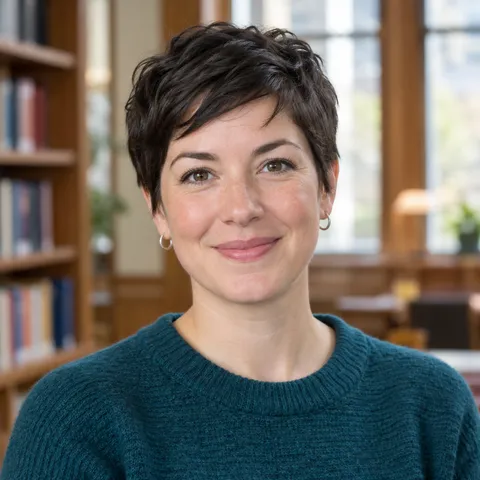
Dr. Colette Duval
Assistant Professor of Public Health
Instructor for PUBH 101, Fall 2026
- Office
- Calder Health Sciences Building 312
- cduval
@university.alkimi.ai
PUBH 101 · Public Health
History, core functions, and essential services of public health; determinants of health; and the ways public health tackles infectious disease, chronic disease, injury, and health inequities.
Fall 2026 · At a glance
100-level courses: introductory, lower-division courses primarily for first-year students. Details: Undergraduate Catalog §9.23.
Assistant Professor of Public Health
Instructor for PUBH 101, Fall 2026
Questions about a major or your plan: Academic Advising Center, Lovell Hall 101, (555) 555-0158.
Class meetings
Tue & Thu, 11:00 a.m.–12:15 p.m.
Calder Health Sciences Building 150
Final exam
Wednesday, December 16, 2026
1:30–3:30 p.m., Calder Health Sciences Building 150
Office hours
Mon & Thu, 9:00–10:30 a.m.
Calder Health Sciences Building 312
Fri, 9:00–10:00 a.m.
Virtual (Zoom link in Canvas)
You may use generative AI tools to explore historical timelines of public health milestones, brainstorm potential community stakeholders for local health initiatives, and check the grammar, organization, and clarity of your drafted assignments. You may not use generative AI to write your community health policy brief, generate synthesized stakeholder arguments, complete weekly quizzes, or answer examination questions.
From the syllabus
Grading
Letter grades follow the university scale (Student Handbook §4.1).
Key dates
First day of classes Past
Midterm Examination 1 Next
Community Health Problem Analysis & Policy Brief
Midterm Examination 2
Public Health Campaign Design Project
Required materials
Riegelman, Richard, and Brenda Kirkwood. Public Health 101: Improving Community Health. 3rd ed., Jones & Bartlett Learning, 2019.
Approx. $85 print, $50 digital rental.
Schneider, Mary-Jane. Introduction to Public Health. 6th ed., Jones & Bartlett Learning, 2021.
Approx. $90 print or digital.
Degree planning
What to take first, what this course opens up, and the requirements it can satisfy, from the Undergraduate Catalog.
No catalog course is required first.
Catalog wording: None.
Every course also counts toward the 120 credits needed for a bachelor's degree. Confirm your plan with your advisor or the Academic Advising Center.
No AP exam awards credit for PUBH 101 (Undergraduate Catalog §3.11).
Registration
None.
PUBH 101 is offered in the fall semester. Register through AlkimiHub self-service registration, which opens by credit standing. Until the add deadline, you don't need instructor permission as long as seats remain and you've met the prerequisites. Details: Student Handbook §3.3.
When a seat opens, AlkimiHub offers it to the first student on the waitlist and emails you. You have 24 hours to claim it before it goes to the next student. Details: Student Handbook §3.10.
Fall 2026 withdrawal deadline
Last day to withdraw with a W or elect Pass/No Pass.
Fall 2027 registration opens
By credit standing, in AlkimiHub.
The Fall 2026 add deadline passed on Sep 2, 2026.
All dates: academic calendar. Registration help: Office of the Registrar.
Official course syllabus
The syllabus as filed with the department and posted in Canvas for Fall 2026.
Term: Fall 2026
Credits: 3.0
Lecture Times & Location: Tuesday & Thursday 11:00 a.m.–12:15 p.m., Calder Health Sciences Building 150
Modality: In-Person
cduval@university.alkimi.ai
History, core functions, and essential services of public health; determinants of health; and the ways public health tackles infectious disease, chronic disease, injury, and health inequities. PUBH 101 provides an introduction to the concepts, institutions, and population-based methodologies that protect and improve the health of communities. Tracing the evolution of public health from sanitary reforms to modern epidemiology, students examine the three core functions (assessment, policy development, and assurance) and the 10 Essential Public Health Services. The course explores the social and ecological determinants of health, epidemiological surveillance, infectious and chronic disease control, environmental health hazards, and systemic strategies to achieve health equity.
None.
Upon successful completion of PUBH 101, students will be able to:
In accordance with Alkimi University Academic Policies (Student Handbook §5.8), PUBH 101 operates under AI Level 2.
| Week | Dates | Topics & Readings | Assignments & Deadlines |
|---|---|---|---|
| Week 1 | Aug 27 | What Is Public Health?: Definitions of population health, medicine versus public health, PERIE evidence-based public health approach, and historical perspectives. Reading: Riegelman & Kirkwood, Ch. 1 | First day of classes: Wed Aug 26. |
| Week 2 | Sep 1, 3 | Evidence-Based Public Health and Vital Statistics: Burden of disease, distribution of health states, mortality and morbidity rates, incidence and prevalence, and public health surveillance. Reading: Riegelman & Kirkwood, Ch. 2 | Wed Sep 2: Add/section change deadline. |
| Week 3 | Sep 8, 10 | Health Informatics and Health Communication: Collection and dissemination of public health data, health literacy, communicating risk, and countering health misinformation. Reading: Riegelman & Kirkwood, Ch. 3 | Mon Sep 7: Labor Day (no classes). Wed Sep 9: Census date (last day to drop without a W). |
| Week 4 | Sep 15, 17 | Social and Behavioral Determinants of Health: Socioeconomic status, culture, religion, social gradient in health, and socio-ecological models of health behavior. Reading: Riegelman & Kirkwood, Ch. 4 | — |
| Week 5 | Sep 22, 24 | Health Law, Policy, and Ethics: Police powers of the state, individual rights versus collective protection, bioethics, Belmont Report, and health policy frameworks. Reading: Riegelman & Kirkwood, Ch. 5 | — |
| Week 6 | Sep 29, Oct 1 | Infectious Diseases: Transmission and Outbreak Control: Chain of infection, epidemic curves, contact tracing, immunization strategies, and antimicrobial resistance; Midterm Examination 1 in class. Reading: Riegelman & Kirkwood, Ch. 6 | Midterm Examination 1 (in class). |
| Week 7 | Oct 6, 8 | Emerging and Re-emerging Global Pathogens: Zoonotic spillover, pandemics, vector-borne diseases, global surveillance networks (WHO), and quarantine measures. Reading: Riegelman & Kirkwood, Ch. 7 | — |
| Week 8 | Oct 15 | Chronic Disease Burden: The Non-Communicable Epidemic: Cardiovascular disease, cancer, diabetes, behavioral risk factors (tobacco, physical inactivity, diet), and screening criteria. Reading: Riegelman & Kirkwood, Ch. 8 | Oct 12–Oct 13: Fall break (no classes). Fri Oct 16: Midterm grades due. |
| Week 9 | Oct 20, 22 | Environmental Health and Physical Hazards: Air quality, safe drinking water, chemical exposures, occupational health hazards, climate change, and vulnerable populations. Reading: Riegelman & Kirkwood, Ch. 9 | Community Health Problem Analysis & Policy Brief due Fri Oct 23 at 11:59 p.m. |
| Week 10 | Oct 27, 29 | Injury Prevention and Violence as a Public Health Issue: Intentional and unintentional injury epidemiology, Haddon matrix, motor vehicle safety, firearm violence, and community violence interventions. Reading: Schneider, Ch. 16 | — |
| Week 11 | Nov 3, 5 | Maternal, Infant, and Child Health: Infant mortality rates as population indicators, prenatal care access, nutrition programs (WIC), and social policies supporting families. Reading: Schneider, Ch. 18 | Fri Nov 6: Last day to withdraw (W) or elect Pass/No Pass. |
| Week 12 | Nov 10, 12 | Public Health Institutions and Systems: Federal agencies (CDC, NIH, FDA), state and local health departments, NGOs, and community health centers; Midterm Examination 2 in class. Reading: Riegelman & Kirkwood, Ch. 12 | Midterm Examination 2 (in class). |
| Week 13 | Nov 17, 19 | Community-Based Participatory Health and Community Health Workers: Empowerment models, community health worker roles, cultural liaisons, and engaging grassroots community coalitions. Reading: Schneider, Ch. 20 | Public Health Campaign Design Project due Fri Nov 20 at 11:59 p.m. |
| Week 14 | Nov 24 | Disaster Preparedness and Emergency Response: Incident Command System, natural disasters, bioterrorism, hospital surge capacity, and emergency risk communication. Reading: Riegelman & Kirkwood, Ch. 13 | Nov 25–Nov 27: Thanksgiving break (no classes). |
| Week 15 | Dec 1, 3 | Future Challenges in Population Health: Artificial intelligence in public health surveillance, demographic aging, health inequities, and planetary health frameworks. Reading: Riegelman & Kirkwood, Ch. 14 | — |
| Week 16 | Dec 8 | Course Synthesis and Advocacy Presentations: Review of public health core functions, career trajectories in population health, and final examination preparation. Reading: Course review packet | Wed Dec 9: Last day of classes. Thu Dec 10: Reading Day. |
| Finals | Dec 16 | Final Examination: Wednesday, December 16, 2026, 1:30–3:30 p.m., Calder Health Sciences Building 150. | Comprehensive exam covering public health history, core functions, determinants, and community health strategies. |
Class attendance and thoughtful engagement in case discussions are essential. Public health is an inherently collaborative field where solving population dilemmas requires active dialogue and diverse perspectives. If illness or emergency causes an absence, please email Dr. Duval. Missing more than three unexcused classes will negatively impact your participation standing. Students who miss the first two class meetings without notifying the instructor may be dropped. Students may miss class for religious observance without penalty if they notify the instructor in writing within the first two weeks of the semester (by Wednesday, September 9, 2026). Absences for university-sponsored activities (athletics, performances, conferences) are excused with a letter from the sponsoring office at least one week in advance.
Assignments submitted after the deadline will be penalized 10% per calendar day up to a maximum of three days. Work submitted more than 72 hours late cannot be accepted. Weekly Canvas quizzes must be completed before the deadline and cannot be submitted late.
Students majoring in Public Health must earn a minimum grade of C in PUBH 101 to advance to upper-division public health coursework. A grade lower than C requires repeating the course.
The final examination (Wednesday, December 16, 2026, 1:30–3:30 p.m.) is scheduled by the University Registrar and can't be moved without the Dean's written approval (Faculty Handbook §5.5). A student with three or more final exams on the same calendar day may reschedule one of them. Requests go to the instructor of the middle exam by the last day of classes. For this term, send the request by Wednesday, December 9, 2026 (Student Handbook §6.4).
Alkimi University is an academic community devoted to rigorous scholarship, open intellectual inquiry, and uncompromising ethical conduct. All students are subject to the regulations of the Alkimi University Academic Integrity Policy. Academic dishonesty—including plagiarism, cheating on examinations, unauthorized collaboration, fabrication of empirical data, and unauthorized submission of academic work generated by artificial intelligence—undermines the integrity of the university and carries severe disciplinary sanctions. Sanctions range from a failing grade on an assignment or exam to an administrative course failure recorded as an 'XF' on the official transcript, academic suspension, or expulsion. Suspected violations are formally investigated and resolved through the Office of Academic Integrity in accordance with Faculty Handbook §6. For detailed information, consult the Office of Academic Integrity, Lovell Hall 315, (555) 555-0163, integrity@university.alkimi.ai.
Alkimi University is committed to providing equitable educational access and reasonable accommodations for all students with documented disabilities, including physical, sensory, psychological, learning, and chronic health conditions. Students requesting academic accommodations must formally register with the Office of Accessibility Services, Harlan Hall 204, (555) 555-0155, access@university.alkimi.ai. Once approved, students will receive an official Faculty Accommodation Letter detailing approved accommodations. Students should present this letter to the instructor as early in the semester as possible, and at least one week prior to any exam or assignment requiring accommodation. Accommodations cannot be applied retroactively.
Your physical health, psychological well-being, and mental health are essential to your academic success. If you experience heightened stress, anxiety, depressive symptoms, personal trauma, or academic burnout, free, confidential counseling and medical care are available through the Hollis Health & Counseling Center, located in the Hollis Center. Routine appointments are available Monday–Friday 8:00 a.m.–6:00 p.m. and Saturday 10:00 a.m.–2:00 p.m. during the semester by calling (555) 555-0190 or emailing health@university.alkimi.ai. Urgent, 24/7 crisis psychological counseling is accessible immediately at (555) 555-0199.
advising@university.alkimi.ai
askalibrarian@university.alkimi.ai
health@university.alkimi.ai
PUBH courses