
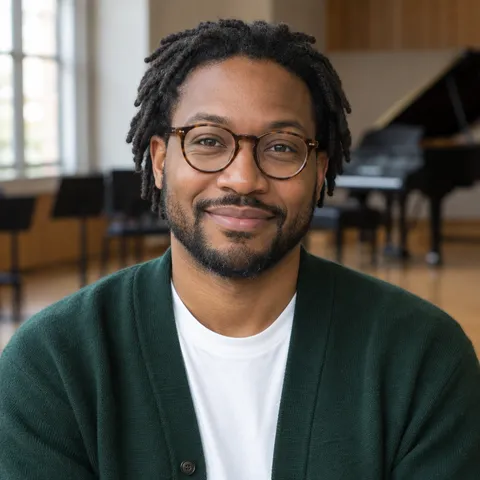
Dr. Julian Whitlock
Assistant Teaching Professor of Music and Theatre
Instructor for MUS 110, Fall 2026 and Spring 2027
- Office
- Lovell Hall 172
- jwhitlock
@university.alkimi.ai
MUS 110 · Music
Introduction to the elements of music, active listening, and aural culture, exploring major historical styles, genres, and world musical traditions from Western art music to contemporary global idioms.
Fall 2026 · At a glance
100-level courses: introductory, lower-division courses primarily for first-year students. Details: Undergraduate Catalog §9.28.
Assistant Teaching Professor of Music and Theatre
Instructor for MUS 110, Fall 2026 and Spring 2027
Questions about a major or your plan: Academic Advising Center, Lovell Hall 101, (555) 555-0158.
Class meetings
Tue & Thu, 8:00–9:15 a.m.
Lovell Hall 130
Final exam
Thursday, December 17, 2026
10:30 a.m.–12:30 p.m., Lovell Hall 130
Office hours
Tue & Fri, 11:30 a.m.–1:00 p.m.
Lovell Hall 172
Wed, 11:00 a.m.–12:00 p.m.
Virtual (Zoom link in Canvas)
You may use generative AI tools to look up composer biographies, verify dates of historical periods, or review definitions of musical forms and orchestral instruments. You may not use generative AI to write concert-attendance reports, fabricate live performance observations, generate listening exam responses, or synthesize musical analyses.
From the syllabus
Grading
Letter grades follow the university scale (Student Handbook §4.1).
Key dates
First day of classes Past
Concert-Attendance Report 1: Chamber or Solo Recital Next
Midterm Listening & Concepts Examination
Concert-Attendance Report 2: Large Ensemble or Orchestra
Concert-Attendance Report 3: Global or Contemporary Idioms
Required materials
Roger Kamien and Anita Kamien. Music: An Appreciation. 13th ed., McGraw-Hill Education, 2021.
Approx. $50 digital rental with streaming audio; $90 print purchase.
Alkimi University Concert Pass (provides free student admission to on-campus concerts, faculty recitals, and visiting ensemble performances).
Free student access with campus ID card.
Degree planning
What to take first, what this course opens up, and the requirements it can satisfy, from the Undergraduate Catalog.
No catalog course is required first.
Catalog wording: None.
No other catalog course lists MUS 110 as a prerequisite.
Every course also counts toward the 120 credits needed for a bachelor's degree. Confirm your plan with your advisor or the Academic Advising Center.
No AP exam awards credit for MUS 110 (Undergraduate Catalog §3.11).
Registration
None.
MUS 110 is offered in both the fall and spring semesters. Register through AlkimiHub self-service registration, which opens by credit standing. Until the add deadline, you don't need instructor permission as long as seats remain and you've met the prerequisites. Details: Student Handbook §3.3.
When a seat opens, AlkimiHub offers it to the first student on the waitlist and emails you. You have 24 hours to claim it before it goes to the next student. Details: Student Handbook §3.10.
Spring 2027 registration opens
By credit standing, in AlkimiHub.
Fall 2026 withdrawal deadline
Last day to withdraw with a W or elect Pass/No Pass.
Spring 2027 add deadline
Last day to add a course or change sections (11:59 p.m.).
Fall 2027 registration opens
By credit standing, in AlkimiHub.
The Fall 2026 add deadline passed on Sep 2, 2026.
All dates: academic calendar. Registration help: Office of the Registrar.
Official course syllabus
The syllabus as filed with the department and posted in Canvas for Fall 2026.
Term: Fall 2026
Credits: 3.0
Lecture Times & Location: Tuesday & Thursday 8:00–9:15 a.m., Lovell Hall 130
Modality: In-Person
jwhitlock@university.alkimi.ai
Introduction to the elements of music, active listening, and aural culture, exploring major historical styles, genres, and world musical traditions from Western art music to contemporary global idioms. MUS 110 develops perceptive, critical listening skills and explores the rich tapestry of global musical expression and aural culture. Beginning with the foundational elements of music—melody, rhythm, harmony, timbre, texture, and musical form—students trace the evolution of musical genres from medieval plainchant through the Renaissance, Baroque, Classical, and Romantic eras to 20th-century modernism, American jazz, and diverse non-Western musical traditions. Through guided in-class listening labs, analytical score study, and live concert-attendance experiences across the campus and local arts community, students discover how musical styles reflect broader cultural, technological, and historical shifts.
None.
Upon successful completion of MUS 110, students will be able to:
In accordance with Alkimi University Academic Policies (Student Handbook §5.8), MUS 110 operates under AI Level 1.
| Week | Dates | Topics & Readings | Assignments & Deadlines |
|---|---|---|---|
| Week 1 | Aug 27 | Elements of Sound: Pitch, Timbre, and the Orchestra: Elements of music: sound properties (pitch, dynamics, tone color), instrument families of the modern symphony orchestra, and vocal ranges. Reading: Kamien Part I, Ch. 1–3 | First day of classes: Wed Aug 26. |
| Week 2 | Sep 1, 3 | Rhythm, Meter, Tempo, and Musical Notation: Rhythm, beat, meter (duple, triple, quadruple, compound), syncopation, tempo markings, and reading basic musical notation. Reading: Kamien Part I, Ch. 4–6 | Wed Sep 2: Add/section change deadline. |
| Week 3 | Sep 8, 10 | Melody, Harmony, and Tonal Organization: Melody, melodic contour, phrases, cadences; harmony, consonance, dissonance, triads, major and minor chord progressions, and tonality. Reading: Kamien Part I, Ch. 7–8 | Mon Sep 7: Labor Day (no classes). Wed Sep 9: Census date (last day to drop without a W). |
| Week 4 | Sep 15, 17 | Musical Texture, Formal Principles, and Performance: Musical textures (monophonic, polyphonic, homophonic), formal architecture (ternary, binary, strophic), and musical performance conventions. Reading: Kamien Part I, Ch. 9–10 | — |
| Week 5 | Sep 22, 24 | Medieval Monophony and Renaissance Polyphony: Gregorian chant, church modes, Hildegard von Bingen; Notre Dame polyphony, organum; Renaissance polyphony (Josquin des Prez, Palestrina) and the madrigal. Reading: Kamien Part II, Ch. 1–4 | — |
| Week 6 | Sep 29, Oct 1 | The Baroque Era: Affections, Concerto Grosso, and Fugue: Aesthetic of the Baroque era, doctrine of the affections, basso continuo, concerto grosso, and ritornello form (Vivaldi); Concert Report 1 due Thursday. Reading: Kamien Part III, Ch. 1–6 | Concert-Attendance Report 1: Chamber or Solo Recital due Thu Oct 1 at 11:59 p.m. |
| Week 7 | Oct 6, 8 | Bach, Handel, and the Birth of Opera: The Baroque fugue, cantata, and sacred oratorio; life and masterworks of J.S. Bach and George Frideric Handel; early opera (Monteverdi, Purcell). Reading: Kamien Part III, Ch. 7–14 | — |
| Week 8 | Oct 15 | Midterm Examination and Listening Synthesis (Fall Break Week): Review of musical elements, early music, and Baroque forms; Midterm Examination with aural listening identifications in class on Thursday. Reading: Kamien review parts I–III; Midterm Examination in class | Oct 12–Oct 13: Fall break (no classes). Fri Oct 16: Midterm grades due. Midterm Listening & Concepts Examination (in class). |
| Week 9 | Oct 20, 22 | The Classical Era and Sonata-Allegro Architecture: Enlightenment ideals in music, balanced phrasing, the classical symphony, and sonata-allegro form (exposition, development, recapitulation, coda). Reading: Kamien Part IV, Ch. 1–6 | — |
| Week 10 | Oct 27, 29 | Haydn, Mozart, and Classical Chamber Forms: Theme and variations, minuet and trio, rondo form; the string quartet; chamber music and orchestral masterworks of Franz Joseph Haydn and W.A. Mozart. Reading: Kamien Part IV, Ch. 7–11 | — |
| Week 11 | Nov 3, 5 | Beethoven: Revolution, Expression, and Triumph: Ludwig van Beethoven as bridge to Romanticism; heroic style, motif transformation in Symphony No. 5, and late string quartets. Reading: Kamien Part IV, Ch. 12–13; Part V, Ch. 1–2 | Fri Nov 6: Last day to withdraw (W) or elect Pass/No Pass. |
| Week 12 | Nov 10, 12 | Romanticism, the Art Song, and Piano Virtuosity: Romantic individuality, program music, the German Lied (Schubert, Schumann), and virtuoso solo piano miniatures (Chopin, Liszt); Concert Report 2 due Thursday. Reading: Kamien Part V, Ch. 3–8 | Concert-Attendance Report 2: Large Ensemble or Orchestra due Thu Nov 12 at 11:59 p.m. |
| Week 13 | Nov 17, 19 | Programmatic Symphonies, Nationalism, and Romantic Opera: Berlioz and the programmatic symphony; nineteenth-century nationalism (Smetana, Dvořák); grand opera traditions (Verdi, Wagner's leitmotif). Reading: Kamien Part V, Ch. 9–17 | — |
| Week 14 | Nov 24 | American Vernacular Music: Blues, Jazz, and Broadway (Thanksgiving Week): Delta blues, New Orleans jazz, swing, bebop, and the American musical theatre tradition (Thanksgiving Week); Concert Report 3 due Tuesday. Reading: Kamien Part VII, Ch. 1–4 | Nov 25–Nov 27: Thanksgiving break (no classes). Concert-Attendance Report 3: Global or Contemporary Idioms due Tue Nov 24 at 11:59 p.m. |
| Week 15 | Dec 1, 3 | Twentieth-Century Modernism and Avant-Garde Innovations: Debussy and Impressionism; Stravinsky's polyrhythms in The Rite of Spring; Schoenberg's atonality and twelve-tone serialism; American modernism (Copland, Gershwin). Reading: Kamien Part VI, Ch. 1–14 | — |
| Week 16 | Dec 8 | Global Aural Cultures, Film Score, and Course Synthesis: Non-Western musical traditions: West African drumming, Indian classical raga and tala, Indonesian gamelan; film music and course synthesis. Reading: Kamien Part VIII, Ch. 1–4; Course review | Wed Dec 9: Last day of classes. Thu Dec 10: Reading Day. |
| Finals | Dec 17 | Final Comprehensive Listening Examination: Thursday, December 17, 2026, 10:30 a.m.–12:30 p.m., Lovell Hall 130. | Comprehensive. |
Aural literacy and listening acuity are built through shared listening experiences, immediate discussion, and live demonstration in class. Regular attendance is required for every lecture. You are permitted two unexcused absences without penalty; each subsequent unexcused absence will lower your final course grade by one third of a letter grade. Missing more than five class sessions will result in a failing grade. Students who miss the first two class meetings without notifying the instructor may be dropped. Students may miss class for religious observance without penalty if they notify the instructor in writing within the first two weeks of the semester (by Wednesday, September 9, 2026). Absences for university-sponsored activities (athletics, performances, conferences) are excused with a letter from the sponsoring office at least one week in advance.
Written concert-attendance reports lose 10% per calendar day late and will not be accepted more than three days beyond the due date. Weekly Canvas listening quizzes close at the deadline and cannot be submitted late without prior documentation of an excused illness or university conflict.
The final examination (Thursday, December 17, 2026, 10:30 a.m.–12:30 p.m.) is scheduled by the University Registrar and can't be moved without the Dean's written approval (Faculty Handbook §5.5). A student with three or more final exams on the same calendar day may reschedule one of them. Requests go to the instructor of the middle exam by the last day of classes. For this term, send the request by Wednesday, December 9, 2026 (Student Handbook §6.4).
Alkimi University is an academic community devoted to rigorous scholarship, open intellectual inquiry, and uncompromising ethical conduct. All students are subject to the regulations of the Alkimi University Academic Integrity Policy. Academic dishonesty—including plagiarism, cheating on examinations, unauthorized collaboration, fabrication of empirical data, and unauthorized submission of academic work generated by artificial intelligence—undermines the integrity of the university and carries severe disciplinary sanctions. Sanctions range from a failing grade on an assignment or exam to an administrative course failure recorded as an 'XF' on the official transcript, academic suspension, or expulsion. Suspected violations are formally investigated and resolved through the Office of Academic Integrity in accordance with Faculty Handbook §6. For detailed information, consult the Office of Academic Integrity, Lovell Hall 315, (555) 555-0163, integrity@university.alkimi.ai.
Alkimi University is committed to providing equitable educational access and reasonable accommodations for all students with documented disabilities, including physical, sensory, psychological, learning, and chronic health conditions. Students requesting academic accommodations must formally register with the Office of Accessibility Services, Harlan Hall 204, (555) 555-0155, access@university.alkimi.ai. Once approved, students will receive an official Faculty Accommodation Letter detailing approved accommodations. Students should present this letter to the instructor as early in the semester as possible, and at least one week prior to any exam or assignment requiring accommodation. Accommodations cannot be applied retroactively.
Your physical health, psychological well-being, and mental health are essential to your academic success. If you experience heightened stress, anxiety, depressive symptoms, personal trauma, or academic burnout, free, confidential counseling and medical care are available through the Hollis Health & Counseling Center, located in the Hollis Center. Routine appointments are available Monday–Friday 8:00 a.m.–6:00 p.m. and Saturday 10:00 a.m.–2:00 p.m. during the semester by calling (555) 555-0190 or emailing health@university.alkimi.ai. Urgent, 24/7 crisis psychological counseling is accessible immediately at (555) 555-0199.
advising@university.alkimi.ai
askalibrarian@university.alkimi.ai
health@university.alkimi.ai
MUS courses