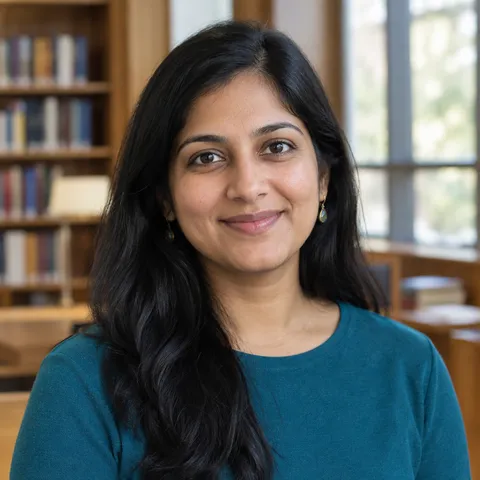
Dr. Anika Sharma
Assistant Professor of Mathematics
Instructor for MATH 140 (Fall 2026)
- Office
- Ashby Hall 118
- asharma@university.alkimi.ai
MATH 140 · Math & Logic
Limits, derivatives, applications of differentiation, and an introduction to integration.
Fall 2026 Overview
Meeting Times & Location
MTWF 11:00–11:50 a.m., Ashby Hall 105
Generative AI Policy
AI Level 2AI Level 2: Permitted with disclosure for specified tasks. You may use AI to check step-by-step calculus algebra, clarify limit definitions, and generate practice problems. You may not submit AI-generated solution steps as your own homework work. Disclosure required.
Assistant Professor of Mathematics
Instructor for MATH 140 (Fall 2026)
Enrolled students have 24/7 access to this course's dedicated AI assistant, grounded in the syllabus, weekly lecture notes, and assignment sheets.
Key Academic Benchmarks
Essential course requirements, grading structure, upcoming deadlines, and required learning materials.
Grading Weights
Deadlines
First Day of Classes
Wednesday, August 26, 2026
Assignment 1 Due
Friday, September 18, 2026
Midterm Exam 1 (In-Class)
Wednesday, October 7, 2026
Midterm Exam 2 (In-Class)
Friday, November 6, 2026
Final Comprehensive Exam
Friday, December 11, 2026 (11:30 a.m.)
Course Texts
Herman & Strang, Calculus Volume 1 (OpenStax)
Free digital access / optional print approx. $35
Graphing Calculator (recommended for homework study; prohibited on exams)
$0.00
Curriculum
Week 1: Introduction to Calculus
Review of functions, tangent lines, average vs. instantaneous velocity, and intuitive limits.
Week 2: Limit Laws & Algebraic Evaluation
Limit laws, algebraic evaluation (factoring, conjugates), one-sided limits, and the Squeeze Theorem.
Week 3: Formal Limits & Continuity
Rigorous epsilon-delta limit definition, continuity criteria, and the Intermediate Value Theorem.
Week 4: The Derivative Concept
Difference quotients, derivative as a function, differentiability vs. continuity, and Power Rule.
Student Interactive Tool
Ask about the syllabus, deadlines, and this week's notes.
The MATH 140 Learning Assistant is embedded directly into Canvas and accessible right here for registered students. Grounded exclusively in Dr. Anika Sharma's verified course documents, the assistant helps you:
Authentication Required
This assistant is private to enrolled students and course instructors. Sign in using your university AlkimiID credentials in the chat frame.
Official Course Contract
The official syllabus as filed with the department and published in Canvas for the Fall 2026 academic semester.
Term: Fall 2026
Credits: 4.0
Meeting Schedule & Location: Monday, Tuesday, Wednesday, Friday 11:00–11:50 a.m., Ashby Hall 105
Modality: In-Person Lecture and Problem Session
asharma@university.alkimi.aiLimits, derivatives, applications of differentiation, and an introduction to integration. MATH 140 is the foundational calculus course for students in mathematics, physics, engineering, computer science, chemistry, and other quantitative disciplines. Topics include intuitive and formal ($\varepsilon$-$\delta$) limits, continuity, the Intermediate Value Theorem, the definition of the derivative as a limit of difference quotients, differentiation rules (power, product, quotient, and chain rules), implicit differentiation, related rates, linear approximation, extreme values and curve sketching, optimization, L’Hôpital’s Rule, Riemann sums, the Fundamental Theorem of Calculus, and integration by substitution.
MATH 115 (Precalculus) with a grade of C or better, or an appropriate score on the Alkimi University Mathematics Placement Exam.
Upon successful completion of MATH 140, students will be able to:
In accordance with Alkimi University Academic Policies (Student Handbook §5.8), MATH 140 operates under AI Level 2.
| Week | Dates | Topics (MTWF) | Homework & Assessments |
|---|---|---|---|
| Week 1 | Aug 26, 28 | Introduction to Calculus: Review of functions, tangent lines, average vs. instantaneous velocity, intuitive limits. (First class: Wed Aug 26; meets Wed & Fri) | Welcome & precalculus review sheet. |
| Week 2 | Aug 31, Sep 1, 2, 4 | Limit Laws & Algebraic Evaluation: Limit laws, evaluating limits algebraically (factoring, conjugates), one-sided limits, Squeeze Theorem. | Wed Sep 2: Add/Drop deadline. Problem Set 1 due Sep 4. |
| Week 3 | Sep 8, 9, 11 | Formal Limits & Continuity: The precise ($\varepsilon$-$\delta$) limit definition, continuity at a point, types of discontinuities, Intermediate Value Theorem (IVT). (Mon Sep 7: Labor Day, No class) | Wed Sep 9: Census date. Quiz 1 (in class Sep 11). Assignment 1 assigned. |
| Week 4 | Sep 14, 15, 16, 18 | The Derivative Concept: Difference quotients, derivative as a function, differentiability vs. continuity, Power Rule, constant multiple rule. | Assignment 1 Due: Friday Sep 18 at 11:59 p.m. Problem Set 2 due. |
| Week 5 | Sep 21, 22, 23, 25 | Basic Differentiation Rules: Product Rule, Quotient Rule, derivatives of trigonometric functions ($\sin x, \cos x, \tan x$). | Problem Set 3 due Sep 25. Quiz 2 (in class Sep 25). |
| Week 6 | Sep 28, 29, 30, Oct 2 | The Chain Rule & Rates of Change: The Chain Rule, composite functions, higher-order derivatives, motion along a line; Review. | Problem Set 4 due Oct 2. |
| Week 7 | Oct 5, 6, 7, 9 | Exam 1 & Implicit Differentiation: Midterm Exam 1; Implicit differentiation, derivatives of inverse trigonometric functions. | Midterm Exam 1: Wednesday Oct 7 in class. |
| Week 8 | Oct 14, 16 | Related Rates & Linear Approximations: Related rates modeling, linear approximations, differentials. (Mon Oct 12 & Tue Oct 13: Fall Break, No class) | Fri Oct 16: Midterm grades due. Problem Set 5 due Oct 16. |
| Week 9 | Oct 19, 20, 21, 23 | Extrema & the Mean Value Theorem: Absolute and local extrema, Extreme Value Theorem (EVT), critical points, Rolle’s Theorem, Mean Value Theorem (MVT). | Problem Set 6 due Oct 23. Quiz 3 (in class Oct 23). |
| Week 10 | Oct 26, 27, 28, 30 | Curve Sketching & Derivatives: First Derivative Test, concavity, points of inflection, Second Derivative Test, limits at infinity and asymptotes. | Problem Set 7 due Oct 30. |
| Week 11 | Nov 2, 3, 4, 6 | Applied Optimization & Exam 2: Formulating and solving geometric, physical, and business optimization problems; Review; Midterm Exam 2. | Fri Nov 6: Withdrawal (W) deadline. Midterm Exam 2: Friday Nov 6 in class. |
| Week 12 | Nov 9, 10, 11, 13 | Indeterminate Forms & Antiderivatives: L’Hôpital’s Rule ($0/0, \infty/\infty$), indeterminate products/powers, Newton’s Method, antiderivatives. | Problem Set 8 due Nov 13. Quiz 4 (in class Nov 13). |
| Week 13 | Nov 16, 17, 18, 20 | Approximating Areas & Definite Integrals: Sigma notation, Riemann sums (left, right, midpoint), area as a limit of sums, definite integrals. | Problem Set 9 due Nov 20. |
| Week 14 | Nov 23, 24 | The Fundamental Theorem of Calculus: FTC Part 1 (derivative of integral), FTC Part 2 (evaluating definite integrals), net change theorem. (Nov 25–27: Thanksgiving Break, No class) | Thanksgiving Break Nov 25–27. |
| Week 15 | Nov 30, Dec 1, 2, 4 | Integration by Substitution: The Substitution Rule ($u$-substitution) for indefinite and definite integrals; symmetry in integration. | Problem Set 10 due Dec 4. Quiz 5 (in class Dec 4). |
| Week 16 | Dec 7, 8, 9 | Areas Between Curves & Final Review: Area between curves, cumulative review for final exam. (Classes end Wed Dec 9) | Wed Dec 9: Last day of classes. Thu Dec 10: Reading Day. |
| Finals | Dec 11 | Final Comprehensive Examination: Friday, December 11, 2026, 11:30 a.m.–1:30 p.m., Ashby Hall 105. | Comprehensive final covering all topics. |
Under university policy (Student Handbook §6.4), any student with three or more final exams scheduled on the same calendar day may petition to reschedule the middle exam by contacting Dr. Sharma in writing by Wednesday, December 9, 2026.
The university Academic Integrity Policy (Student Handbook §5.1) is strictly enforced. While students are encouraged to discuss homework concepts collaboratively, every student must write up their solutions independently. Copying solutions from peers, solution manuals, photomath/symbolab calculators, or generative AI without authorization constitutes cheating. First offenses may result in a formal resolution agreement with an F on the assignment or in the course, reported to the Office of Academic Integrity (Lovell Hall 315, integrity@university.alkimi.ai, (555) 555-0163).
Students with disabilities requiring testing or classroom accommodations should contact the Office of Accessibility Services:
access@university.alkimi.aiPlease deliver your accommodation letter to Dr. Sharma within the first two weeks of classes.
advising@university.alkimi.ai