
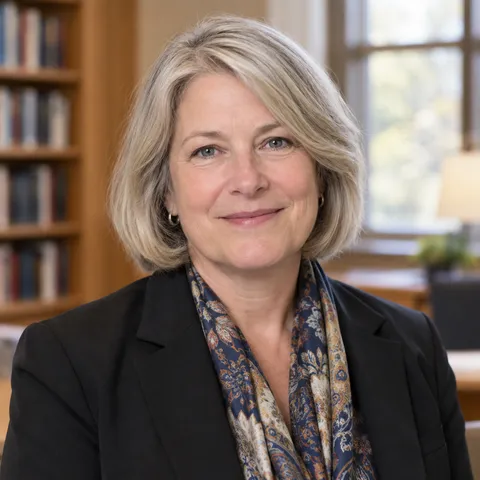
Prof. Rebecca Stroud
Professor of Political Science; President of the Faculty Senate (2026–27)
Instructor for HON 301, Fall 2026
- Office
- Lovell Hall 260
- Phone
- (555) 555-0168
- rstroud
@university.alkimi.ai
HON 301 · University Honors
Philosophical, historical, and institutional investigations into concepts of justice, equality, civic obligation, and the public good across diverse cultural traditions and democratic societies.
Fall 2026 · At a glance
300-level courses: advanced, upper-division courses requiring prior foundational preparation. Counts toward the 36 upper-division credits every bachelor's degree requires (Undergraduate Catalog §2.3). Details: Undergraduate Catalog §9.32.
Professor of Political Science; President of the Faculty Senate (2026–27)
Instructor for HON 301, Fall 2026
Class meetings
Tue & Thu, 11:00 a.m.–12:15 p.m.
Lovell Hall 325
Final exam
Wednesday, December 16, 2026
1:30–3:30 p.m., Lovell Hall 325
Office hours
Mon & Wed, 1:30–3:00 p.m.
Lovell Hall 260
Tue, 3:00–4:00 p.m.
Virtual (Zoom link in Canvas)
You may consult generative AI tools for contextual historical timelines (such as the drafting dates of constitutional amendments) or to verify standard bibliographic citation formats. You may not use generative AI to synthesize philosophical arguments, write seminar reaction papers, generate drafts of policy analyses, or formulate essay thesis statements.
From the syllabus
Grading
Letter grades follow the university scale (Student Handbook §4.1).
Key dates
First day of classes Past
Analytical Essay 1: Distributive Justice & Individual Rights Next
Constitutional Deliberation & Policy Brief
Major Capstone Essay 2: Pluralism and the Common Good
Required materials
Michael J. Sandel. Justice: What's the Right Thing to Do? Farrar, Straus and Giroux, 2010.
Approx. $16 print purchase.
John Rawls. Justice as Fairness: A Restatement. Ed. Erin Kelly. Harvard University Press, 2001.
Approx. $22 print purchase.
Michael Walzer. Spheres of Justice: A Defense of Pluralism and Equality. Basic Books, 1983.
Approx. $20 print purchase.
Alkimi Honors Reader in Jurisprudence and Political Ethics: Aristotle, Kant, Nozick, Young, and Landmark Supreme Court Opinions.
Free digital course reader provided via Canvas.
Degree planning
What to take first, what this course opens up, and the requirements it can satisfy, from the Undergraduate Catalog.
No catalog course is required first.
Catalog wording: Admission to the University Honors Program.
No other catalog course lists HON 301 as a prerequisite.
No major, minor, or Core area in the catalog names this course.
Every course also counts toward the 120 credits needed for a bachelor's degree. Confirm your plan with your advisor or the Academic Advising Center.
No AP exam awards credit for HON 301 (Undergraduate Catalog §3.11).
Registration
Admission to the University Honors Program.
HON 301 is offered in the fall semester. Register through AlkimiHub self-service registration, which opens by credit standing. Until the add deadline, you don't need instructor permission as long as seats remain and you've met the prerequisites. Details: Student Handbook §3.3.
When a seat opens, AlkimiHub offers it to the first student on the waitlist and emails you. You have 24 hours to claim it before it goes to the next student. Details: Student Handbook §3.10.
Fall 2026 withdrawal deadline
Last day to withdraw with a W or elect Pass/No Pass.
Fall 2027 registration opens
By credit standing, in AlkimiHub.
The Fall 2026 add deadline passed on Sep 2, 2026.
All dates: academic calendar. Registration help: Office of the Registrar.
Official course syllabus
The syllabus as filed with the department and posted in Canvas for Fall 2026.
Term: Fall 2026
Credits: 3.0
Lecture Times & Location: Tuesday & Thursday 11:00 a.m.–12:15 p.m., Lovell Hall 325
Modality: In-Person
rstroud@university.alkimi.ai
Philosophical, historical, and institutional investigations into concepts of justice, equality, civic obligation, and the public good across diverse cultural traditions and democratic societies. HON 301 is an advanced interdisciplinary honors seminar investigating the fundamental concepts of justice, political equality, civic obligation, and the public good. Drawing on political philosophy, constitutional jurisprudence, and contemporary democratic theory, we explore how diverse societies resolve tensions between individual liberty and collective welfare. Seminar discussions interrogate foundational paradigms from classical antiquity through modern deliberative democracy, examining distributive justice, human rights, structural injustice, and democratic institutional design. Honors scholars will rigorously assess primary texts, articulate nuanced written arguments, and debate the moral duties of citizenship in divided polities.
Admission to the University Honors Program.
Upon successful completion of HON 301, students will be able to:
In accordance with Alkimi University Academic Policies (Student Handbook §5.8), HON 301 operates under AI Level 1.
| Week | Dates | Topics & Readings | Assignments & Deadlines |
|---|---|---|---|
| Week 1 | Aug 27 | Moral Dilemmas, Law, and the Concept of Justice: Introduction: What is justice? The trolley problem, price gouging, civic virtue, and conflicting conceptions of the right and the good. Reading: Sandel, Ch. 1 | First day of classes: Wed Aug 26. |
| Week 2 | Sep 1, 3 | Classical Virtue and Teleological Justice: Aristotle: Telos, honor, and distributive justice according to merit; civic participation and human flourishing in Aristotle's Politics (Book III). Reading: Aristotle, *Politics (selections); Sandel, Ch. 8* | Wed Sep 2: Add/section change deadline. |
| Week 3 | Sep 8, 10 | Utilitarianism, Welfare, and Aggregate Happiness: Bentham and Mill: Maximizing utility, cost-benefit analysis, pain and pleasure calculi, and individual rights critiques in Bentham and Mill. Reading: Bentham, *Principles of Morals and Legislation; Mill, Utilitarianism; Sandel, Ch. 2* | Mon Sep 7: Labor Day (no classes). Wed Sep 9: Census date (last day to drop without a W). |
| Week 4 | Sep 15, 17 | Deontology, Duty, and Human Dignity: Immanuel Kant: Autonomy, duty, categorical imperatives, persons as ends in themselves, and the rejection of instrumentalism in Kantian ethics. Reading: Kant, *Groundwork of the Metaphysics of Morals; Sandel, Ch. 5* | — |
| Week 5 | Sep 22, 24 | Libertarianism, Free Markets, and Self-Ownership: Robert Nozick: Self-ownership, taxation as forced labor, the minimal state, and entitlement theory in Robert Nozick's Anarchy, State, and Utopia. Reading: Nozick, *Anarchy, State, and Utopia (Ch. 7); Sandel, Ch. 3* | — |
| Week 6 | Sep 29, Oct 1 | Justice as Fairness: The Social Contract and the Original Position: The original position, the veil of ignorance, and the rejection of moral desert; Analytical Essay 1 due Thursday. Reading: Rawls, *Justice as Fairness, Parts I & II; Sandel, Ch. 6* | Analytical Essay 1: Distributive Justice & Individual Rights due Thu Oct 1 at 11:59 p.m. |
| Week 7 | Oct 6, 8 | The Two Principles of Justice and the Difference Principle: Equal basic liberties, fair equality of opportunity, the difference principle, and addressing arbitrary natural endowments. Reading: Rawls, *Justice as Fairness, Part III* | — |
| Week 8 | Oct 15 | Communitarianism and Obligations of Membership (Fall Break Week): Communitarian critiques of the unencumbered self; moral ties of membership, loyalty, and civic solidarity; Fall break week. Reading: Sandel, Ch. 9; MacIntyre, *After Virtue (selections)* | Oct 12–Oct 13: Fall break (no classes). |
| Week 9 | Oct 20, 22 | Pluralism, Complex Equality, and Social Spheres: Michael Walzer: Complex equality, the autonomy of social goods, and preventing dominance across distinct spheres of social life. Reading: Walzer, *Spheres of Justice, Ch. 1–4* | — |
| Week 10 | Oct 27, 29 | Constitutional Jurisprudence, Equal Protection, and Fundamental Rights: Equal protection, strict scrutiny, due process, and constitutional deliberation on fundamental rights; Policy Brief due Thursday. Reading: Landmark judicial rulings (Brown*, Carolene Products Footnote 4, Obergefell)* | Constitutional Deliberation & Policy Brief due Thu Oct 29 at 11:59 p.m. |
| Week 11 | Nov 3, 5 | Corrective Justice, Affirmative Action, and Historical Reparation: Compensatory justice, historical injustices, diversity rationales, affirmative action, and the debate over reparations. Reading: Sandel, Ch. 7; Coates, 'The Case for Reparations' | Fri Nov 6: Last day to withdraw (W) or elect Pass/No Pass. |
| Week 12 | Nov 10, 12 | Structural Injustice and Political Responsibility: Iris Marion Young: The five faces of oppression, systemic injustice beyond individual blame, and the social connection model of responsibility. Reading: Iris Marion Young, *Responsibility for Justice, Ch. 2 & 4* | — |
| Week 13 | Nov 17, 19 | Public Reason, Deliberative Democracy, and Civic Disagreement: Disagreement, overlapping consensus, public reason, and institutional legitimacy in diverse democracies; Major Capstone Essay 2 due Thursday. Reading: Rawls, *Justice as Fairness, Part IV; Habermas, 'Three Normative Models of Democracy'* | Major Capstone Essay 2: Pluralism and the Common Good due Thu Nov 19 at 11:59 p.m. |
| Week 14 | Nov 24 | Global Distributive Justice and Transnational Obligations (Thanksgiving Week): Do obligations of justice stop at national borders? Cosmopolitanism vs. nationalist priority in global poverty relief (Thanksgiving week). Reading: Peter Singer, 'Famine, Affluence, and Morality'; Thomas Pogge selections | Nov 25–Nov 27: Thanksgiving break (no classes). |
| Week 15 | Dec 1, 3 | Environmental Justice and Intergenerational Equity: Intergenerational equity, climate change burdens, ecological racism, and collective responsibility for the global commons. Reading: Gardiner, *A Perfect Moral Storm (selections); Bullard environmental justice readings* | — |
| Week 16 | Dec 8 | A Politics of the Common Good: Seminar Retrospective and Synthesis: Cultivating civic virtue, democratic leadership, and the defense of the common good in polarized societies; Seminar retrospective. Reading: Sandel, Ch. 10; Seminar synthesis prompt | Wed Dec 9: Last day of classes. Thu Dec 10: Reading Day. |
| Finals | Dec 16 | Comprehensive Seminar Final Examination: Wednesday, December 16, 2026, 1:30–3:30 p.m., Lovell Hall 325. | Comprehensive examination evaluating primary text arguments, jurisprudential principles, and normative theories of justice. |
As an upper-division Honors Seminar, HON 301 is organized as an active intellectual laboratory and forum for democratic deliberation. Regular, prepared, and prompt attendance is mandatory. You are permitted up to two excused absences for health or university obligations with timely notice. Each subsequent unexcused absence lowers your final grade by one-third of a letter grade. Missing more than four seminar meetings will result in a failing grade for the course. Students who miss the first two class meetings without notifying the instructor may be dropped. Students may miss class for religious observance without penalty if they notify the instructor in writing within the first two weeks of the semester (by Wednesday, September 9, 2026). Absences for university-sponsored activities (athletics, performances, conferences) are excused with a letter from the sponsoring office at least one week in advance.
Essays and policy briefs lose one-third of a letter grade for each calendar day they are submitted past the deadline. No work will be accepted after three days past the deadline without prior documented authorization. Weekly reading critiques must be posted on time to inform classroom seminar discussion; no late critiques are accepted, but your lowest score is dropped automatically.
The final examination (Wednesday, December 16, 2026, 1:30–3:30 p.m.) is scheduled by the University Registrar and can't be moved without the Dean's written approval (Faculty Handbook §5.5). A student with three or more final exams on the same calendar day may reschedule one of them. Requests go to the instructor of the middle exam by the last day of classes. For this term, send the request by Wednesday, December 9, 2026 (Student Handbook §6.4).
Alkimi University is an academic community devoted to rigorous scholarship, open intellectual inquiry, and uncompromising ethical conduct. All students are subject to the regulations of the Alkimi University Academic Integrity Policy. Academic dishonesty—including plagiarism, cheating on examinations, unauthorized collaboration, fabrication of empirical data, and unauthorized submission of academic work generated by artificial intelligence—undermines the integrity of the university and carries severe disciplinary sanctions. Sanctions range from a failing grade on an assignment or exam to an administrative course failure recorded as an 'XF' on the official transcript, academic suspension, or expulsion. Suspected violations are formally investigated and resolved through the Office of Academic Integrity in accordance with Faculty Handbook §6. For detailed information, consult the Office of Academic Integrity, Lovell Hall 315, (555) 555-0163, integrity@university.alkimi.ai.
Alkimi University is committed to providing equitable educational access and reasonable accommodations for all students with documented disabilities, including physical, sensory, psychological, learning, and chronic health conditions. Students requesting academic accommodations must formally register with the Office of Accessibility Services, Harlan Hall 204, (555) 555-0155, access@university.alkimi.ai. Once approved, students will receive an official Faculty Accommodation Letter detailing approved accommodations. Students should present this letter to the instructor as early in the semester as possible, and at least one week prior to any exam or assignment requiring accommodation. Accommodations cannot be applied retroactively.
Your physical health, psychological well-being, and mental health are essential to your academic success. If you experience heightened stress, anxiety, depressive symptoms, personal trauma, or academic burnout, free, confidential counseling and medical care are available through the Hollis Health & Counseling Center, located in the Hollis Center. Routine appointments are available Monday–Friday 8:00 a.m.–6:00 p.m. and Saturday 10:00 a.m.–2:00 p.m. during the semester by calling (555) 555-0190 or emailing health@university.alkimi.ai. Urgent, 24/7 crisis psychological counseling is accessible immediately at (555) 555-0199.
advising@university.alkimi.ai
askalibrarian@university.alkimi.ai
health@university.alkimi.ai
HON courses