
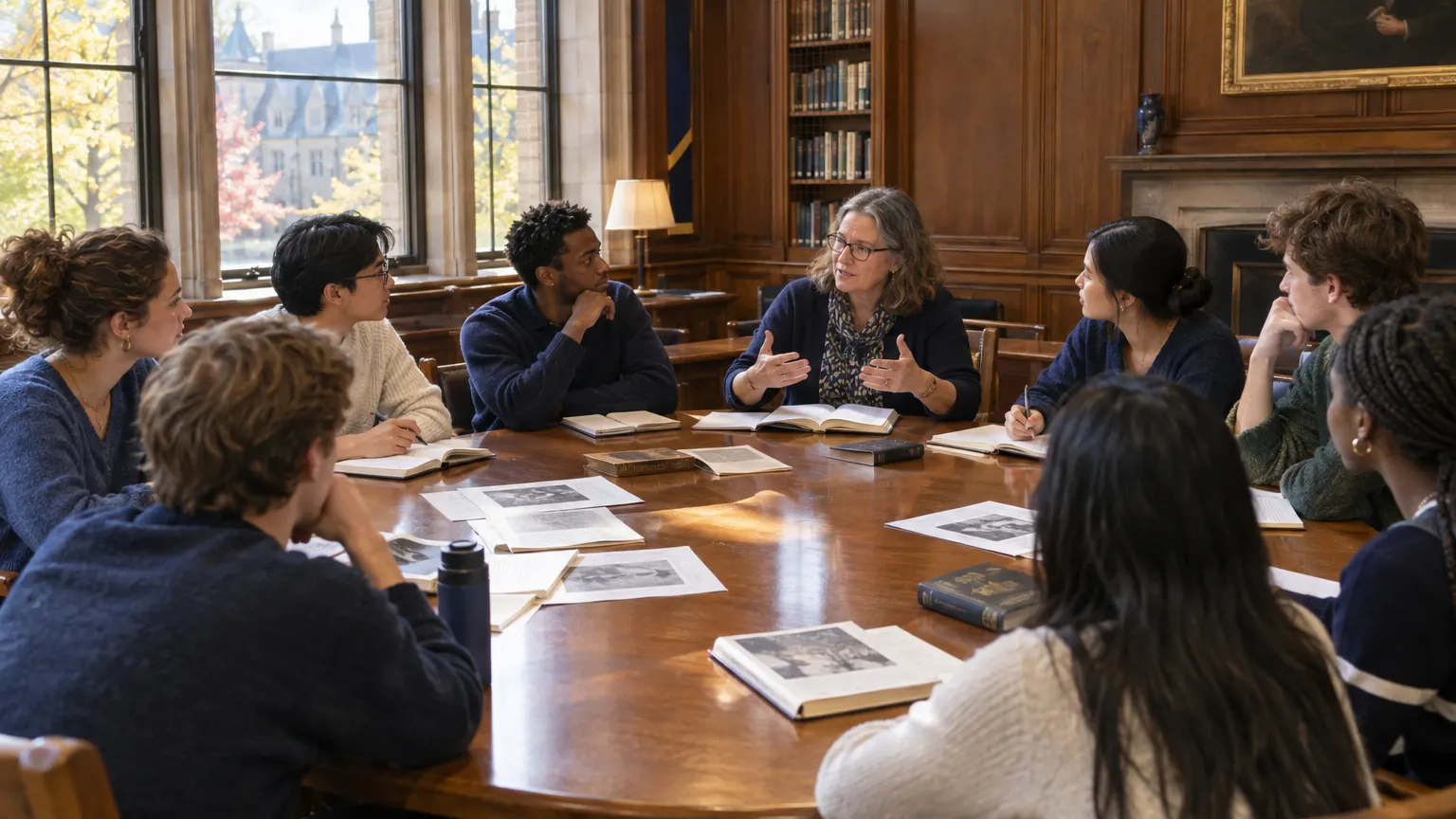

Prof. Harriet Vance
Professor of History; Chair of the University Promotion & Tenure Committee
Instructor for GLBL 201, Fall 2026
- Office
- Lovell Hall 222
- Phone
- (555) 555-0135
- hvance
@university.alkimi.ai
GLBL 201 · Global Studies
Interdisciplinary examination of global interconnectedness, economic integration, transnational migration, cultural hybridization, and the social impacts of globalization across modern societies.
Fall 2026 · At a glance
200-level courses: intermediate, lower-division courses suitable for sophomores and above. Details: Undergraduate Catalog §9.31.
Professor of History; Chair of the University Promotion & Tenure Committee
Instructor for GLBL 201, Fall 2026

Professor of History
Instructor for GLBL 201, Spring 2027
Questions about a major or your plan: Academic Advising Center, Lovell Hall 101, (555) 555-0158.
Class meetings
Tue & Thu, 1:00–2:15 p.m.
Lovell Hall 140
Final exam
Monday, December 14, 2026
1:00–3:00 p.m., Lovell Hall 140
Office hours
Mon & Thu, 9:30–11:00 a.m.
Lovell Hall 222
Tue, 10:00–11:00 a.m.
Virtual (Zoom link in Canvas)
You may use generative AI tools to assist in researching background facts on international organizations, exploring alternative perspectives on trade agreements, and proofreading written drafts. You may not use generative AI to write your weekly reading critiques, draft your case study essays, formulate primary arguments, or complete examinations.
From the syllabus
Grading
Letter grades follow the university scale (Student Handbook §4.1).
Key dates
First day of classes Past
Global Case Study Essay 1: Commodity Chains and Labor Next
Midterm Examination
Global Case Study Essay 2: Migration and Cultural Hybridity
Required materials
Manfred B. Steger. Globalization: A Very Short Introduction. 5th ed., Oxford University Press, 2020.
Approx. $12 print or digital purchase.
Frank J. Lechner and John Boli, eds. The Globalization Reader. 6th ed., Wiley-Blackwell, 2020.
Approx. $45 print purchase; digital options available.
Alkimi Global Studies Reader: Foundational Policy Documents, Treaties, and Case Studies.
Free digital access provided via Canvas.
Degree planning
What to take first, what this course opens up, and the requirements it can satisfy, from the Undergraduate Catalog.
No catalog course is required first.
Catalog wording: None.
No other catalog course lists GLBL 201 as a prerequisite.
Every course also counts toward the 120 credits needed for a bachelor's degree. Confirm your plan with your advisor or the Academic Advising Center.
No AP exam awards credit for GLBL 201 (Undergraduate Catalog §3.11).
Registration
None.
GLBL 201 is offered in both the fall and spring semesters. Register through AlkimiHub self-service registration, which opens by credit standing. Until the add deadline, you don't need instructor permission as long as seats remain and you've met the prerequisites. Details: Student Handbook §3.3.
When a seat opens, AlkimiHub offers it to the first student on the waitlist and emails you. You have 24 hours to claim it before it goes to the next student. Details: Student Handbook §3.10.
Spring 2027 registration opens
By credit standing, in AlkimiHub.
Fall 2026 withdrawal deadline
Last day to withdraw with a W or elect Pass/No Pass.
Spring 2027 add deadline
Last day to add a course or change sections (11:59 p.m.).
Fall 2027 registration opens
By credit standing, in AlkimiHub.
The Fall 2026 add deadline passed on Sep 2, 2026.
All dates: academic calendar. Registration help: Office of the Registrar.
Official course syllabus
The syllabus as filed with the department and posted in Canvas for Fall 2026.
Term: Fall 2026
Credits: 3.0
Lecture Times & Location: Tuesday & Thursday 1:00–2:15 p.m., Lovell Hall 140
Modality: In-Person
hvance@university.alkimi.ai
Interdisciplinary examination of global interconnectedness, economic integration, transnational migration, cultural hybridization, and the social impacts of globalization across modern societies. GLBL 201 provides an interdisciplinary examination of the structural forces and human experiences that define modern globalization. We investigate how the accelerating circulation of capital, commodities, people, technologies, and ideas reshapes national sovereignty, local traditions, and cultural identities. Drawing on history, political economy, sociology, and cultural anthropology, the course explores global trade networks, international governance institutions, labor migration, diaspora communities, and media flows. Students analyze the tensions between cultural homogenization and hybridization, interrogating how global interconnectedness generates both unprecedented collaboration and deep inequalities across societies.
None.
Upon successful completion of GLBL 201, students will be able to:
In accordance with Alkimi University Academic Policies (Student Handbook §5.8), GLBL 201 operates under AI Level 2.
| Week | Dates | Topics & Readings | Assignments & Deadlines |
|---|---|---|---|
| Week 1 | Aug 27 | Foundations of Globalization: Concepts and Dimensions: What is globalization? Historical benchmarks, definitions, core dimensions (economic, political, cultural, ecological), and ideological debates. Reading: Steger, Ch. 1; Lechner & Boli, Introduction | First day of classes: Wed Aug 26. |
| Week 2 | Sep 1, 3 | Theoretical Paradigms: Hyperglobalists, Skeptics, and Transformationalists: Competing analytical paradigms: hyperglobalists, skeptics, and transformationalists; the role of technological connectivity. Reading: Held et al., 'Rethinking Globalization'; Steger, Ch. 2 | Wed Sep 2: Add/section change deadline. |
| Week 3 | Sep 8, 10 | Historical Precedents: Empire, Trade, and Colonial Legacies: Colonialism, imperial trade routes, mercantilism, the Atlantic slave trade, and the historical precursors of modern global systems. Reading: Lechner & Boli, Part I selections | Mon Sep 7: Labor Day (no classes). Wed Sep 9: Census date (last day to drop without a W). |
| Week 4 | Sep 15, 17 | Global Economic Architecture: Bretton Woods and Neoliberalism: The Bretton Woods conference, the Washington Consensus, structural adjustment programs, trade liberalization, and neoliberal economic theory. Reading: Steger, Ch. 3; Stiglitz, 'Globalism's Discontents' | — |
| Week 5 | Sep 22, 24 | Transnational Corporations and Global Commodity Chains: Global value chains, multinational corporate supply networks, sweatshop labor, race-to-the-bottom dynamics, and international labor standards. Reading: Gereffi, 'The Organization of Global Commodity Chains' | — |
| Week 6 | Sep 29, Oct 1 | Multilateral Institutions and Global Governance: The United Nations system, the World Trade Organization, the International Monetary Fund, and non-governmental organizations; Case Study Essay 1 due Thursday. Reading: Steger, Ch. 4; Lechner & Boli, Part IV selections | Global Case Study Essay 1: Commodity Chains and Labor due Thu Oct 1 at 11:59 p.m. |
| Week 7 | Oct 6, 8 | National Sovereignty and Transnational Political Formations: Is the nation-state eroding? Supranational unions (the EU), Westphalian sovereignty, border security regimes, and regional trade blocs. Reading: Strange, 'The Declining Authority of the States' | — |
| Week 8 | Oct 15 | Global Stratification and Grassroots Resistance (Fall Break Week): Income inequality between and within states, fair trade certification, labor organizing, and grassroots resistance; Fall break week. Reading: Milanovic, 'Global Inequality by the Numbers' | Oct 12–Oct 13: Fall break (no classes). Fri Oct 16: Midterm grades due. |
| Week 9 | Oct 20, 22 | Transnational Migration and Refugee Flows & Midterm Exam: Push and pull factors, labor migration, brain drain vs. brain gain, refugee crises, and asylum policies; Midterm Examination in class Thursday. Reading: Castles, 'Why Migration Policies Fail'; Midterm Review | Midterm Examination (in class). |
| Week 10 | Oct 27, 29 | Cultural Globalization: Homogenization vs. Hybridization: Cultural imperialism, Americanization, glocalization, the McDonaldization thesis, and the persistence of local cultural resilience. Reading: Steger, Ch. 5; Appadurai, 'Disjuncture and Difference' | — |
| Week 11 | Nov 3, 5 | Global Cities, Urban Segregation, and Cosmopolitanism: Saskia Sassen's global city hypothesis, financial command centers, spatial segregation, and cosmopolitan identities in global metropolises. Reading: Sassen, 'The Global City: Introducing a Concept' | Fri Nov 6: Last day to withdraw (W) or elect Pass/No Pass. |
| Week 12 | Nov 10, 12 | Religion, Identity, and Fundamentalism in a Globalized Age: The resurgence of religious identity, transnational religious networks, religious fundamentalism as a reaction to secular modernity; Case Study Essay 2 due Thursday. Reading: Juergensmeyer, 'The Global Rise of Religious Nationalism' | Global Case Study Essay 2: Migration and Cultural Hybridity due Thu Nov 12 at 11:59 p.m. |
| Week 13 | Nov 17, 19 | Ecological Globalization and Climate Justice: Planetary ecological challenges, transboundary pollution, climate change negotiations, the Paris Agreement, and climate justice for the Global South. Reading: Steger, Ch. 6; Lechner & Boli, Part IX selections | — |
| Week 14 | Nov 24 | Digital Globalization and Network Societies (Thanksgiving Week): The internet, social media networks, digital capitalism, information warfare, surveillance, and virtual transnational publics (Thanksgiving week). Reading: Selected articles on digital transnational networks | Nov 25–Nov 27: Thanksgiving break (no classes). |
| Week 15 | Dec 1, 3 | Backlash and Deglobalization: Populism and Nationalism: Right-wing populism, economic protectionism, Brexit, border walls, and the resurgence of ethno-nationalism across Europe and the Americas. Reading: Rodrik, 'Populism and the Economics of Globalization' | — |
| Week 16 | Dec 8 | Future Trajectories of Globalization and Course Synthesis: Future trajectories of the international order: multipolarity, sustainable development goals, global citizenship, and course synthesis. Reading: Steger, Ch. 7 & 8; Review | Wed Dec 9: Last day of classes. Thu Dec 10: Reading Day. |
| Finals | Dec 14 | Comprehensive Final Examination: Monday, December 14, 2026, 1:00–3:00 p.m., Lovell Hall 140. | Culminating essay and comparative analysis exam covering theoretical paradigms, transnational institutions, and cultural globalization. |
Regular and engaged attendance is vital for meaningful seminar discussion, collaborative policy simulations, and peer case critiques. Students are permitted two unexcused absences during the semester. Each subsequent unexcused absence will reduce your overall course grade by one-third of a letter grade. Missing more than five class sessions will result in a failing grade for the course. Students who miss the first two class meetings without notifying the instructor may be dropped. Students may miss class for religious observance without penalty if they notify the instructor in writing within the first two weeks of the semester (by Wednesday, September 9, 2026). Absences for university-sponsored activities (athletics, performances, conferences) are excused with a letter from the sponsoring office at least one week in advance.
Written case study essays lose one-third of a letter grade (e.g., from A- to B+) for each 24-hour period they are submitted past the deadline. Essays submitted more than three days late will not be accepted without prior formal accommodation. Weekly reading critiques must be submitted on Canvas by Tuesday at 10:00 a.m. to facilitate discussion and cannot be submitted late.
The final examination (Monday, December 14, 2026, 1:00–3:00 p.m.) is scheduled by the University Registrar and can't be moved without the Dean's written approval (Faculty Handbook §5.5). A student with three or more final exams on the same calendar day may reschedule one of them. Requests go to the instructor of the middle exam by the last day of classes. For this term, send the request by Wednesday, December 9, 2026 (Student Handbook §6.4).
Alkimi University is an academic community devoted to rigorous scholarship, open intellectual inquiry, and uncompromising ethical conduct. All students are subject to the regulations of the Alkimi University Academic Integrity Policy. Academic dishonesty—including plagiarism, cheating on examinations, unauthorized collaboration, fabrication of empirical data, and unauthorized submission of academic work generated by artificial intelligence—undermines the integrity of the university and carries severe disciplinary sanctions. Sanctions range from a failing grade on an assignment or exam to an administrative course failure recorded as an 'XF' on the official transcript, academic suspension, or expulsion. Suspected violations are formally investigated and resolved through the Office of Academic Integrity in accordance with Faculty Handbook §6. For detailed information, consult the Office of Academic Integrity, Lovell Hall 315, (555) 555-0163, integrity@university.alkimi.ai.
Alkimi University is committed to providing equitable educational access and reasonable accommodations for all students with documented disabilities, including physical, sensory, psychological, learning, and chronic health conditions. Students requesting academic accommodations must formally register with the Office of Accessibility Services, Harlan Hall 204, (555) 555-0155, access@university.alkimi.ai. Once approved, students will receive an official Faculty Accommodation Letter detailing approved accommodations. Students should present this letter to the instructor as early in the semester as possible, and at least one week prior to any exam or assignment requiring accommodation. Accommodations cannot be applied retroactively.
Your physical health, psychological well-being, and mental health are essential to your academic success. If you experience heightened stress, anxiety, depressive symptoms, personal trauma, or academic burnout, free, confidential counseling and medical care are available through the Hollis Health & Counseling Center, located in the Hollis Center. Routine appointments are available Monday–Friday 8:00 a.m.–6:00 p.m. and Saturday 10:00 a.m.–2:00 p.m. during the semester by calling (555) 555-0190 or emailing health@university.alkimi.ai. Urgent, 24/7 crisis psychological counseling is accessible immediately at (555) 555-0199.
advising@university.alkimi.ai
askalibrarian@university.alkimi.ai
health@university.alkimi.ai
GLBL courses