
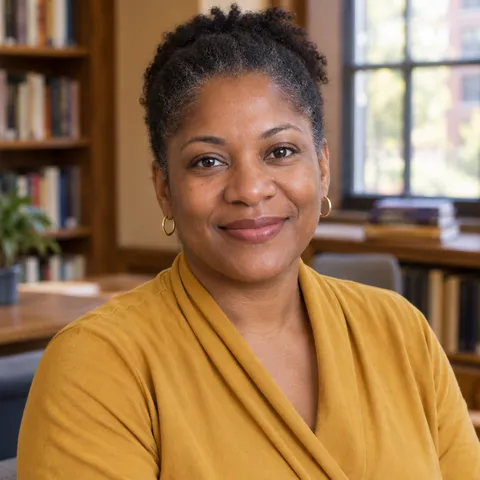
Dr. Renée Baptiste
Associate Professor of Sociology
Instructor for ANTH 105, Fall 2026 and Spring 2027
- Office
- Lovell Hall 132
- rbaptiste
@university.alkimi.ai
ANTH 105 · Anthropology
Comparative study of human societies and cultural systems, examining kinship, language, economic subsistence, ritual, power dynamics, and social change across non-Western and global cultures.
Fall 2026 · At a glance
100-level courses: introductory, lower-division courses primarily for first-year students. Details: Undergraduate Catalog §9.26.
Associate Professor of Sociology
Instructor for ANTH 105, Fall 2026 and Spring 2027
Questions about a major or your plan: Academic Advising Center, Lovell Hall 101, (555) 555-0158.
Class meetings
Tue & Thu, 8:00–9:15 a.m.
Lovell Hall 140
Final exam
Thursday, December 17, 2026
10:30 a.m.–12:30 p.m., Lovell Hall 140
Office hours
Mon & Thu, 11:30 a.m.–1:00 p.m.
Lovell Hall 132
Fri, 4:00–5:00 p.m.
Virtual (Zoom link in Canvas)
You may use generative AI tools for preliminary bibliographic queries, clarifying definitions of technical anthropological terms, or checking spelling and grammar on preliminary essay outlines. You may not use generative AI to generate ethnographic fieldnotes, synthesize participant-observation reflections, write analytical essays, or complete examination responses.
From the syllabus
Grading
Letter grades follow the university scale (Student Handbook §4.1).
Key dates
First day of classes Past
Ethnographic Fieldwork Proposal & Site Selection Past
Midterm Examination Next
Ethnographic Fieldwork Project & Analysis
Required materials
Kenneth J. Guest. Cultural Anthropology: A Toolkit for a Global Age. 4th ed., W. W. Norton & Co., 2023.
Approx. $48 digital rental, $75 print purchase.
James Spradley and David W. McCurdy, eds. Conformity and Conflict: Readings in Cultural Anthropology. 15th ed., Pearson, 2016.
Approx. $35 used or digital rental.
Degree planning
What to take first, what this course opens up, and the requirements it can satisfy, from the Undergraduate Catalog.
No catalog course is required first.
Catalog wording: None.
No other catalog course lists ANTH 105 as a prerequisite.
Every course also counts toward the 120 credits needed for a bachelor's degree. Confirm your plan with your advisor or the Academic Advising Center.
No AP exam awards credit for ANTH 105 (Undergraduate Catalog §3.11).
Registration
None.
ANTH 105 is offered in both the fall and spring semesters. Register through AlkimiHub self-service registration, which opens by credit standing. Until the add deadline, you don't need instructor permission as long as seats remain and you've met the prerequisites. Details: Student Handbook §3.3.
When a seat opens, AlkimiHub offers it to the first student on the waitlist and emails you. You have 24 hours to claim it before it goes to the next student. Details: Student Handbook §3.10.
Spring 2027 registration opens
By credit standing, in AlkimiHub.
Fall 2026 withdrawal deadline
Last day to withdraw with a W or elect Pass/No Pass.
Spring 2027 add deadline
Last day to add a course or change sections (11:59 p.m.).
Fall 2027 registration opens
By credit standing, in AlkimiHub.
The Fall 2026 add deadline passed on Sep 2, 2026.
All dates: academic calendar. Registration help: Office of the Registrar.
Official course syllabus
The syllabus as filed with the department and posted in Canvas for Fall 2026.
Term: Fall 2026
Credits: 3.0
Lecture Times & Location: Tuesday & Thursday 8:00–9:15 a.m., Lovell Hall 140
Modality: In-Person
rbaptiste@university.alkimi.ai
Comparative study of human societies and cultural systems, examining kinship, language, economic subsistence, ritual, power dynamics, and social change across non-Western and global cultures. ANTH 105 introduces students to the holistic and comparative study of human cultures, societies, and lived experiences across the globe. Grounded in the foundational concepts of cultural relativism and ethnography, the course examines how human groups organize kinship, language, economic subsistence, religious ritual, and political authority. Students investigate the social construction of race, gender, and identity, while exploring the impacts of colonialism, globalization, and transnational migration on localized communities. Through a guided empirical ethnographic fieldwork project, students practice participant observation, reflexive fieldnote recording, and qualitative cultural interpretation.
None.
Upon successful completion of ANTH 105, students will be able to:
In accordance with Alkimi University Academic Policies (Student Handbook §5.8), ANTH 105 operates under AI Level 1.
| Week | Dates | Topics & Readings | Assignments & Deadlines |
|---|---|---|---|
| Week 1 | Aug 27 | Anthropology in a Global Age and the Culture Concept: What is cultural anthropology? The four fields of anthropology, holistic approaches, the culture concept, and overcoming ethnocentrism. Reading: Guest Ch. 1; Spradley & McCurdy Ch. 1 | First day of classes: Wed Aug 26. |
| Week 2 | Sep 1, 3 | Ethnographic Fieldwork: Method, Ethics, and Representation: Fieldwork methodology, participant observation, fieldnotes, key informants, reflexivity, power dynamics, and ethical guidelines (AAA Code of Ethics). Reading: Guest Ch. 3; Spradley & McCurdy Ch. 2 | Wed Sep 2: Add/section change deadline. |
| Week 3 | Sep 8, 10 | Language, Communication, and Cultural Meaning: Linguistic anthropology, descriptive linguistics, the Sapir-Whorf hypothesis, sociolinguistics, nonverbal communication, and language loss. Reading: Guest Ch. 4; Spradley & McCurdy Ch. 5, 7 | Mon Sep 7: Labor Day (no classes). Wed Sep 9: Census date (last day to drop without a W). |
| Week 4 | Sep 15, 17 | Subsistence Strategies and Ecological Adaptation: Adaptive strategies: foraging, horticulture, pastoralism, agriculture, and industrialism; carrying capacity and environmental interactions. Reading: Guest Ch. 11; Spradley & McCurdy Ch. 10, 11 | — |
| Week 5 | Sep 22, 24 | Economic Systems, Reciprocity, and Circulation: Principles of exchange: generalized, balanced, and negative reciprocity; redistribution, potlatching, and market economies; Fieldwork Proposal due Thursday. Reading: Guest Ch. 12; Spradley & McCurdy Ch. 12, 13 | Ethnographic Fieldwork Proposal & Site Selection due Thu Sep 24 at 11:59 p.m. |
| Week 6 | Sep 29, Oct 1 | Kinship, Descent, and Social Networks: Descent systems (unilineal, bilateral), lineages, clans, kinship terminology systems, and social organization. Reading: Guest Ch. 9; Spradley & McCurdy Ch. 17, 18 | — |
| Week 7 | Oct 6, 8 | Marriage, Family Forms, and Domestic Life: Cross-cultural marriage practices: monogamy, polygyny, polyandry; exogamy, endogamy, incest taboos, bridewealth, and dowry. Reading: Guest Ch. 10; Spradley & McCurdy Ch. 19, 20 | — |
| Week 8 | Oct 15 | Midterm Examination and Fieldwork Check-in (Fall Break Week): Synthesizing foundational concepts of culture, language, economy, and kinship; Midterm Examination administered in class on Thursday. Reading: Guest review chapters 1–4, 9–12; Midterm Examination in class | Oct 12–Oct 13: Fall break (no classes). Fri Oct 16: Midterm grades due. Midterm Examination (in class). |
| Week 9 | Oct 20, 22 | Gender, Sexuality, and Cultural Identity: Biological sex vs. cultural gender, gender stratification, the cultural construction of masculinity and femininity, and third genders cross-culturally. Reading: Guest Ch. 7, 8; Spradley & McCurdy Ch. 21, 23 | — |
| Week 10 | Oct 27, 29 | Race, Ethnicity, and Social Stratification: The biological fallacy and social reality of race; racialization, whiteness, institutional discrimination, and ethnic boundary markers. Reading: Guest Ch. 5, 6; Spradley & McCurdy Ch. 25, 27 | — |
| Week 11 | Nov 3, 5 | Politics, Power, and Social Control: Bands, tribes, chiefdoms, and states; authority, leadership, social control, law, hegemony, weapons of the weak, and political resistance. Reading: Guest Ch. 13; Spradley & McCurdy Ch. 28, 29 | Fri Nov 6: Last day to withdraw (W) or elect Pass/No Pass. |
| Week 12 | Nov 10, 12 | Religion, Myth, Ritual, and Meaning: Animism, polytheism, monotheism; rituals, rites of passage (Van Gennep, Turner), liminality, magic, witchcraft, and religious revitalization. Reading: Guest Ch. 14; Spradley & McCurdy Ch. 31, 32 | — |
| Week 13 | Nov 17, 19 | Art, Aesthetics, and Expressive Culture: Visual and material culture, ethnomusicology, bodily ornamentation, performance, and indigenous media; Ethnographic Fieldwork Project due Thursday. Reading: Guest Ch. 16; Spradley & McCurdy Ch. 34 | Ethnographic Fieldwork Project & Analysis due Thu Nov 19 at 11:59 p.m. |
| Week 14 | Nov 24 | Medical Anthropology and Global Health (Thanksgiving Week): Cross-cultural understandings of the body, illness etiology, ethnomedicine, shamanism, biomedical hegemony, and social determinants of health. Reading: Guest Ch. 15; Spradley & McCurdy Ch. 35 | Nov 25–Nov 27: Thanksgiving break (no classes). |
| Week 15 | Dec 1, 3 | Colonialism, Globalization, and Migration: Colonial expansion, world-systems theory, core-periphery dynamics, transnational labor migration, refugees, and cultural hybridity. Reading: Guest Ch. 17; Spradley & McCurdy Ch. 37, 38 | — |
| Week 16 | Dec 8 | Applied Anthropology, Public Action, and Future Horizons: Anthropologists working in development, business, public health, and human rights advocacy; indigenous sovereignty and course synthesis. Reading: Guest Ch. 18; Spradley & McCurdy Ch. 39; Course review | Wed Dec 9: Last day of classes. Thu Dec 10: Reading Day. |
| Finals | Dec 17 | Final Comprehensive Examination: Thursday, December 17, 2026, 10:30 a.m.–12:30 p.m., Lovell Hall 140. | Comprehensive. |
Cultural anthropology relies upon collaborative seminar discussions, respectful cross-cultural debates, and ethnographic fieldwork exercises. Regular and prompt attendance is required at all class meetings. You are allowed two unexcused absences without penalty; each additional absence lowers your final course grade by one third of a letter grade. Accumulating more than five unexcused absences will result in a failing grade. Students who miss the first two class meetings without notifying the instructor may be dropped. Students may miss class for religious observance without penalty if they notify the instructor in writing within the first two weeks of the semester (by Wednesday, September 9, 2026). Absences for university-sponsored activities (athletics, performances, conferences) are excused with a letter from the sponsoring office at least one week in advance.
Written fieldwork proposals, project papers, and reflections lose 10% per calendar day late and cannot be submitted more than three days past the deadline. In-class examinations and group workshops cannot be made up without advance written documentation of an excused absence.
The final examination (Thursday, December 17, 2026, 10:30 a.m.–12:30 p.m.) is scheduled by the University Registrar and can't be moved without the Dean's written approval (Faculty Handbook §5.5). A student with three or more final exams on the same calendar day may reschedule one of them. Requests go to the instructor of the middle exam by the last day of classes. For this term, send the request by Wednesday, December 9, 2026 (Student Handbook §6.4).
Alkimi University is an academic community devoted to rigorous scholarship, open intellectual inquiry, and uncompromising ethical conduct. All students are subject to the regulations of the Alkimi University Academic Integrity Policy. Academic dishonesty—including plagiarism, cheating on examinations, unauthorized collaboration, fabrication of empirical data, and unauthorized submission of academic work generated by artificial intelligence—undermines the integrity of the university and carries severe disciplinary sanctions. Sanctions range from a failing grade on an assignment or exam to an administrative course failure recorded as an 'XF' on the official transcript, academic suspension, or expulsion. Suspected violations are formally investigated and resolved through the Office of Academic Integrity in accordance with Faculty Handbook §6. For detailed information, consult the Office of Academic Integrity, Lovell Hall 315, (555) 555-0163, integrity@university.alkimi.ai.
Alkimi University is committed to providing equitable educational access and reasonable accommodations for all students with documented disabilities, including physical, sensory, psychological, learning, and chronic health conditions. Students requesting academic accommodations must formally register with the Office of Accessibility Services, Harlan Hall 204, (555) 555-0155, access@university.alkimi.ai. Once approved, students will receive an official Faculty Accommodation Letter detailing approved accommodations. Students should present this letter to the instructor as early in the semester as possible, and at least one week prior to any exam or assignment requiring accommodation. Accommodations cannot be applied retroactively.
Your physical health, psychological well-being, and mental health are essential to your academic success. If you experience heightened stress, anxiety, depressive symptoms, personal trauma, or academic burnout, free, confidential counseling and medical care are available through the Hollis Health & Counseling Center, located in the Hollis Center. Routine appointments are available Monday–Friday 8:00 a.m.–6:00 p.m. and Saturday 10:00 a.m.–2:00 p.m. during the semester by calling (555) 555-0190 or emailing health@university.alkimi.ai. Urgent, 24/7 crisis psychological counseling is accessible immediately at (555) 555-0199.
advising@university.alkimi.ai
askalibrarian@university.alkimi.ai
health@university.alkimi.ai
ANTH courses